Last updated: September 24, 2026 · Originally published: September 8, 2026 · By Alex Petrov
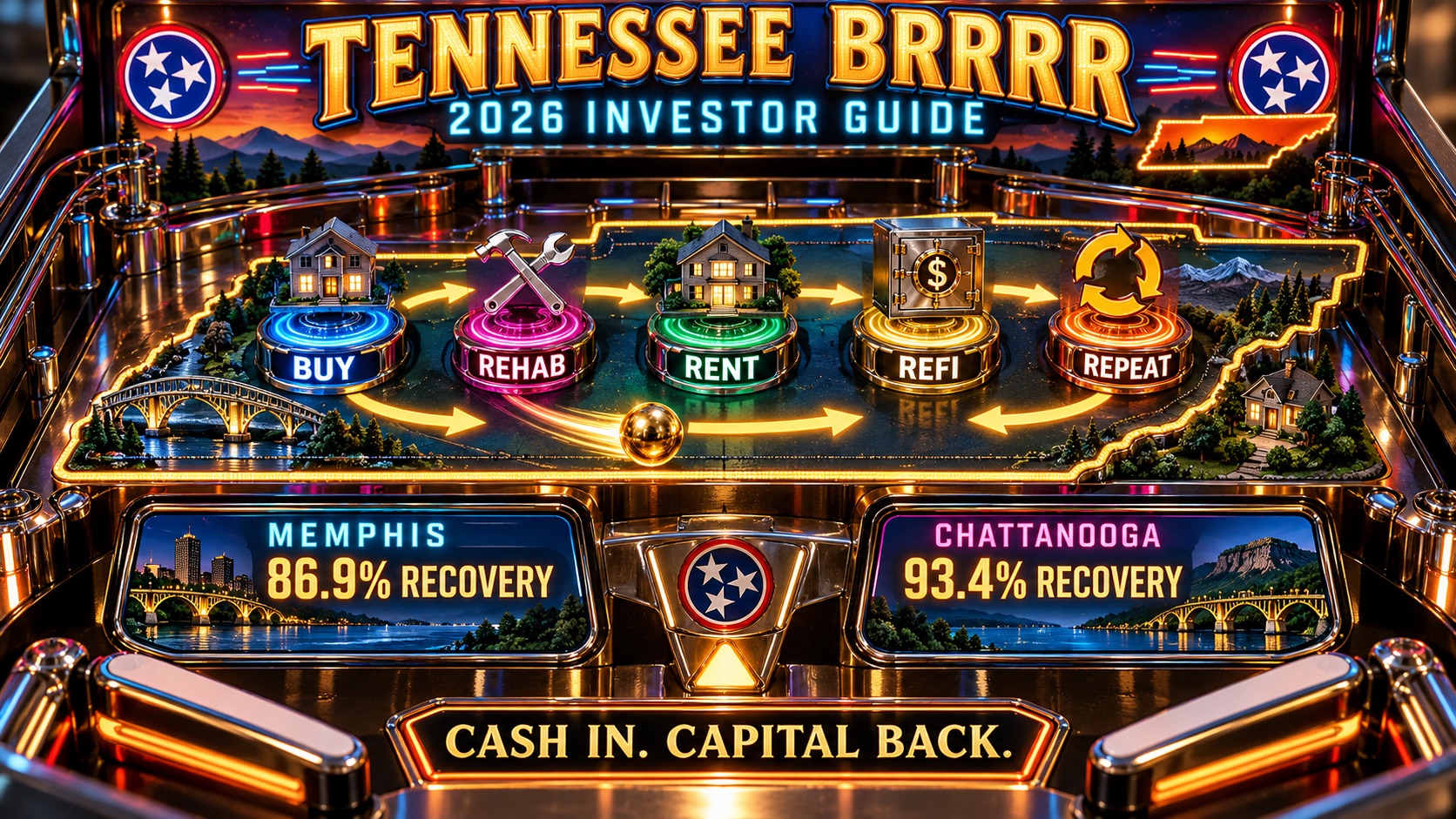
BRRRR Tennessee works best in Memphis — $100K distressed purchases rehabbing to $155K+ ARV with zero state income tax on rental profits. A Memphis SFR bought at $95K, rehabbed for $30K, appraising at $160K recovers 89% of capital at 75% LTV refinance. A Chattanooga duplex at $130K purchase, $45K rehab, $240K ARV recovers 92%. Tennessee’s 0.56% property tax and 0% income tax keep holding costs and post-refi expenses lower than any other BRRRR state. Here is how the numbers play out across five Tennessee metros.
Why BRRRR Tennessee Works
- Memphis distressed inventory — deep pool of properties at $80K–$120K that appraise at $150K–$190K after cosmetic rehab. Shelby County foreclosure auctions run weekly. More distressed inventory than Indianapolis or Cleveland.
- Zero state income tax — rental income after refinance is taxed only at federal rates. Per Tennessee Department of Revenue, the state has no personal income tax. Compared to Indiana (3.05% + county), Ohio (2.75%), or Georgia (4.99%), Tennessee BRRRR investors keep 3–5% more of post-refi cash flow.
- Lowest property tax — 0.56% effective rate keeps holding costs during rehab/seasoning minimal. On a $100K purchase: $47/month in taxes during the hold phase. Indiana charges $71. Texas charges $133. Lower holding costs = more capital available for rehab.
- Low rehab costs — Tennessee labor rates are competitive. Per Bureau of Labor Statistics, Memphis-area carpenter wages average $20/hour vs $28 nationally. A full cosmetic rehab runs $25K–$40K vs $40K–$60K in Nashville or Charlotte.
BRRRR Tennessee has one challenge: Memphis has 7.2% vacancy and higher tenant turnover than Midwest markets. Post-refi, budget for 1–2 months vacancy per year. And Tennessee charges a transfer tax of $0.37/$100 — $370 on a $100K purchase, added to closing costs. Model your deal in the Tennessee BRRRR calculator.
Worked Example: Memphis SFR BRRRR (Cash Purchase)
PHASE 1: ACQUISITION
 Purchase Price: $95,000 (cash — no hard money)
 Closing Costs (3%): $2,850
 Transfer Tax ($0.37/$100): $352

PHASE 2: REHAB
 Renovation Budget: $30,000
 Contingency (15%): $4,500
 Total Rehab: $34,500

PHASE 3: HOLDING (5 months — rehab + seasoning)
 Insurance (5 mo): $1,000
 Property Tax (5 mo): $281
 Utilities: $750
 Total Holding: $2,031

TOTAL CASH INVESTED: $134,733

PHASE 4: REFINANCE
 ARV (appraised): $160,000
 New Loan (75% LTV): $120,000
 Refi Closing (2%): −$2,400
 Transfer Tax: −$444
 Cash-Out Proceeds: $117,156

PHASE 5: RESULTS
 Capital Recovery: $117,156 / $134,733 = 86.9%
 Capital Left in Deal: $17,577
 Monthly Rent: $1,200
 Monthly PITIA (7.0%): $799 + $95 + $200 = $1,094
 Monthly Expenses (PM 10% + maint + vac): $396
 Monthly Cash Flow: $1,200 − $1,094 − $396 = −$290/mo
86.9% capital recovery but negative cash flow. Memphis rents ($1,200) cannot cover a $120K mortgage at 7% plus 10% management and 7.2% vacancy. The deal builds equity ($17,577 trapped + appreciation) but requires reserves to cover the $290/month shortfall.
How to fix:
- Buy at $80K (save $15K) → recovery 94%, CF −$190
- ARV at $175K → recovery 95%, CF −$230 (larger loan)
- Self-manage (save 10% PM) → CF −$170
- Duplex instead of SFR → two rents fix everything
Worked Example: Chattanooga Duplex BRRRR (Cash Purchase)
PHASE 1: ACQUISITION
 Purchase Price: $130,000 (cash)
 Closing Costs (3%): $3,900
 Transfer Tax: $481

PHASE 2: REHAB
 Renovation (both units): $45,000
 Contingency (15%): $6,750
 Total Rehab: $51,750

PHASE 3: HOLDING (5 months)
 Insurance (5 mo): $833
 Property Tax (5 mo): $260
 Utilities: $1,000
 Total Holding: $2,093

TOTAL CASH INVESTED: $188,224

PHASE 4: REFINANCE
 ARV (appraised): $240,000
 New Loan (75% LTV): $180,000
 Refi Closing (2%): −$3,600
 Transfer Tax: −$666
 Cash-Out Proceeds: $175,734

PHASE 5: RESULTS
 Capital Recovery: $175,734 / $188,224 = 93.4%
 Capital Left in Deal: $12,490
 Monthly Rent (2 × $750): $1,500
 Monthly PITIA (7.0%): $1,198 + $96 + $167 = $1,461
 Monthly Expenses: $375
 Monthly Cash Flow: $1,500 − $1,461 − $375 = −$336/mo

 BUT — at $900/unit ($1,800 total):
 Cash Flow: $1,800 − $1,461 − $450 = −$111/mo
93.4% capital recovery — excellent. Only $12,490 left in the deal controlling a $240K asset. Cash flow is negative at $750/unit but improves dramatically if rents hit $900/unit. Chattanooga rents are rising 3–4%/year — $900/unit is achievable within 12–18 months after refi. The zero income tax means every dollar of future rent improvement goes directly to cash flow with no state tax drag.
BRRRR Tennessee Viability by Metro
| Metro | Typical Entry | Typical ARV | Rehab Budget | BRRRR Viability |
|---|---|---|---|---|
| Memphis | $80K–$120K | $150K–$190K | $25K–$40K | Strong — deepest distressed inventory in TN |
| Chattanooga | $120K–$170K | $220K–$270K | $35K–$50K | Good — growing market, solid ARV support |
| Clarksville | $110K–$150K | $200K–$240K | $30K–$45K | Good — military demand supports ARV |
| Knoxville | $130K–$180K | $240K–$290K | $35K–$50K | Moderate — higher entry squeezes margins |
| Nashville | $200K–$280K | $350K–$450K | $50K–$80K | Difficult — high entry, thin spreads |
Memphis dominates Tennessee BRRRR because the distressed-to-ARV spread is widest and rehab costs are lowest. Chattanooga is rising as the #2 BRRRR market with stronger appreciation and lower vacancy. Nashville BRRRR requires $250K+ capital deployment with thin margins — only for experienced investors. For state comparisons: Indiana BRRRR, Ohio BRRRR, Georgia BRRRR.
BRRRR Tennessee Cost Advantages
Zero Income Tax on Rental Profits
Post-refi rental income is taxed at 0% state level. On $3,000/year net rental income: Indiana charges $153 (3.05% + county), Ohio charges $83 (2.75%), Georgia charges $150 (4.99%). Tennessee charges $0. Over 10 years on a 5-property portfolio: $4,000–$7,500 in cumulative state tax savings.
Lowest Holding Costs
During the 4–6 month rehab + seasoning phase, property tax and insurance are your carrying costs (assuming cash purchase). Tennessee’s 0.56% tax rate means $47/month on a $100K property. Combined with insurance at $183/month: $230/month total. Indiana: $271/month. Ohio: $303/month. Texas: $467/month. Over 5 months: Tennessee saves $205–$1,185 vs other states.
Transfer Tax (Small Disadvantage)
Tennessee charges $0.37/$100 on both purchase and refinance. On a $100K purchase: $370. On a $120K refi: $444. Total $814 in transfer taxes per BRRRR cycle. Compare to Indiana ($0) and Texas ($0). Not deal-breaking but reduces recovery by ~0.5%. Per Tennessee Department of Revenue, this applies to all real property transfers.
5 BRRRR Tennessee Mistakes
1. Using Hard Money in Memphis When Cash Is Available
Hard money at 12% + 3 points on a $95K Memphis purchase adds $6,000–$9,000 to total cost. On a deal with $17K capital left, that is a 35–53% increase in trapped capital. Cash purchase recovers 87%. Hard money recovers ~65%. If you have cash, use it — especially in Memphis where deals close quickly.
2. Overestimating Memphis ARV
Memphis has extreme neighborhood variance. A comp 0.5 miles away across a major road can be $25K–$40K different. Always use 5+ comps within 0.25 miles on the SAME side of major boundaries (I-240, Poplar Ave, Summer Ave). Use the ARV calculator with strict comp filters.
3. Underbudgeting Memphis Management
Memphis requires professional property management — 10% is standard, not 8–9% like Midwest markets. Higher tenant turnover (14 months average lease vs 24 nationally) means more placement fees ($500–$800 each), more make-ready costs ($1,000–$2,000), and more vacancy between tenants. Budget 10% PM plus $1,500/year in turnover costs.
4. Ignoring Flood Risk
Memphis properties near the Mississippi, Wolf River, or Loosahatchie Creek may require FEMA flood insurance ($500–$2,000/year) on top of hazard insurance. This adds $42–$167/month to PITIA, directly reducing DSCR and cash flow. Check the FEMA flood map before underwriting any Memphis BRRRR.
5. Attempting Nashville BRRRR Without Deep Pockets
Nashville BRRRR requires $250K–$350K total capital (purchase + rehab + holding). At 75% LTV refi on a $400K ARV, you recover $300K — but you needed $300K+ to get there. Capital recovery percentage may be high, but the absolute dollars trapped are $30K–$50K. Only attempt Nashville BRRRR if you have $500K+ in liquid capital and can absorb -$300+/month cash flow post-refi.
Frequently Asked Questions
Does BRRRR work in Tennessee in 2026?
Yes — Memphis is one of the best BRRRR markets in the US. $80–120K entry prices, $150–190K ARV, 85–95% capital recovery with cash purchases. Zero state income tax and 0.56% property tax keep holding costs and post-refi expenses lower than any competing state. Cash flow after refi is typically -$100 to -$300/month at 2026 rates — the strategy works for equity building and capital recycling, not immediate cash flow. Use the Tennessee BRRRR calculator to model your deal.
Which Tennessee city is best for BRRRR?
What capital recovery should I target for Tennessee BRRRR?
How does Tennessee’s zero income tax help BRRRR?
Should I use hard money or cash for Tennessee BRRRR?
Related Calculators and Guides
- Tennessee BRRRR Calculator — Full cycle with TN defaults
- Tennessee Rental Property Calculator — Post-refi analysis
- Tennessee DSCR Calculator — Refi qualification
- Tennessee Cap Rate Calculator — ARV-based return
- Tennessee Closing Costs — Acquisition + refi costs
- ARV Calculator — After-repair value
- Hard Money Calculator — Bridge financing
- All Tennessee Calculators
Other state BRRRR guides:
Leave a Reply