Last updated: September 24, 2026 · Originally published: September 1, 2026 · By Alex Petrov
The BRRRR calculator models every stage of the Buy-Rehab-Rent-Refinance-Repeat strategy in one analysis — from acquisition cost through cash-out refinance proceeds. On a $120K Cleveland SFR with $30K rehab that appraises at $190K, the BRRRR calculator shows you recover 94% of your capital on the refinance, leaving only $9,300 in the deal while generating +$145/month cash flow. Here is how to use every input and output to evaluate BRRRR deals before committing capital.
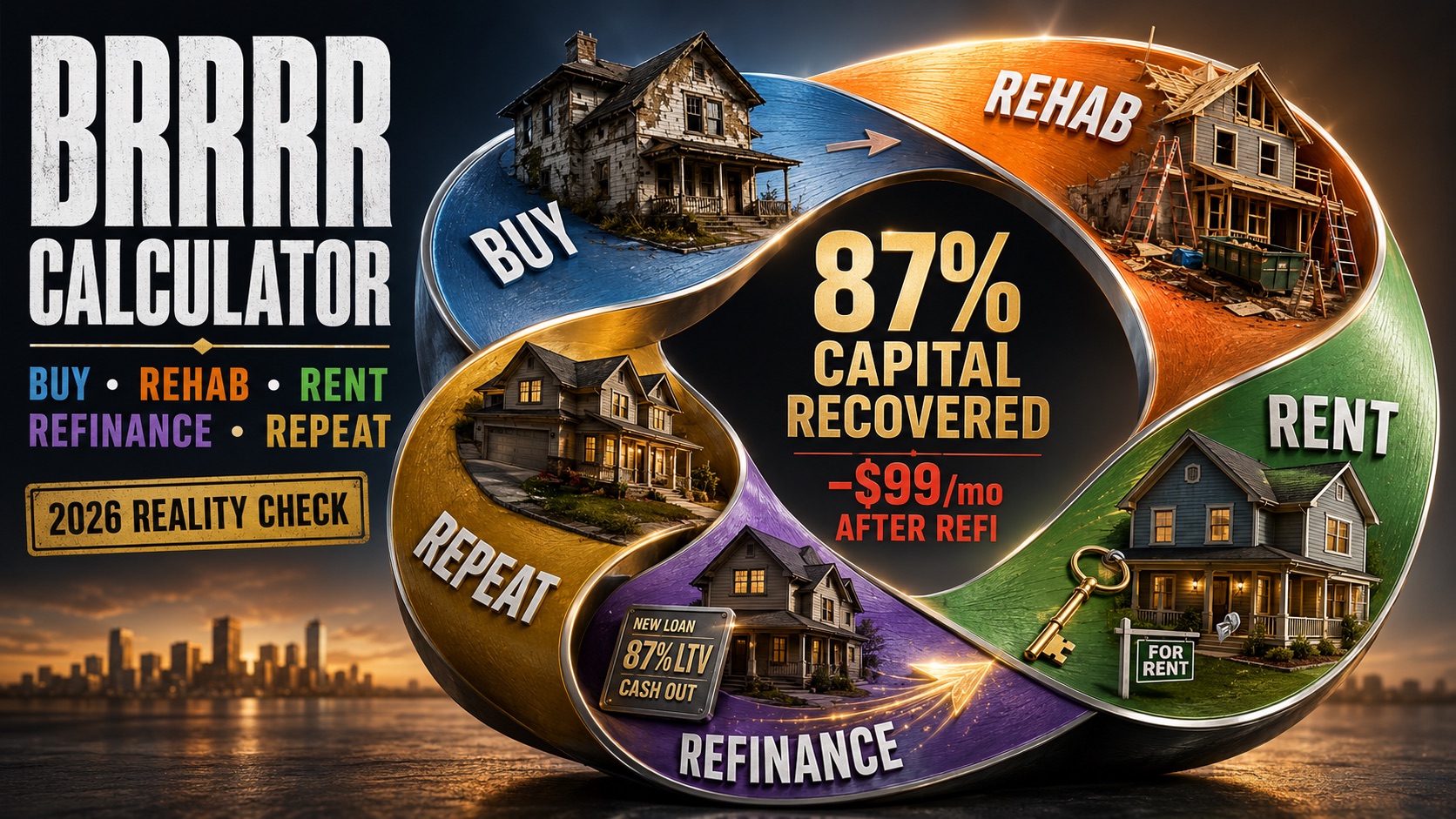
What the BRRRR Calculator Does
The BRRRR strategy has five phases, and the BRRRR calculator models all of them:
- Buy — purchase price, closing costs, down payment or cash purchase
- Rehab — renovation budget, holding costs during rehab (hard money interest, insurance, utilities)
- Rent — post-rehab monthly rent, operating expenses, cash flow projection
- Refinance — after-repair value (ARV), LTV ratio, new loan amount, cash-out proceeds
- Repeat — capital remaining in deal, cash-on-cash return, total ROI
The key number is capital recovery — how much of your invested cash you get back on the refinance. The BRRRR calculator shows this as a dollar amount and percentage. 90%+ recovery means you can repeat the strategy almost indefinitely with the same pool of capital.
For the general BRRRR strategy overview, see our BRRRR strategy guide. For the refinance math specifically, use the BRRRR refinance calculator.
How to Use the BRRRR Calculator: Step by Step
Step 1: Enter Acquisition Costs
Purchase price — what you pay for the property. BRRRR investors target distressed properties at 60-75% of ARV. A property worth $190K after rehab should be purchased at $115K-$140K.
Closing costs — buyer closing costs at purchase (2-4% of purchase price). Include title insurance, attorney fees, inspection, and recording fees. Estimate in the closing costs calculator.
Financing type — cash, hard money, or conventional. Most BRRRR investors use hard money for the acquisition phase because conventional lenders will not finance distressed properties. Hard money rates: 10-14% with 2-4 points. Model costs in the hard money calculator.
Step 2: Enter Rehab Details
Rehab budget — total renovation cost. Be conservative — add 15-20% contingency. A $30K rehab budget should be entered as $34K-$36K to account for surprises. See our cost to rehab guide for room-by-room estimates.
Rehab timeline — months from purchase to rent-ready. Typical BRRRR rehab: 2-4 months for cosmetic, 4-6 months for structural. This determines your hard money holding costs.
Holding costs during rehab — hard money interest, insurance, property taxes, utilities during renovation. On a $150K hard money loan at 12%: $1,500/month interest alone. Four months of holding = $6,000+ before you collect a single dollar of rent.
Step 3: Enter Post-Rehab Rental Details
Monthly rent — expected rent after renovation at the ARV condition. Pull comps for renovated properties in your area, not distressed ones. See our rent estimation guide.
Operating expenses — property taxes, insurance, vacancy (5-8%), maintenance (5-8% for newly rehabbed), management (8-10%), and CapEx reserves (3-5%). Newly rehabbed properties have lower maintenance initially, but budget conservatively for the BRRRR calculator to show realistic long-term cash flow.
Step 4: Enter Refinance Parameters
This is the most critical section of the BRRRR calculator:
After-Repair Value (ARV) — what the property is worth after renovation. Get this from comps of recently sold renovated properties within 0.5 mile. Be conservative — if your ARV is wrong, your entire BRRRR analysis falls apart. Estimate in the ARV calculator.
LTV ratio — what percentage of ARV the lender will finance. Cash-out refinance: 70-75% LTV typical. Rate-and-term: up to 80%. DSCR lenders: 75-80% cash-out. The BRRRR calculator uses this to compute your new loan amount. Model LTV scenarios in the LTV calculator.
Refinance rate — your new long-term mortgage rate. Currently 6.5-7.5% for conventional investment loans, 7.0-8.5% for DSCR. Check FRED for current rates.
Refinance closing costs — 1.5-2.5% of new loan amount. Includes appraisal ($400-$600), title insurance, origination fees, and recording fees.
Step 5: Read the Results
The BRRRR calculator shows:
- Total Capital Invested — all cash you put in (purchase + closing + rehab + holding costs)
- Cash-Out Refinance Proceeds — new loan amount minus refi closing costs
- Capital Recovery % — proceeds ÷ total invested. Target: 90%+. At 100%, you pulled ALL cash out. Above 100% = you made money on the refinance.
- Capital Left in Deal — total invested minus cash-out proceeds. This is your real equity position.
- Monthly Cash Flow — rent minus expenses minus new mortgage payment
- Cash-on-Cash Return — annual cash flow ÷ capital left in deal. With only $9,300 left, even $145/month CF = 18.7% CoC — far better than traditional buy-and-hold.
Worked Example: Cleveland SFR BRRRR
Property: 3-bed/1-bath SFR in Cleveland Heights. Distressed, needs full cosmetic rehab.
ACQUISITION:
 Purchase Price: $120,000 (cash)
 Closing Costs: $3,600 (3%)
 Total Acquisition: $123,600

REHAB:
 Renovation Budget: $30,000
 Contingency (15%): $4,500
 Holding Costs (3 mo): $2,400 (insurance, taxes, utilities)
 Total Rehab Phase: $36,900

TOTAL CAPITAL INVESTED: $160,500

POST-REHAB RENTAL:
 ARV: $190,000
 Monthly Rent: $1,450
 Expenses (taxes, ins, vac, maint, mgmt): $625/mo
 NOI: $825/mo

REFINANCE (75% LTV):
 New Loan: $142,500 ($190K × 75%)
 Refi Closing Costs: $2,850 (2%)
 Cash-Out Proceeds: $139,650

RESULTS:
 Capital Recovery: $139,650 / $160,500 = 87%
 Capital Left in Deal: $20,850
 Monthly Mortgage (6.75%, 30yr): $924
 Monthly Cash Flow: $825 - $924 = -$99/month

 PROBLEM: Cash flow is NEGATIVE at 75% LTV and 6.75% rate.
This is reality in 2026. At current rates (6.75%+), many BRRRR deals that worked at 4-5% rates in 2020-2021 are now cash flow negative after refinance. The BRRRR calculator shows this clearly — no guessing.
Fix options the BRRRR calculator helps you model:
- Lower purchase price to $110K → capital recovery 95%, CF still -$50
- Reduce LTV to 70% → CF +$5/month but only recover 80% of capital
- Higher rent ($1,550) → CF +$1/month at 75% LTV
- Self-manage (save 10% PM) → CF +$46/month
The honest answer: this Cleveland BRRRR is marginal at current rates. It builds equity ($20,850 day-1 equity) but requires either self-management or lower LTV to cash flow. Compare to a traditional purchase in the rental property calculator.
Worked Example: Indianapolis Duplex BRRRR
ACQUISITION:
 Purchase Price: $140,000 (hard money: 90% LTV = $126K loan + $14K down)
 Hard Money: 12%, 2pts, 4 months = $5,040 interest + $2,520 points
 Closing Costs: $4,200

REHAB:
 Budget + Contingency: $45,000
 Holding Costs (4 mo): $3,200

TOTAL CASH INVESTED: $69,960 ($14K down + $4.2K close + $45K rehab + $3.2K hold + $5K HM int + $2.5K pts)

POST-REHAB:
 ARV: $240,000
 Monthly Rent: $2,600 (2 units × $1,300)
 NOI: $1,150/mo

REFINANCE (75% LTV, DSCR 7.5%):
 New Loan: $180,000
 Pay off Hard Money: -$126,000
 Refi Closing: -$3,600
 Cash-Out Proceeds: $50,400

RESULTS:
 Capital Recovery: $50,400 / $69,960 = 72%
 Capital Left in Deal: $19,560
 Monthly Mortgage: $1,259
 Monthly Cash Flow: $1,150 - $1,259 = -$109/month
Again, negative cash flow at current DSCR rates. But the BRRRR calculator reveals the strategy still works for equity building: $19,560 cash left controls a $240K asset with $60K in equity. The -$109/month costs $1,308/year — while equity grows $7,200/year at 3% appreciation plus $3,600/year in principal paydown. Net wealth gain: +$9,492/year on $19,560 invested = 48.5% annualized total return.
For state-specific BRRRR analysis: Ohio, Georgia, North Carolina, Texas, Florida BRRRR guides.
BRRRR Calculator vs Other Calculators
| Need | Use This |
|---|---|
| Full BRRRR cycle analysis | BRRRR Calculator |
| Refinance proceeds only | BRRRR Refinance Calculator |
| ARV estimation | ARV Calculator |
| Hard money cost during hold | Hard Money Calculator |
| LTV and max loan | LTV Calculator |
| Post-refi cash flow | Cash Flow Calculator |
| DSCR qualification check | DSCR Calculator |
| Traditional buy-and-hold comparison | Rental Property Calculator |
5 Mistakes When Using the BRRRR Calculator
1. Overestimating ARV
The entire BRRRR strategy hinges on ARV. If your ARV is $190K but the appraisal comes in at $170K, your 75% LTV refinance drops from $142,500 to $127,500 — that is $15,000 less cash back. Use conservative comps. The BRRRR calculator lets you model multiple ARV scenarios — always check the downside case. Estimate ARV in the ARV calculator.
2. Forgetting Holding Costs
Hard money interest, insurance, property taxes, and utilities during rehab add $1,500-$3,000/month. A 4-month rehab at $2,000/month = $8,000 in holding costs most investors forget. The BRRRR calculator includes a holding cost input — use it. Model hard money carrying costs in the hard money calculator.
3. Using Pre-2022 Rate Assumptions
BRRRR guides written in 2020-2021 assumed 3-4% refi rates. In 2026, rates are 6.5-7.5%. That difference changes everything: a $142,500 loan costs $924/month at 6.75% vs $680 at 3.5%. The $244/month difference is the reason many BRRRR deals that “worked” at old rates are now cash-flow negative. Always use current rates in the BRRRR calculator.
4. Targeting 100% Capital Recovery at Any Cost
Forcing 100% recovery means higher LTV = higher monthly payment = worse cash flow. Sometimes recovering 85% of capital with positive cash flow is better than recovering 100% with -$200/month. The BRRRR calculator shows the trade-off at different LTV levels — optimize for total return, not just recovery percentage.
5. Not Checking DSCR Before Refinancing
If your DSCR (NOI ÷ annual debt service) is below 1.0, most lenders will decline the refinance entirely. You end up stuck with expensive hard money. Run the BRRRR calculator AND the DSCR calculator before buying — if the post-refi DSCR fails, the deal does not work regardless of ARV.
Frequently Asked Questions
Does BRRRR still work in 2026 with high interest rates?
BRRRR still works for equity building and capital recycling, but cash flow after refinance is challenging at 6.5-7.5% rates. Most BRRRR deals in 2026 produce slightly negative cash flow (-$50 to -$150/month) but generate strong total returns through equity buildup and appreciation. The strategy works best in markets with low purchase prices and strong rent-to-price ratios (Cleveland, Indianapolis, Augusta). Per NAR, inventory is at the highest level since 2019 — giving BRRRR investors more negotiating power on distressed acquisitions. Use the BRRRR calculator to model your specific deal at current rates — do not rely on examples from pre-2022 rate environments.
What is a good capital recovery percentage for BRRRR?
How long should I hold before refinancing in a BRRRR?
Should I use hard money or cash for BRRRR?
What is the difference between BRRRR calculator and rental property calculator?
Related Calculators and Guides
- BRRRR Calculator — Full BRRRR cycle analysis
- BRRRR Refinance Calculator — Cash-out refi proceeds
- ARV Calculator — After-repair value estimation
- Hard Money Calculator — Bridge financing costs
- LTV Calculator — Refinance loan amount
- DSCR Calculator — Refi loan qualification
- Cash Flow Calculator — Post-refi monthly cash flow
- Rental Property Calculator — Traditional buy-and-hold comparison
- All 30+ Calculators
State-specific BRRRR guides:
- Ohio BRRRR Guide
- Georgia BRRRR Guide
- North Carolina BRRRR Guide
- Texas BRRRR Guide
- Florida BRRRR Guide
Related blog guides:
Leave a Reply