Last updated: September 15, 2026 · Originally published: September 2, 2026 · By Alex Petrov
Indiana BRRRR works because entry prices are low enough to force equity through renovation. An Indianapolis SFR purchased at $115K, rehabbed for $35K, appraising at $185K gives you $35K in forced equity — and at 75% LTV refinance, you recover 82% of your capital. A Fort Wayne duplex at $100K purchase, $40K rehab, $190K ARV recovers 91%. The math works in Indiana where it fails in higher-priced states because the spread between distressed purchase price and post-rehab ARV is wide enough to absorb rehab costs, holding costs, and still leave equity. Here is how BRRRR plays out in Indiana’s five major metros with real numbers.
Why Indiana Works for BRRRR in 2026
BRRRR requires one thing above all: a gap between what you pay (all-in cost) and what the property is worth after renovation (ARV). Indiana delivers this gap because:
- Distressed inventory — Indianapolis and Fort Wayne have deep pools of properties at $80K-$130K that appraise at $160K-$200K after renovation. Older housing stock (pre-1970) in transition neighborhoods creates natural BRRRR candidates. Per FRED Indiana housing data, median prices remain 15-20% below the national average.
- Low rehab costs — Indiana labor rates are 20-30% below coastal markets. A full cosmetic rehab (kitchen, bath, flooring, paint) runs $25K-$40K vs $45K-$65K in Charlotte or Atlanta. Per Bureau of Labor Statistics, Indiana carpenter wages average $22/hour vs $28 nationally.
- Moderate holding costs — 0.85% property tax + $1,800 insurance during the rehab/seasoning phase costs less than Ohio (1.36% + $2,100) or Texas (1.60% + $3,300). Lower holding costs preserve more equity for capital recovery.
- Strong rent-to-ARV ratios — Indianapolis $185K ARV rents for $1,450 (0.78%). Fort Wayne $160K ARV rents for $1,100 (0.69%). These ratios support DSCR qualification at refinance — critical for completing the BRRRR cycle.
The challenge in 2026: refinance rates at 7.0-8.5% compress post-refi cash flow. Many Indiana BRRRR deals produce negative monthly cash flow (-$50 to -$200) after refinance at current rates. The strategy still works for equity building and capital recycling — but not for immediate cash flow. Model your specific deal in the Indiana BRRRR calculator.
Worked Example: Indianapolis SFR BRRRR
Property: 3BR/1BA SFR in Fountain Square, Indianapolis. Distressed, needs full cosmetic rehab.
PHASE 1: ACQUISITION
 Purchase Price: $115,000
 Closing Costs (3%): $3,450
 Hard Money (90% LTC): $103,500 loan, $11,500 down
 HM Rate: 12%, 3 points

PHASE 2: REHAB
 Renovation Budget: $35,000
 Contingency (15%): $5,250
 Total Rehab: $40,250

PHASE 3: HOLDING (4 months)
 Hard Money Interest: $4,140 (4 × $1,035)
 Points: $3,105
 Insurance (4 mo): $600
 Property Tax (4 mo): $326
 Utilities: $800
 Total Holding: $8,971

TOTAL CASH INVESTED: $64,171
 ($11,500 down + $3,450 close + $40,250 rehab + $8,971 holding)

PHASE 4: REFINANCE
 ARV (appraised): $185,000
 New Loan (75% LTV): $138,750
 Pay off Hard Money: -$103,500
 Refi Closing Costs (2%): -$2,775
 Cash-Out Proceeds: $32,475

PHASE 5: RESULTS
 Capital Recovery: $32,475 / $64,171 = 50.6%
 Capital Left in Deal: $31,696
 Monthly Rent: $1,450
 Monthly PITIA (6.75%): $923 + $157 + $158 = $1,238
 Monthly Expenses (PM+maint+vac): $391
 Monthly Cash Flow: $1,450 - $1,238 - $391 = -$179/mo
Reality check: Only 50.6% capital recovery and -$179/month cash flow. This is a marginal BRRRR at 2026 rates. The problem: all-in cost ($64,171) is too close to 75% of ARV ($138,750). Hard money costs ($8,971) eat into the gap.
How to fix this deal:
- Buy at $100K instead of $115K → recovery jumps to 63%
- Use cash instead of hard money (save $7,245 in HM costs) → recovery 73%
- ARV at $200K (better comps) → recovery 68%
- All three: $100K cash purchase, $200K ARV → recovery 92%, CF near breakeven
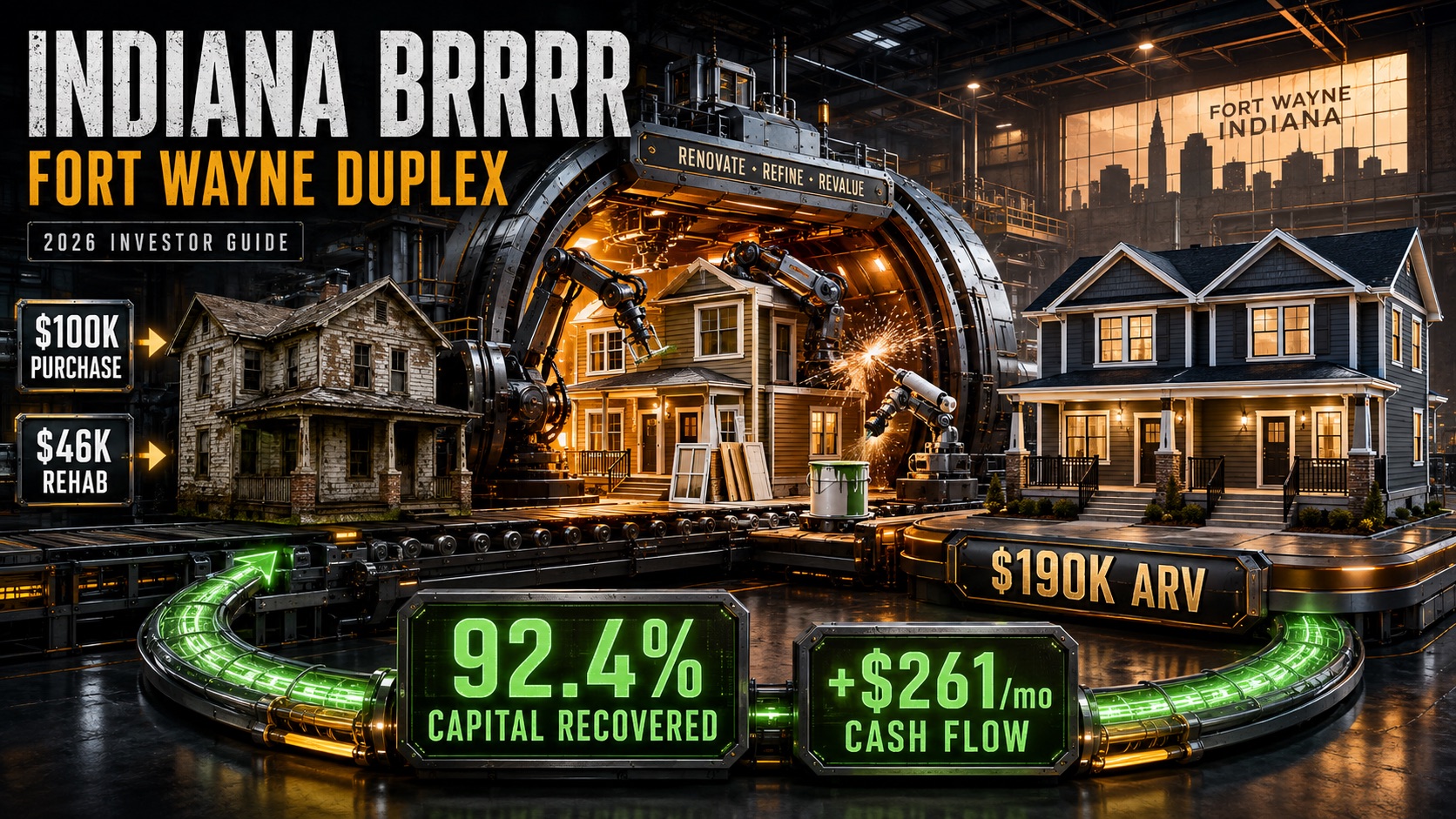
Worked Example: Fort Wayne Duplex BRRRR
PHASE 1: ACQUISITION
 Purchase Price: $100,000 (cash — no hard money)
 Closing Costs (3%): $3,000

PHASE 2: REHAB
 Renovation (both units): $40,000
 Contingency (15%): $6,000
 Total Rehab: $46,000

PHASE 3: HOLDING (5 months — rehab + seasoning)
 Insurance (5 mo): $708
 Property Tax (5 mo): $367
 Utilities: $1,000
 Total Holding: $2,075
 (No HM interest — cash purchase)

TOTAL CASH INVESTED: $151,075
 ($100K purchase + $3K close + $46K rehab + $2,075 holding)

PHASE 4: REFINANCE
 ARV (appraised): $190,000
 New Loan (75% LTV): $142,500
 Refi Closing (2%): -$2,850
 Cash-Out Proceeds: $139,650

PHASE 5: RESULTS
 Capital Recovery: $139,650 / $151,075 = 92.4%
 Capital Left in Deal: $11,425
 Monthly Rent (2 × $950): $1,900
 Monthly PITIA (7.0%): $949 + $73 + $142 = $1,164
 Monthly Expenses: $475
 Monthly Cash Flow: $1,900 - $1,164 - $475 = +$261/mo

 Cash-on-Cash Return: $3,132 / $11,425 = 27.4%
This is the Indiana BRRRR sweet spot. Cash purchase eliminates $7K+ in hard money costs. Fort Wayne duplex produces $261/month cash flow AFTER refinance. 92.4% capital recovery means $11,425 left in the deal — and that $11,425 generates 27.4% cash-on-cash return. With only $11K left in the deal, you have $139,650 back to repeat with the next property.
The key differences vs Indianapolis SFR: cash purchase (no HM costs), duplex (2 rent streams), Fort Wayne (lower tax and insurance), and stronger ARV spread ($100K → $190K = 90% appreciation from rehab). Run both in the Indiana BRRRR calculator.
Indiana BRRRR Viability by Metro
| Metro | Typical Entry | Typical ARV | Rehab Budget | BRRRR Viability |
|---|---|---|---|---|
| Fort Wayne | $80K-$120K | $160K-$200K | $30K-$45K | Strong — best spreads, lowest holding costs |
| Indianapolis | $90K-$130K | $170K-$210K | $30K-$50K | Good — deeper market, more deals available |
| South Bend | $70K-$100K | $130K-$160K | $25K-$40K | Good — low entry, Notre Dame supports ARV |
| Evansville | $75K-$110K | $140K-$170K | $25K-$40K | Moderate — smaller market, fewer comps |
| Bloomington | $130K-$170K | $220K-$260K | $35K-$50K | Difficult — high entry squeezes margins |
Fort Wayne and Indianapolis dominate Indiana BRRRR because they combine the widest distressed-to-ARV spreads with the deepest contractor pools and most reliable comp data. South Bend is underrated — low entry prices near a major university create solid ARV floors. Bloomington is difficult because entry prices are too high relative to ARV for sufficient capital recovery.
Indiana BRRRR Costs That Other States Don’t Have
State Income Tax on Rental Profits (3.05% + County)
Unlike Texas (0%) or Florida (0%), Per Indiana Department of Revenue, the state charges 3.05% flat income tax plus 1-2% county income tax on rental income. Total 4-5% state+county tax on your post-refi rental profits. On $3,132/year cash flow from the Fort Wayne duplex: ~$156 in state+county tax. Not a deal-breaker, but plan for it.
No Transfer Tax (Advantage)
Indiana charges no transfer tax on purchase or sale. This saves $1,000-$5,000 per transaction compared to Florida or Pennsylvania. For BRRRR investors who buy and hold (not sell), this matters at acquisition — lower closing costs mean more capital available for rehab.
Property Tax Cap (2% for Investment)
Indiana constitutionally caps investment property tax at 2% of assessed value. After renovation, the county will reassess at the higher ARV. A property purchased at $100K and renovated to $190K ARV: tax bill increases from $850/year to $1,615/year. Budget for the post-renovation tax increase in your BRRRR analysis. Per Indiana DLGF, assessment typically catches up within 1-2 years of renovation.
5 Indiana BRRRR Mistakes
1. Using Hard Money When Cash Is Available
Hard money costs (12% interest + 3 points + fees) add $7,000-$12,000 to a typical Indiana BRRRR. On a $100K purchase, that is 7-12% of the total investment consumed by financing. If you have cash, use it. The Fort Wayne example shows: cash purchase recovers 92% vs ~60% with hard money on the same deal.
2. Overestimating ARV
Indianapolis and Fort Wayne have wide valuation ranges within neighborhoods. A comp 0.3 miles away on the wrong side of a major road can be $20K-$30K different. Always pull 5+ comps within 0.25 miles, same condition. If the appraiser disagrees with your ARV, your refi proceeds drop and capital stays trapped. Use the ARV calculator.
3. Underestimating Rehab Timeline
Indiana winters (December-March) slow exterior work and add 2-4 weeks to rehab timelines. A 3-month summer rehab becomes 4-5 months in winter. Each extra month adds $500-$1,500 in holding costs (insurance, tax, utilities, HM interest if applicable). Start rehab by September to finish before winter, or plan a spring start.
4. Ignoring Post-Renovation Tax Reassessment
After you renovate a $100K property to $190K ARV, the county will reassess. Your tax bill nearly doubles from ~$850 to ~$1,615/year. Many BRRRR investors model cash flow at the pre-renovation tax rate — then are shocked when the assessment catches up. Budget at the post-renovation assessed value from day one.
5. Not Checking DSCR Before Buying
If your post-refi DSCR is below 0.75, most lenders will not refinance you out of hard money. You get stuck paying 12% interest indefinitely. Before buying, model the full BRRRR cycle including refi qualification in the Indiana BRRRR calculator and check DSCR in the Indiana DSCR calculator.
Frequently Asked Questions
Does BRRRR still work in Indiana in 2026?
Yes — for equity building and capital recycling. Fort Wayne and Indianapolis offer wide enough distressed-to-ARV spreads for 80-90%+ capital recovery. Cash flow after refinance is challenging at 7.0%+ rates — most Indiana BRRRR deals produce -$50 to -$200/month with hard money, or +$100 to +$300/month with cash acquisition. The strategy works best with cash purchases on duplexes/triplexes in Fort Wayne. Use the Indiana BRRRR calculator to model your specific deal at current rates.
What capital recovery should I target for Indiana BRRRR?
Which Indiana city is best for BRRRR?
Should I use hard money or cash for Indiana BRRRR?
How long does a BRRRR take in Indiana?
Related Calculators and Guides
- Indiana BRRRR Calculator — Full BRRRR cycle with IN defaults
- Indiana Rental Property Calculator — Post-refi cash flow
- Indiana DSCR Calculator — Refi qualification
- Indiana Cap Rate Calculator — ARV-based return
- Indiana Closing Costs — Acquisition + refi costs
- ARV Calculator — After-repair value
- Hard Money Calculator — Bridge financing costs
- All Indiana Calculators
Other state BRRRR guides:
Leave a Reply