Last updated: September 15, 2026 · Originally published: September 3, 2026 · By Alex Petrov
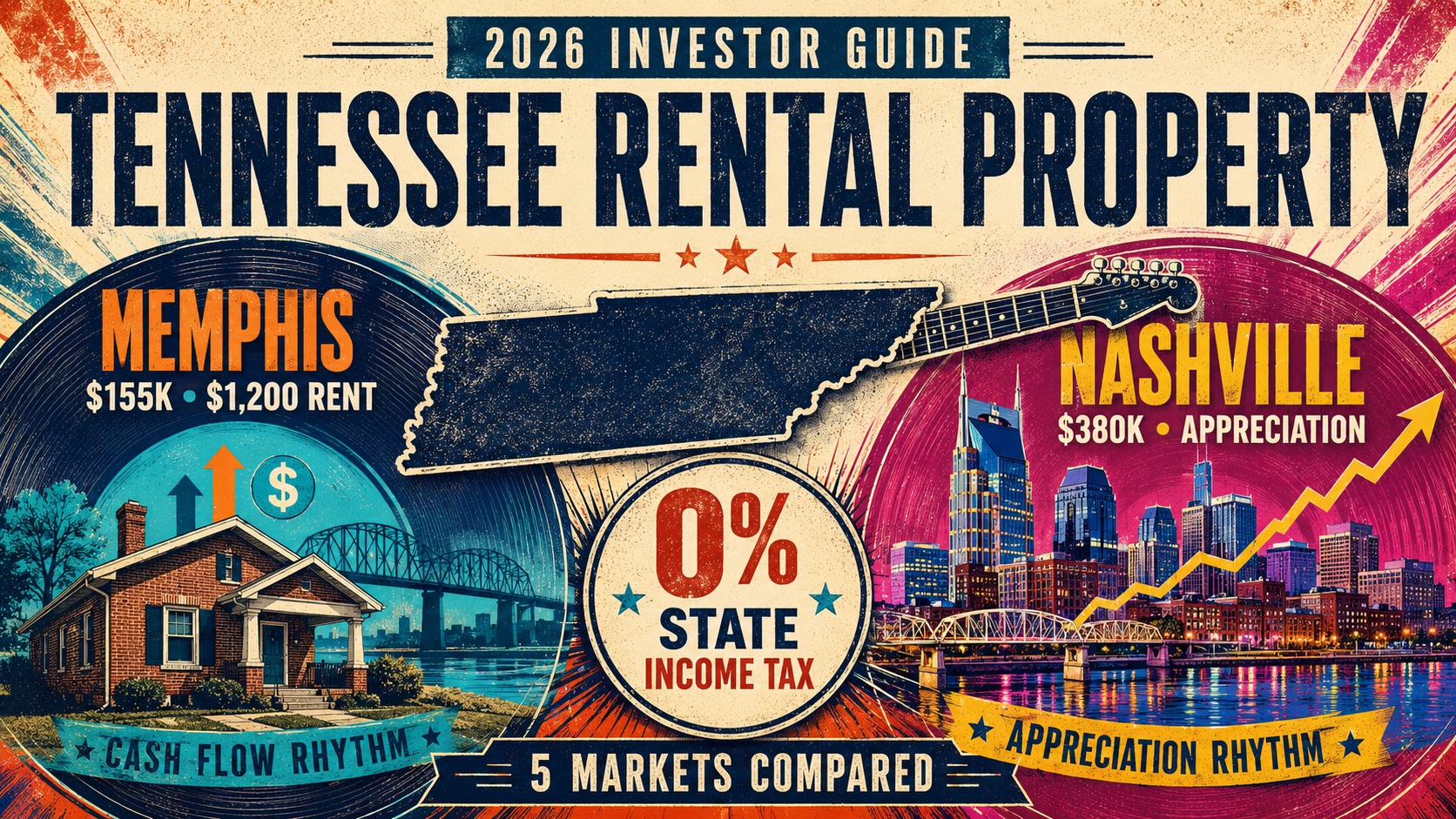
Tennessee rental property investment combines the best of both worlds: Memphis delivers cash flow at $155K median price and $1,200/month rent (0.77% ratio), while Nashville delivers appreciation at $380K with strong tenant demand from healthcare and tech. The state charges zero income tax on rental profits — joining Texas and Florida as the only major investment states with this advantage. Property tax is 0.56% effective (lowest among top investment states), though insurance runs $2,200/year due to tornado and hail risk in middle Tennessee. Here is what the numbers look like across five Tennessee metros with worked examples.
Why Tennessee for Rental Property in 2026
Tennessee consistently ranks in the top 5 states for rental property investment. Four factors drive this:
- No state income tax — Tennessee repealed the Hall Tax in 2021. Zero tax on wages, rental income, and capital gains at the state level. Per Tennessee Department of Revenue, the state has no personal income tax of any kind. Compared to Georgia (4.99%), Ohio (2.75%), or Indiana (3.05% + county), Tennessee investors keep 3-5% more of net rental income.
- Lowest property tax among investment states — 0.56% effective rate per Tax Foundation. On a $200K property: $1,120/year. Ohio charges $2,720. Texas charges $3,200. That $1,600-$2,080 annual savings goes directly to NOI and cash flow.
- Two distinct investment strategies — Memphis for cash flow ($155K entry, 0.77% ratio). Nashville for appreciation ($380K, strong population growth). Most states force you into one strategy. Tennessee lets you choose.
- Population growth — Nashville metro grew 14% from 2020 to 2025, the 4th fastest major metro in the US. Per US Census estimates, Clarksville and Chattanooga are also growing above the national average. Population growth drives tenant demand and appreciation.
The trade-off: Tennessee insurance averages $2,200/year — higher than Indiana ($1,800) or Ohio ($2,100) — due to tornado, hail, and severe storm risk in middle and west Tennessee. Memphis properties face additional flood risk along the Mississippi. And Tennessee charges a transfer tax of $0.37 per $100 of sale price. Model your deal with Tennessee-specific defaults in the Tennessee rental property calculator.
Tennessee Rental Property Markets: 5 Metros Compared
| Metro | Median Price | Median Rent (3BR) | Rent/Price | Vacancy | Property Tax | Insurance |
|---|---|---|---|---|---|---|
| Memphis | $155,000 | $1,200 | 0.77% | 7.2% | 0.71% | $2,400 |
| Nashville | $380,000 | $2,100 | 0.55% | 5.5% | 0.52% | $2,200 |
| Chattanooga | $250,000 | $1,500 | 0.60% | 5.8% | 0.48% | $2,000 |
| Knoxville | $270,000 | $1,600 | 0.59% | 5.5% | 0.50% | $2,100 |
| Clarksville | $230,000 | $1,400 | 0.61% | 6.0% | 0.55% | $1,900 |
Memphis is the cash flow capital of Tennessee. $155K median entry, $1,200 rent, 0.77% ratio — one of the best in the entire US. The catch: 7.2% vacancy and higher tenant turnover. Budget conservatively. Best for: experienced investors, property management required.
Nashville is a pure appreciation play at current prices. $380K entry with $2,100 rent = 0.55% ratio — negative cash flow at 7% rates. But population growth, healthcare (HCA), and tech (Oracle, Amazon) support 4-5% annual appreciation. Best for: deep pockets, long-term hold.
Chattanooga is the balanced option. $250K entry, growing tech scene (EPB fiber optic network attracted remote workers), outdoor recreation economy. Best for: investors wanting both moderate cash flow and appreciation.
Knoxville benefits from University of Tennessee creating consistent rental demand. $270K entry is moderate. Best for: stable tenant pool, moderate appreciation.
Clarksville is a military town (Fort Campbell). $230K entry with $1,400 rent. Military tenants are reliable (BAH covers rent) but deploy frequently. Best for: consistent occupancy, military housing allowance income.
Compare all five in the Tennessee cap rate calculator. For DSCR loan qualification, use the Tennessee DSCR calculator.
Worked Example: Memphis SFR ($155K)
Purchase Price: $155,000
Down Payment (25%): $38,750
Loan Amount: $116,250
Interest Rate: 7.0% / 30yr
Monthly P&I: $774

Monthly Income:
 Gross Rent: $1,200
 Vacancy (7.2%): −$86
 Effective Rent: $1,114

Monthly Expenses:
 Property Tax (0.71%): −$92
 Insurance: −$200
 Management (10%): −$111
 Maintenance (8%): −$89
 CapEx (5%): −$56
 Total Expenses: −$548

NOI: $566/mo ($6,792/yr)
Cash Flow: $566 − $774 = −$208/mo

Cap Rate: $6,792 / $155,000 = 4.38%
Cash-on-Cash: −$2,496 / $38,750 = −6.4%
Surprise: Memphis is cash flow negative at market price with professional management. The 0.77% rent-to-price ratio is strong, but 7.2% vacancy and $200/month insurance eat the margin. To cash flow positive: self-manage (saves $111/month → CF = −$97) or buy at $130K (saves $166/month in P&I → CF near breakeven).
The real Memphis play: buy distressed at $100-120K, rehab for $25-35K, rent at $1,200, refinance at $155K ARV. BRRRR recovers 80-90% of capital and the forced equity makes the deal work. Model this in the Tennessee BRRRR calculator.
Worked Example: Clarksville Duplex ($230K)
Purchase Price: $230,000
Down Payment (25%): $57,500
Loan: $172,500 at 7.0%
Monthly P&I: $1,148

Rent (2 × $700): $1,400/mo
Vacancy (6.0%): −$84
Effective Rent: $1,316

Expenses:
 Property Tax (0.55%): −$105
 Insurance: −$158
 Management (9%): −$118
 Maintenance (8%): −$105
 CapEx (5%): −$66
 Total: −$552

NOI: $764/mo ($9,168/yr)
Cash Flow: $764 − $1,148 = −$384/mo
Clarksville duplex is deeply negative — $230K is too high for $1,400 rent. The 0.61% ratio cannot support 7% financing. To make Clarksville work: target properties under $180K or find duplexes renting $800+/unit ($1,600 total). Military housing allowance (BAH) for Fort Campbell E-5 with dependents is approximately $1,400/month — matching your total rent, but only if you find the right unit.
Tennessee Tax Advantages for Investors
No State Income Tax
Tennessee charges zero state income tax on rental income, capital gains, and all other personal income. This is a permanent structural advantage over states like Georgia (4.99%), Ohio (2.75%), North Carolina (4.50%), and Indiana (3.05% + county). On $10,000/year net rental profit, you save $275-$499 annually compared to those states. Over a 10-year hold: $2,750-$4,990 in cumulative tax savings.
Low Property Tax (0.56%)
Tennessee’s effective property tax rate is the lowest among the top 10 investment states. Comparison on a $200K property:
| State | Effective Rate | Annual Tax | vs Tennessee |
|---|---|---|---|
| Tennessee | 0.56% | $1,120 | — |
| Florida | 0.89% | $1,780 | +$660 |
| Indiana | 0.85% | $1,700 | +$580 |
| Georgia | 0.92% | $1,840 | +$720 |
| Ohio | 1.36% | $2,720 | +$1,600 |
| Texas | 1.60% | $3,200 | +$2,080 |
Transfer Tax ($0.37/$100)
Tennessee charges a state transfer tax of $0.37 per $100 of sale price. On a $200K purchase: $740. This is moderate — lower than Florida ($1,400) or Pennsylvania ($4,000) but higher than Indiana ($0) or Texas ($0). Factor into closing costs. Calculate in the Tennessee closing costs calculator.
5 Mistakes Investing in Tennessee Rental Property
1. Treating Memphis Like a Passive Investment
Memphis has the best numbers on paper but the highest management intensity. Tenant turnover is frequent (average lease 14 months vs 24 months nationally), eviction rates are above average, and property crime varies dramatically block by block. Memphis requires strong local property management — do not self-manage from out of state.
2. Buying Nashville at Market Price for Cash Flow
Nashville at $380K and $2,100 rent = 0.55% ratio. Cash flow is -$300+ per month at 7% rates. Nashville is an appreciation play, not a cash flow play. If you need cash flow, buy in Memphis or Clarksville, not Nashville.
3. Ignoring Tornado and Hail Risk
Middle Tennessee (Nashville corridor) is in tornado alley. The March 2020 Nashville tornado caused $2.2B in damage. Insurance premiums in this corridor run $2,200-$3,000/year. Budget $200-$250/month for insurance, not the $150/month that national averages suggest.
4. Assuming All Military Tenants Are Reliable
Clarksville (Fort Campbell) has strong military demand, but deployment orders can trigger early lease termination under the Servicemembers Civil Relief Act (SCRA). Budget for one unexpected mid-lease vacancy every 2-3 years. The advantage: BAH payments are guaranteed income while the tenant is in place.
5. Not Factoring Transfer Tax Into Flip Returns
Tennessee’s $0.37/$100 transfer tax applies to both purchase and sale. On a $200K flip: $740 at purchase + $740 at sale = $1,480 in transfer taxes. Not deal-breaking, but it reduces flip profit. Compare to Indiana ($0) or Texas ($0). Model in the fix and flip calculator.
Frequently Asked Questions
Is Tennessee a good state for rental property investment?
Yes — Tennessee ranks in the top 5 for rental property investment in 2026. Memphis offers 0.77% rent-to-price ratio for cash flow. Nashville offers strong appreciation. Zero state income tax + 0.56% property tax (lowest among investment states) give Tennessee a structural tax advantage. The main drawback is higher insurance ($2,200/year) due to tornado risk. Use the Tennessee rental property calculator to model your deal.
Does Tennessee have state income tax on rental income?
Which Tennessee city is best for rental property?
How much is property tax in Tennessee?
Is Memphis or Nashville better for rental investment?
Related Calculators and Guides
- Tennessee Rental Property Calculator — Full analysis with TN defaults
- Tennessee Cap Rate Calculator — Compare metro cap rates
- Tennessee Closing Costs Calculator — Buyer cost estimate
- Tennessee DSCR Calculator — Loan qualification
- Tennessee BRRRR Calculator — Buy-rehab-rent-refinance
- All Tennessee Calculators
- All 30+ Calculators
Other state guides:
Leave a Reply