Last updated: September 24, 2026 · Originally published: August 18, 2026 · By Alex Petrov
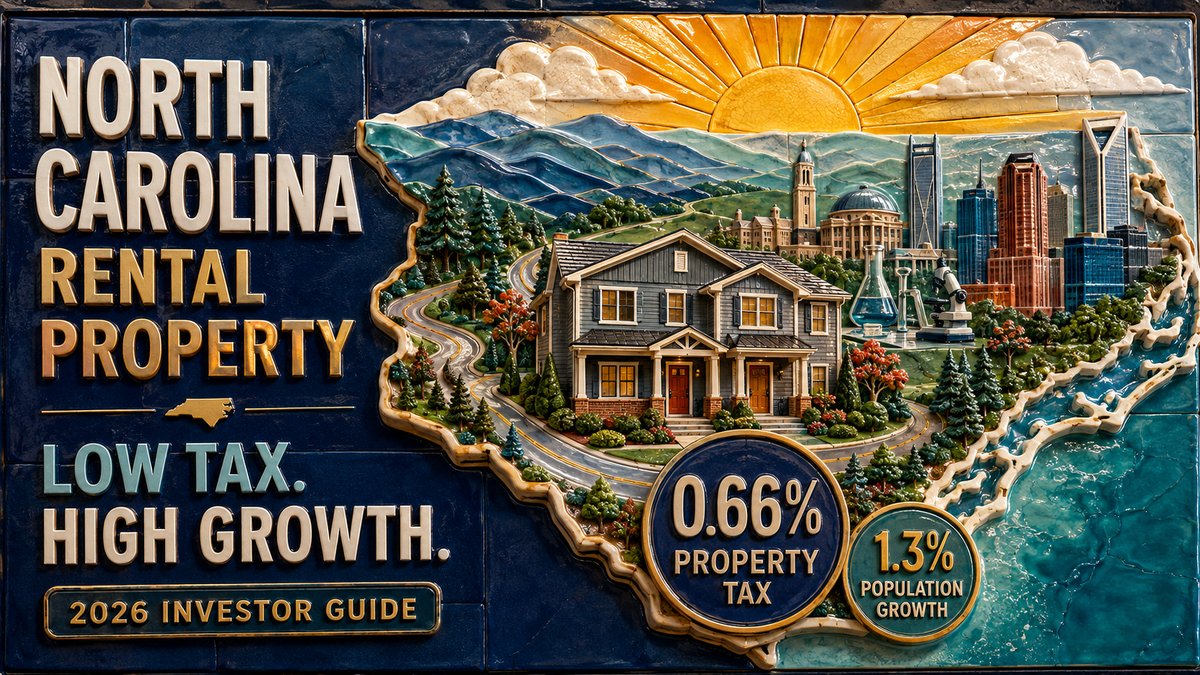
North Carolina rental property investment is driven by the Research Triangle boom, Charlotte’s banking sector expansion, and one of the lowest property tax rates in the US (0.66%). Population growth of 1.3% makes NC the ninth-fastest-growing state. The challenge: rising insurance costs ($3,000/yr average after two consecutive rate hikes) and appreciation-driven pricing that makes cash flow thin at current rates. Use the NC rental property calculator to run any deal with state-specific defaults.
Why North Carolina for Rental Property in 2026
Research Triangle demand. Apple, Google, Epic Games, and dozens of biotech companies have expanded into the Raleigh-Durham area. NC State, Duke, and UNC provide a permanent base of 100,000+ students. Vacancy in Wake County sits at 4.0% — tightest in the Southeast.
Charlotte banking growth. Bank of America and Wells Fargo HQs anchor Charlotte. The city added 20,000+ jobs in 2025. New light rail expansion is opening suburban corridors for investment. Population growth in Mecklenburg County outpaces the state average.
Lowest property tax in the region. NC’s effective rate of 0.66% per Tax Foundation beats Georgia (0.79%), Florida (1.10%), and Texas (1.40%). On a $300K property, that saves $2,220/year vs Texas — real money in your NOI.
Attorney-closing state. Like Georgia, NC requires an attorney at closing ($600–$1,200). Factor it into your closing costs.
NC Tax Rules for Investors
| Tax | Rate | Notes |
|---|---|---|
| Property Tax | 0.66% effective | Varies: Mecklenburg (Charlotte) 0.83%, Wake (Raleigh) 0.72%, Durham 1.04% |
| State Income Tax | 3.99% flat | Effective 2026. Trending toward 2.49% by 2030. No municipal income tax. |
| Excise Tax | 0.2% | $1 per $500 ($2 per $1,000). Paid by seller. NC DOR |
| Insurance | ~$3,000/yr | Rose sharply after 7.5% hikes in 2025 and 2026. Coastal 2-3x higher. |
NC’s 3.99% income tax is lower than Georgia (4.99%) and Ohio (2.75% + municipal). Combined with the 0.66% property tax, NC’s total tax burden on rental income is competitive despite having a state income tax. No municipal income tax anywhere in NC — unlike Ohio where cities charge 1.5–2.5%.
Charlotte: Banking Capital, Appreciation Market
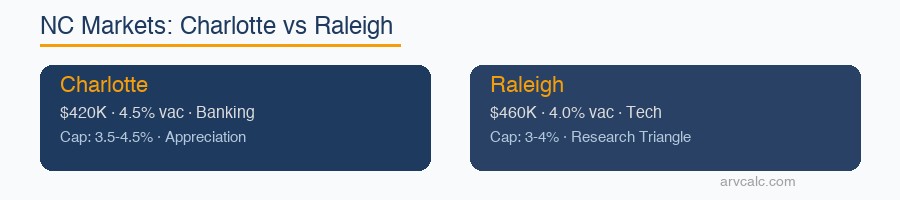
Median price: $420,000 · Rent: $1,750/mo · Vacancy: 4.5% · Tax: 0.83%
Charlotte is NC’s largest metro and a pure appreciation play at current rates. A $420K SFR with $1,750 rent produces a 2.4% cap rate and deeply negative cash flow. Investors buy Charlotte for equity growth (4.5% YoY price increase) and tight vacancy, not monthly income.
Best Charlotte strategy: value-add duplexes in emerging neighborhoods (NoDa, Plaza Midwood, West End) where rent-to-price ratios are more favorable. Use the NC cap rate calculator to find your breakpoint.
Raleigh: Research Triangle Premium
Median price: $460,000 · Rent: $1,800/mo · Vacancy: 4.0% · Tax: 0.72%
Raleigh is the most expensive NC metro — and the most insulated from downturns. Tech employment (Apple campus opening 2026), three tier-1 universities, and a 4.0% vacancy rate create sustained demand. Properties sell in 16 days — fastest in NC.
Cash flow is negative on virtually all SFR at $460K median. Raleigh works for investors with 10+ year horizons who can absorb $300–$500/month negative cash flow in exchange for 5%+ annual appreciation. Check DSCR qualification in the NC DSCR calculator — most Raleigh deals do not qualify.
Greensboro: Best Cash Flow in NC
Median price: $245,000 · Rent: $1,300/mo · Vacancy: 6.5% · Tax: 0.95%
Greensboro (Piedmont Triad) is where NC investors go for cash flow — or at least the closest thing to it. At $245K median, it is 42% cheaper than Charlotte and 47% cheaper than Raleigh. Toyota’s battery plant in nearby Randolph County is creating housing demand. Growing logistics hub (FedEx, Amazon distribution).
A $180K duplex with $1,500/month rent produces a 5.6% cap rate — the best in NC. Cash flow is still marginally negative (−$65/month) at 7% rates with PM, but Greensboro is the only NC metro where deals approach breakeven. Self-managing pushes into positive territory.
Asheville: Mountain Tourism + STR
Median price: $395,000 · Rent: $1,650/mo · Vacancy: 5.0% · Tax: 0.65%
Asheville is a tourism market with strong short-term rental potential. Year-round appeal (skiing, hiking, craft breweries, Biltmore Estate) drives Airbnb demand. Limited land for new construction keeps supply tight. The 0.65% property tax (Buncombe County) is the lowest among NC metros.
Long-term rental math is stretched at $395K. STR income can be 2-3x higher than LTR in the right neighborhoods. Insurance is moderate (mountain, not coastal). Use the NC rental property calculator for LTR analysis.
North Carolina vs Texas vs Florida vs Georgia
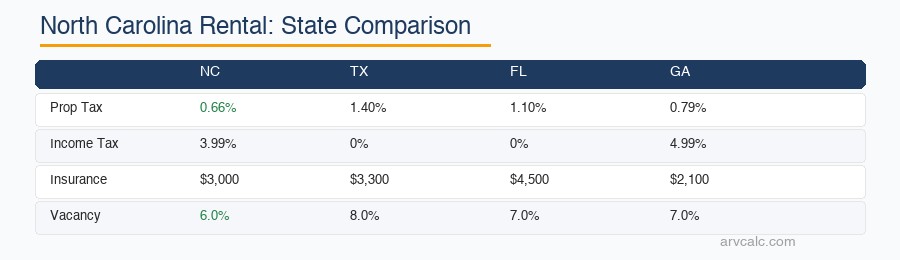
| Factor | North Carolina | Texas | Florida | Georgia |
|---|---|---|---|---|
| Property Tax | 0.66% | 1.40% | 1.10% | 0.79% |
| Income Tax | 3.99% | 0% | 0% | 4.99% |
| Insurance | $3,000 | $3,300 | $4,500 | $2,100 |
| Median Price | $380,000 | $335,000 | $400,000 | $355,000 |
| Vacancy | 6.0% | 8.0% | 7.0% | 7.0% |
| Pop Growth | 1.3% | 1.7% | 1.6% | 1.3% |
| Attorney Required | Yes | No | No | Yes |
| Best For | Tech growth + low tax | No income tax | Appreciation + STR | Low tax + film |
NC wins on property tax (lowest of all four) and vacancy (tightest). Loses on insurance ($3,000 — rose sharply) and median price ($380K — higher than TX or GA). The 3.99% income tax is between GA (4.99%) and TX/FL (0%). For state comparisons, see cap rate by state guide.
Worked Example: Greensboro Duplex — $180,000
Property: Duplex in Greensboro near Toyota battery plant corridor
Purchase: $180,000 · Down: 25% ($45,000) · Loan: $135,000 at 7.0%
Rent: $750/unit × 2 = $1,500/month
Step 1: Effective Gross Income
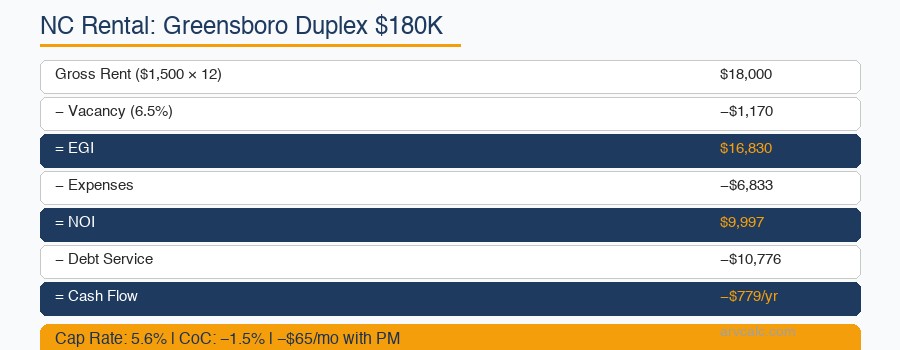
Gross rent: $1,500 × 12 = $18,000
Vacancy (6.5%): −$1,170
EGI: $16,830
Step 2: Operating Expenses
| Expense | Annual | Basis |
|---|---|---|
| Property Tax | $1,710 | 0.95% effective (Guilford County) |
| Insurance | $2,000 | Inland NC, duplex |
| Maintenance | $1,440 | 8% of gross rent |
| Property Management | $1,683 | 10% of EGI |
| Total | $6,833 |
Step 3: NOI and Cash Flow
NOI = $16,830 − $6,833 = $9,997
Cap Rate = $9,997 ÷ $180,000 = 5.6%

Monthly P&I: $898
Annual debt service: $10,776

Cash flow = $9,997 − $10,776 = −$779/year (−$65/month)
Total cash = $45,000 + $5,400 (closing) = $50,400
CoC = −$779 ÷ $50,400 = −1.5%
Result: 5.6% cap rate, −$65/month cash flow, −1.5% CoC. Marginally negative with professional management. Self-managing saves $1,683/year and pushes cash flow to +$75/month (1.8% CoC). This is the best-case scenario in NC at current rates — Greensboro is the only metro where the numbers approach breakeven.
If rates drop to 6%: P&I falls to $809, cash flow turns positive at $109/month. Run scenarios in the NC rental property calculator.
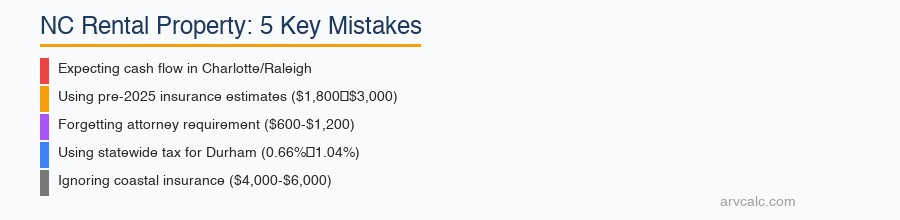
5 Things NC Investors Get Wrong
1. Expecting Cash Flow in Charlotte or Raleigh
Why: At $420K–$460K median with $1,700–$1,800 rent, Charlotte/Raleigh SFRs produce deeply negative cash flow at 7% rates. These are appreciation markets, not cash flow markets.
Fix: Treat Charlotte/Raleigh as equity growth plays. For cash flow, target Greensboro or Winston-Salem. Compare in the cash-on-cash calculator.
2. Using Pre-2025 Insurance Estimates
Why: NC insurance rose 7.5% in both 2025 and 2026. Old estimates of $1,500–$1,800/yr are 40–60% too low. Current average is $3,000. Coastal is $4,000–$6,000.
Fix: Get actual insurance quotes from NC Dept of Insurance marketplace before making offers. Budget $3,000 minimum.
3. Forgetting the Attorney Requirement
Why: NC is an attorney-closing state. $600–$1,200 per transaction that TX and FL investors don’t budget.
Fix: Include attorney fee in NC closing costs calculator.
4. Ignoring County Tax Rate Variation
Why: Statewide 0.66% vs Durham 1.04% = 58% higher. On a $300K property: $1,980 vs $3,120 — $1,140/year difference.
Fix: Always use county-specific rate from the county tax assessor.
5. Not Factoring Coastal Insurance for Wilmington/OBX
Why: Coastal NC insurance runs $4,000–$6,000/yr — double inland rates. Add flood insurance ($700–$2,500) and a $300K coastal property’s insurance can exceed $8,000/yr, destroying any cap rate advantage.
Fix: Get real quotes for coastal properties. If insurance exceeds $5,000, the deal must work on STR income, not LTR.
Frequently Asked Questions
Is North Carolina good for rental property investment?
NC has the lowest property tax in the region (0.66%), strong population growth (1.3%), and booming tech employment in the Research Triangle. The challenge is that insurance costs rose sharply ($3,000/yr) and median prices ($380K) make cash flow difficult at current rates. Greensboro is the best cash flow market; Charlotte and Raleigh are appreciation plays.
What is the best city in North Carolina for rental property?
Does North Carolina have state income tax on rental income?
What is North Carolina’s property tax rate?
Do I need an attorney to close in North Carolina?
Why is NC insurance so expensive now?
Can I use a DSCR loan for NC rental property?
NC Investment Calculators
- NC Rental Property Calculator
- NC Cap Rate Calculator
- NC Closing Costs Calculator
- NC DSCR Calculator
- NC BRRRR Calculator
- NC Calculator Hub
- All 30+ Calculators
Leave a Reply