Last updated: September 24, 2026 · Originally published: August 20, 2026 · By Alex Petrov
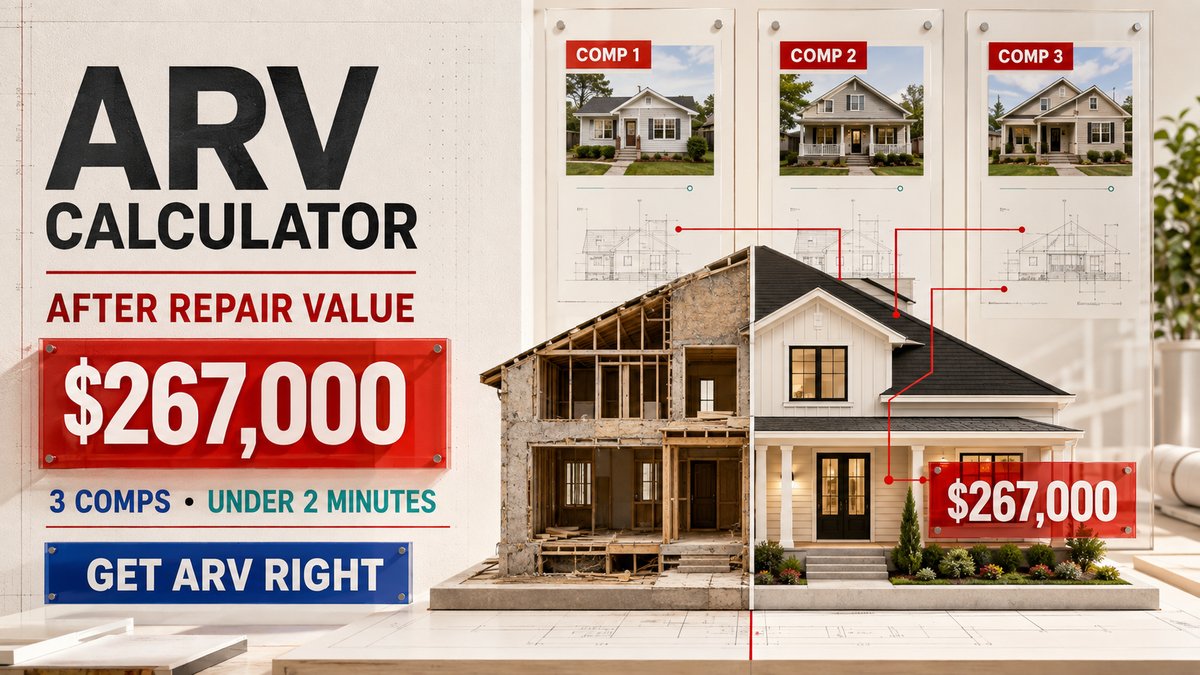
The ARV calculator estimates what a property will be worth after renovation — the single most important number for any flip or BRRRR deal. Get the ARV wrong by 10% and a profitable flip becomes a loss. Enter comparable sales, adjust for differences, and get your after-repair value in under 2 minutes.
What Is ARV and Why It Matters
ARV = After Repair Value — the estimated market value of a property after all renovations are complete. It drives every investment decision:
- Maximum offer price — the 70% rule says: Max Offer = ARV × 0.70 − Rehab Cost
- Flip profit — Profit = ARV − Purchase − Rehab − Selling Costs − Holding Costs
- BRRRR refinance — Cash-out refi at 75% of ARV determines how much capital you recover
- Hard money qualification — most lenders cap at 65–75% of ARV
If ARV is $267K and you estimate $300K, your 70% rule max offer jumps from $142K to $165K — you overpay by $23K. That is the difference between a $21K profit and a $2K loss. The ARV calculator eliminates guesswork by systematizing the comp analysis process.
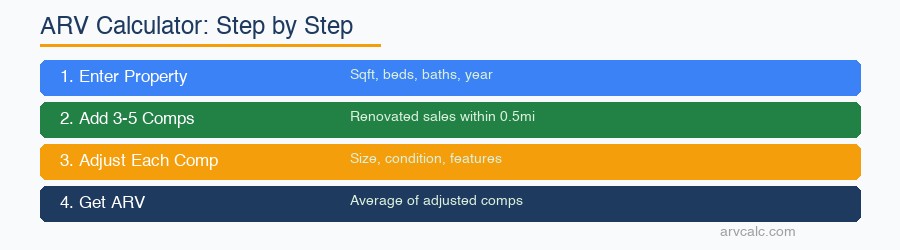
How to Use the ARV Calculator: Step by Step
Step 1 — Enter Subject Property Details
Address, square footage, bed/bath count, lot size, year built. These are the baseline for comp adjustments. Get exact numbers from the county assessor or MLS listing — do not estimate.
Step 2 — Enter 3–5 Comparable Sales
Recent sales (last 6 months) of similar properties in the same neighborhood, in renovated condition. The comps should represent what YOUR property will look like after rehab — not what it looks like now.
Good comp criteria:
- Within 0.5 miles of subject property
- Sold within last 6 months (3 months ideal)
- Similar size (±20% sqft)
- Same property type (SFR to SFR, not SFR to condo)
- Similar bed/bath configuration (±1 bed, ±1 bath)
- Renovated condition (matching your post-rehab quality)
Source comps from MLS, Zillow, Redfin, or county records. Use at least 3 — never base ARV on a single sale. Per NAR, investors who use 3+ comps have 15% more accurate valuations than those using 1–2.
Step 3 — Adjust Each Comp
No two properties are identical. Adjust each comp for differences vs your subject property after rehab:
| Feature Difference | Typical Adjustment | Direction |
|---|---|---|
| Smaller sqft (comp smaller) | +$30–$80 per sqft | Add to comp |
| Larger sqft (comp larger) | −$30–$80 per sqft | Subtract from comp |
| Extra bedroom (comp has more) | −$5,000 to −$15,000 | Subtract from comp |
| Extra bathroom (comp has more) | −$3,000 to −$10,000 | Subtract from comp |
| Better condition (comp nicer) | −$5,000 to −$20,000 | Subtract from comp |
| Garage (comp has, yours doesn’t) | −$10,000 to −$25,000 | Subtract from comp |
| Pool (comp has, yours doesn’t) | −$5,000 to −$15,000 | Subtract from comp |
Rule: adjust the comp to match the subject — if the comp is better, subtract. If the comp is worse, add. The ARV calculator walks you through each adjustment.
Step 4 — Calculate ARV
The calculator averages the adjusted comp values. If your 3 adjusted comps are $267K, $264K, and $270K, your ARV is $267,000. Some investors weight the most similar comp higher — the calculator supports weighting.
Worked Example: Memphis SFR Flip
Subject: 3-bed/2-bath, 1,400 sqft, built 1985, needs full kitchen/bath rehab
Purchase: $180,000 · Rehab: $45,000
Post-rehab condition: Updated kitchen, new baths, LVP flooring, fresh paint, new HVAC
Comparable Sales (last 4 months, within 0.4 miles)
| Comp | Sale Price | Sqft | Bed/Bath | Condition | Adjustment | Adjusted |
|---|---|---|---|---|---|---|
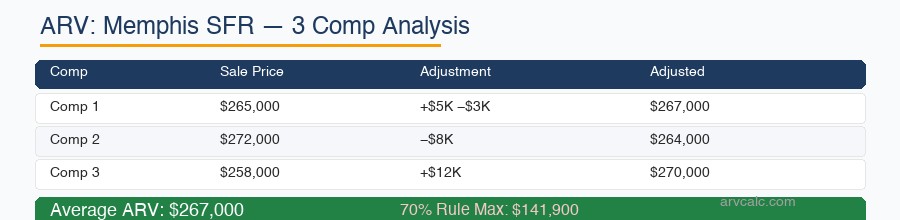
| Comp 1 | $265,000 | 1,350 | 3/2 | Updated | +$5,000 (50sqft smaller) −$3,000 (newer build) | $267,000 |
| Comp 2 | $272,000 | 1,450 | 3/2 | Premium | −$8,000 (better finishes) | $264,000 |
| Comp 3 | $258,000 | 1,380 | 2/2 | Updated | +$12,000 (missing bedroom) | $270,000 |
Adjusted comp average: ($267,000 + $264,000 + $270,000) ÷ 3 = $267,000

ARV = $267,000
Using ARV for Decisions
70% Rule Max Offer: $267,000 × 0.70 − $45,000 = $141,900
Actual purchase price: $180,000 (above 70% rule — tighter margins)

Flip Profit: $267,000 − $180,000 − $45,000 − $16,020 (6% sell) − $5,000 (hold) = $20,980
BRRRR Refi: 75% of $267,000 = $200,250 cash-out
At $180K purchase, the flip produces $20,980 profit. Above the 70% rule ($141,900), so margins are tighter than ideal — but still profitable. If one comp came in $20K lower and ARV dropped to $247K, profit would be only $8,700. This is why accurate ARV matters. Run your comps in the ARV calculator.
For the full flip analysis, use the fix and flip calculator. For max offer, use the 70% rule calculator. For rehab budget, see the rehab cost estimator.
ARV for BRRRR Strategy
In BRRRR, ARV determines your refinance proceeds — and therefore how much capital you recover.
Purchase: $110,000
Rehab: $30,000
Total invested: $147,000 (with closing + holding)

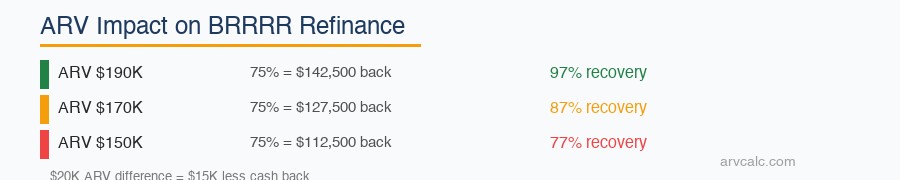
ARV: $190,000 → 75% LTV refi = $142,500 cash back (97% recovery)
ARV: $170,000 → 75% LTV refi = $127,500 cash back (87% recovery)
ARV: $150,000 → 75% LTV refi = $112,500 cash back (77% recovery)
$20K ARV difference = $15K less cash back. Underestimating ARV by 10% means leaving $15K more in the deal — money that could fund the next purchase. Always verify ARV with a BPO (broker price opinion) before committing to rehab scope. Model the full BRRRR cycle in the BRRRR calculator. For state-specific BRRRR, see NC BRRRR, GA BRRRR, or OH BRRRR.
Where to Find Comps
| Source | Cost | Best For |
|---|---|---|
| MLS (via agent) | Free (with agent) | Most accurate — includes days on market, price changes |
| Zillow/Redfin | Free | Quick screening — may miss off-market sales |
| County Assessor | Free | Official sale price — no listing details |
| PropStream/BatchLeads | $99–$199/mo | Investor-grade comps with filters |
| BPO (Broker Price Opinion) | $50–$150 | Professional opinion — good for BRRRR pre-refi |
Use free sources (Zillow, Redfin) for initial screening, MLS for serious analysis, and BPO before committing to a BRRRR rehab. For more on comp analysis, read the complete ARV guide. Per Census Bureau new construction data, new builds in your comp area affect ARV — new supply can compress resale values.
5 ARV Mistakes
1. Using Pre-Rehab Comps
Why: ARV estimates the post-rehab value. If your comps are distressed/unrenovated properties, your ARV will be 20–30% too low. Use renovated comps only.
Fix: Filter comps for “updated,” “renovated,” or “move-in ready” condition. Photos confirm condition better than listing descriptions.
2. Going Beyond 0.5 Miles
Why: Real estate is hyper-local. A comp 1 mile away in a different school district or across a major road can be $30K–$50K different.
Fix: Stay within 0.5 miles. If you can’t find 3 comps, expand to 0.75 miles but adjust for neighborhood quality.
3. Using Sales Older Than 6 Months
Why: Markets change. A comp from 12 months ago in a market that appreciated 5% understates current value. A comp from a declining market overstates it.
Fix: 3 months is ideal. 6 months maximum. Apply time adjustments for older comps using FRED home price trends.
4. Not Adjusting for Differences
Why: Raw comp average ignores that Comp 2 has a premium kitchen (+$8K) or Comp 3 is missing a bedroom (−$12K). Unadjusted ARV can be off by $15K–$25K.
Fix: Always adjust. The ARV calculator has fields for each adjustment category.
5. Relying on Zillow Zestimate as ARV
Why: Zestimate reflects current condition — not post-rehab condition. On a property needing $45K rehab, Zestimate might be $200K (current) while true ARV is $267K (post-rehab). Using Zestimate = undervaluing by $67K.
Fix: Use Zestimate for the current “as-is” value only. For ARV, use renovated comp sales. Read the ARV by address guide for more detail.
Frequently Asked Questions
What is ARV in real estate?
ARV (After Repair Value) is the estimated market value of a property after all renovations are completed. It is calculated by analyzing comparable sales of recently renovated properties in the same area and adjusting for differences in size, condition, and features. ARV drives flip profit calculations, BRRRR refinance amounts, and maximum offer prices.
How do I calculate ARV for a flip?
How many comps do I need for an accurate ARV?
What is the 70% rule and how does it use ARV?
How does ARV affect BRRRR refinance?
Is Zillow Zestimate the same as ARV?
Related Calculators and Guides
- ARV Calculator — Estimate after-repair value
- 70% Rule Calculator — Maximum offer based on ARV
- Fix and Flip Calculator — Full flip profit analysis
- BRRRR Calculator — Buy, rehab, rent, refinance, repeat
- Rehab Cost Estimator — Room-by-room budget
- Hard Money Calculator — Bridge financing costs
- House Flipping Profit Calculator
- All 30+ Calculators
Blog guides:
Leave a Reply