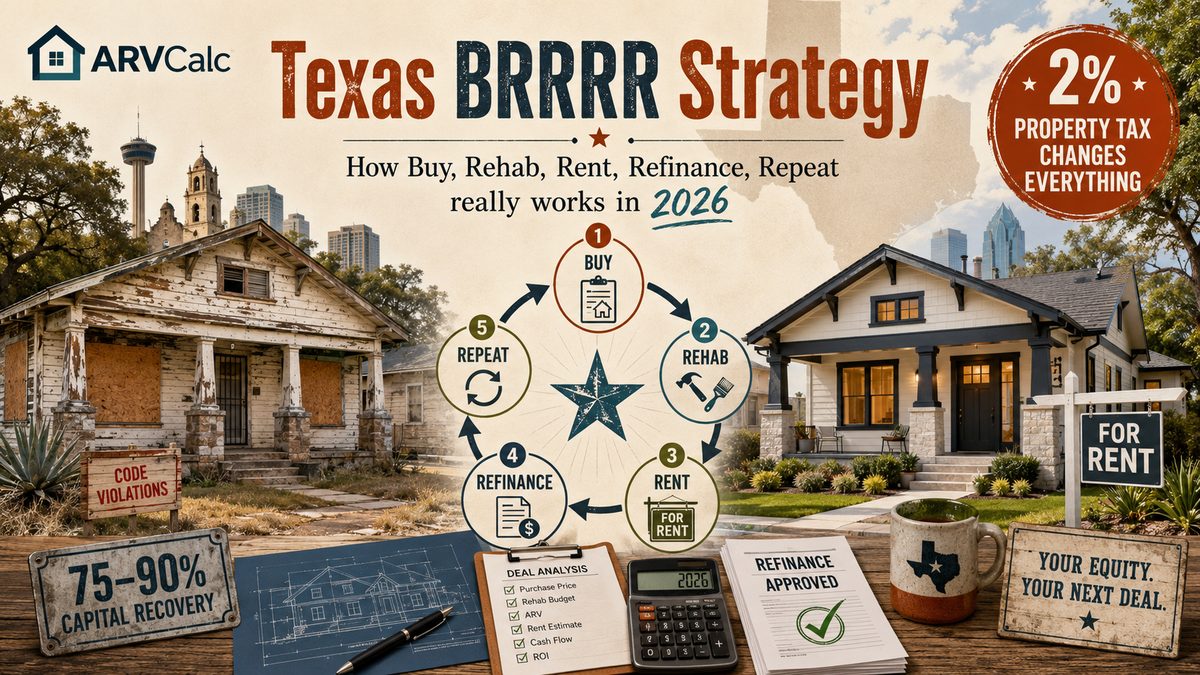
The BRRRR Texas strategy still produces results in 2026 — but only if you account for 2% property tax eating into every phase of the deal. This guide walks through real San Antonio and Houston examples with a free BRRRR Texas calculator.
{
“@context”: “https://schema.org”,
“@type”: “FAQPage”,
“mainEntity”: [
{
“@type”: “Question”,
“name”: “Does the BRRRR strategy work in Texas?”,
“acceptedAnswer”: {
“@type”: “Answer”,
“text”: “Yes, the BRRRR strategy works in Texas, but it requires careful market selection and expense planning. Texas has no state income tax, strong rental demand, and growing metros — but the 1.8–2.2% annual property tax rate adds $300–550/month to holding and rental phase costs that investors in other states don’t face. San Antonio and Houston offer the strongest BRRRR fundamentals in 2026.”
}
},
{
“@type”: “Question”,
“name”: “What is the BRRRR method in real estate?”,
“acceptedAnswer”: {
“@type”: “Answer”,
“text”: “BRRRR stands for Buy, Rehab, Rent, Refinance, Repeat. An investor purchases a distressed property below market value, renovates it to increase the ARV (after-repair value), rents it out, then does a cash-out refinance based on the new appraised value. The refinance proceeds are used to buy the next property, recycling the same capital repeatedly.”
}
},
{
“@type”: “Question”,
“name”: “How much capital do I need to start BRRRR Texas?”,
“acceptedAnswer”: {
“@type”: “Answer”,
“text”: “A typical Texas BRRRR deal requires $50,000–$100,000 in liquid capital to cover the down payment or full cash purchase plus rehab costs. Many investors use hard money loans (10–14% interest, 12-month terms) for acquisition and rehab, then refinance into a DSCR or conventional loan. After refinance, you may recover 70–90% of your invested capital depending on the deal.”
}
},
{
“@type”: “Question”,
“name”: “What is the 70% rule in BRRRR?”,
“acceptedAnswer”: {
“@type”: “Answer”,
“text”: “The 70% rule states that your all-in cost (purchase price plus rehab) should not exceed 70% of the ARV. This leaves a 30% equity buffer that allows you to refinance at 70–75% LTV and recover most or all of your invested capital. On a $265,000 ARV property in Texas, your all-in cost should stay under $185,500 for a perfect 70% deal.”
}
},
{
“@type”: “Question”,
“name”: “What loan do I use to refinance in a Texas BRRRR deal?”,
“acceptedAnswer”: {
“@type”: “Answer”,
“text”: “Most Texas investors use a DSCR (Debt Service Coverage Ratio) loan for the refinance phase. DSCR lenders qualify based on rental income rather than personal income, making them ideal for investors with multiple properties. Texas-specific note: most lenders require 6–12 months of seasoning after title vests before they will order a new appraisal for refinance purposes.”
}
},
{
“@type”: “Question”,
“name”: “Which Texas cities are best for BRRRR investing?”,
“acceptedAnswer”: {
“@type”: “Answer”,
“text”: “San Antonio and Houston offer the strongest BRRRR conditions in Texas as of 2026, with median home prices that allow meaningful spread between purchase price, rehab cost, and ARV. Dallas-Fort Worth is possible in specific zip codes. Austin is extremely difficult due to high entry prices that compress the equity spread needed for a full capital recovery refinance.”
}
},
{
“@type”: “Question”,
“name”: “How does Texas property tax affect BRRRR returns?”,
“acceptedAnswer”: {
“@type”: “Answer”,
“text”: “Texas property tax averages 1.8–2.2% annually, which translates to $350–550/month on a $265,000 property. This hits twice: first during the rehab holding period (you owe tax on the property even while it generates no income), and again during the rental phase (reducing monthly cash flow). Investors must budget for this carefully — many Texas BRRRR deals that look profitable on paper fail because of tax costs.”
}
}
]
}
The BRRRR Texas strategy still works — but 2% property tax changes everything. The BRRRR Texas strategy still works in 2026 — but property tax at 2% changes everything. The BRRRR Texas strategy works — but only if you understand what property tax does to your numbers. Picture this: a real estate investor driving through San Antonio’s Beacon Hill neighborhood spots a 1940s bungalow with plywood on the windows and a code violation notice on the door. The list price is $178,000. Two streets over, a renovated comparable just sold for $268,000. That gap — $90,000 of potential equity — is exactly where the brrrr strategy texas investors call their home turf, and why brrrr texas searches have surged 40% over the past 18 months as capital migrates from overheated coastal markets.
This guide walks through the full BRRRR mechanics in a Texas context: two complete worked examples with real numbers, a frank assessment of which metros actually work, and the five mistakes that blow up deals before the refinance ever happens. All math checks out. No fluff.
Yes — in the right markets. San Antonio and Houston still offer enough spread between distressed purchase prices and ARVs to run a full BRRRR cycle and recover 75–90% of invested capital at refinance. The catch is Texas’s 1.8–2.2% property tax rate, which adds $350–550/month to your expense stack. Budget for it from day one or the cash flow math falls apart. Use the Texas BRRRR calculator to stress-test your specific deal before you make an offer.
How the BRRRR Method Works (Texas Version)
BRRRR stands for Buy, Rehab, Rent, Refinance, Repeat. The core idea is to use the forced appreciation created by renovation to pull most or all of your original capital back out through a cash-out refinance — leaving you with a cash-flowing rental property that cost you little to nothing in permanent capital.
The Texas version of this strategy has three quirks that investors from other states often miss:
- Property tax starts immediately. The moment you close, you owe property taxes on the assessed value — even during the months the property sits vacant while crews gut-renovate it. That’s 6–9 months of tax payments with zero income to offset them.
- Seasoning requirements are real. Most DSCR and conventional lenders in Texas require 6–12 months of seasoning after you take title before they’ll use a new appraisal for refinance purposes. Plan your holding timeline accordingly.
- Insurance during rehab is a separate product. Standard landlord policies don’t cover vacant properties under renovation. You need a builder’s risk or vacant property policy, which costs more and has different coverage limits.
With those Texas-specific factors in mind, use the Texas BRRRR calculator to model your deal before committing — the tool accounts for local tax rates, holding period costs, and refinance scenarios side by side.
For the refinance step, most Texas investors turn to DSCR loans. Read the full breakdown in our Texas DSCR loan guide — DSCR lenders qualify your deal on rental income rather than personal W-2 income, which matters if you’re building a portfolio.
Worked Example 1: San Antonio Single-Family (The Numbers That Actually Work)
This is the Beacon Hill scenario from the opening. Here’s how the full BRRRR cycle plays out with real Texas numbers.
Acquisition & Rehab
| Item | Amount |
|---|---|
| Purchase price | $180,000 |
| Rehab budget | $35,000 |
| All-in cost | $215,000 |
| ARV (after-repair value) | $265,000 |
| Equity created | $50,000 |
| All-in as % of ARV | 81.1% |
Note: At 81.1% of ARV, this deal is slightly above the classic 70% rule threshold. That’s intentional — most real-world Texas deals land in the 75–85% range. Perfect 70% deals exist but require patience and, often, off-market sourcing. The refinance math still works, as you’ll see below.
Get accurate rehab cost estimates before you make an offer. Our guide to rehab costs breaks down line-item costs for kitchens, bathrooms, HVAC, and foundations — the four budget-killers on Texas deals.
Refinance Phase
After rehab is complete and the property is stabilized with a tenant, you refinance at 75% LTV on the appraised ARV:
- ARV: $265,000
- Refi at 75% LTV: $265,000 × 0.75 = $198,750
- All-in cost: $215,000
- Capital left in deal: $215,000 − $198,750 = $16,250
You recover $198,750 of your original $215,000 outlay — a 92.4% capital recovery rate. That $16,250 remaining in the deal is your “stranded capital.” On a $265K asset generating rental income, that’s an acceptable outcome. You can now deploy the recycled $198,750 into the next deal.
Monthly Cash Flow Analysis
The refinance loan: $198,750 at 7.25% over 30 years = approximately $1,356/month P&I.
| Income / Expense | Monthly |
|---|---|
| Gross rent | $1,600 |
| Vacancy (8%) | −$128 |
| Effective gross income | $1,472 |
| Property tax (2% of $265K/12) | −$442 |
| Insurance | −$275 |
| Property management (8.5%) | −$130 |
| Maintenance reserve | −$150 |
| Total operating expenses | −$997 |
| NOI (before debt service) | $475 |
| PITIA (P&I + tax + insurance already above) | −$1,356 (P&I) |
| Monthly cash flow | −$881 |
The cash flow is negative. Let’s be direct about why and what this means.
At $1,600/month rent, a $198,750 loan at 7.25% doesn’t cash flow positively. This is a real tension in the 2026 Texas market — interest rates have compressed the rental yield spread. The deal still makes strategic sense because: (a) you recycled $198,750 to deploy into the next deal, (b) you own a $265K asset with $66K of equity for only $16,250 stranded, and (c) appreciation and rent growth in San Antonio average 4–5% annually.
To make this cash flow positive, you need either: rent above $1,900/month, a lower loan rate (6.5% or below), or a purchase price closer to $150K with the same ARV. Check market rents for your specific zip code using the Texas rental property calculator before underwriting your offer price.
The DSCR on this deal: NOI/debt service = $475/$1,356 = 0.35. Most DSCR lenders require 1.0–1.25 minimum. This loan would not qualify for a standard DSCR product at these numbers — you’d need to bring additional reserves or find a portfolio lender. This is the honest reality of Texas BRRRR at 7%+ rates. Use the Texas DSCR calculator to find the rent threshold where your specific deal qualifies.
Worked Example 2: Houston Duplex (The Deal That Actually Recycles Capital)
The Houston duplex example illustrates why two-unit properties often outperform single-family homes in the BRRRR framework. Two rental streams, one roof, one property tax bill.
Deal Overview
| Item | Amount |
|---|---|
| Purchase price | $220,000 |
| Rehab budget | $45,000 |
| All-in cost | $265,000 |
| ARV (stabilized duplex) | $330,000 |
| All-in as % of ARV | 80.3% |
| Gross monthly rent (2 units × $1,400) | $2,800 |
Refinance Math
- Refi at 75% LTV: $330,000 × 0.75 = $247,500
- All-in cost: $265,000
- Capital left in deal: $265,000 − $247,500 = $17,500
- Capital recovery rate: 93.4%
Monthly Cash Flow
Refinance loan: $247,500 at 7.25% over 30 years = approximately $1,689/month P&I.
| Income / Expense | Monthly |
|---|---|
| Gross rent (2 units) | $2,800 |
| Vacancy (7% — duplex diversification) | −$196 |
| Effective gross income | $2,604 |
| Property tax (2% of $330K/12) | −$550 |
| Insurance (duplex) | −$310 |
| Property management (8.5%) | −$221 |
| Maintenance reserve | −$200 |
| Total operating expenses | −$1,281 |
| NOI | $1,323 |
| Mortgage P&I | −$1,689 |
| Monthly cash flow | −$366 |
Still slightly negative — but dramatically better than the single-family example. DSCR = $1,323/$1,689 = 0.78. Closer, but most lenders want 1.0+. At $2,800 rent, you need roughly $2,300/month NOI to service this debt with a 1.0 DSCR. The break-even rent for positive cash flow after all expenses is approximately $3,070/month — achievable in Houston’s Midtown, East End, or Heights submarkets where duplex rents run $1,500–1,700/unit.
The near-infinite return angle: if you model this deal at a 6.5% rate (refinancing in a lower-rate environment) and $3,100/month rent — both plausible within 24 months in Houston — you generate roughly $125/month cash flow on $17,500 permanently invested. That’s an 8.6% annual cash-on-cash return on remaining capital, plus equity growth on a $330K asset. That’s the scenario where BRRRR approaches an “infinite return” on the recycled capital pool.
Run your own numbers with the Texas BRRRR calculator — input your specific purchase price, rehab budget, ARV estimate, and current rate to see your actual projected returns.
Why Texas Property Tax Makes BRRRR Harder Than It Looks
Texas ranks among the top five states for property tax burden, according to Tax Foundation data. The statewide effective rate averages 1.80%, with suburban counties like Bexar (San Antonio) and Harris (Houston) often assessed at 2.0–2.2% on improved residential property.
For a BRRRR investor, this creates two separate problems:
Problem 1: Tax During the Holding Period
The moment you record the deed, you owe property taxes. On a $180,000 purchase in a 2% tax county, that’s $300/month from day one. Your rehab takes 4–6 months. Add holding costs: $300/month tax × 6 months = $1,800 in pure tax expense before a single dollar of rent. This is real money that many pro formas don’t include. Add it to your true all-in cost and recalculate your ARV spread before you make an offer.
During a 6-month rehab, property tax alone adds $1,500–2,700 to your all-in cost depending on purchase price and county tax rate. Layer in hard money interest (typically 11–13% annually on the loan balance), builder’s risk insurance, utilities, and carrying costs, and a 6-month rehab timeline can easily add $8,000–15,000 beyond the purchase and rehab budget.
Problem 2: Tax During the Rental Phase
Post-refinance, property tax is your single largest operating expense line — larger than insurance, property management, and maintenance combined. On the San Antonio example at $265,000 ARV and 2% tax rate, you owe $5,300/year ($442/month). In the Houston duplex example at $330,000 ARV, that’s $6,600/year ($550/month).
Compare this to a comparable property in, say, Georgia or Indiana where effective property tax rates run 0.8–1.1%. A Texas investor pays an extra $200–350/month in property taxes on the same asset — a real structural drag on cash flow that doesn’t exist in lower-tax states.
The offset, of course, is that Texas has no state income tax. Rental income is not taxed at the state level. For high-income investors, this trade-off can favor Texas. For lower-income investors relying on monthly cash flow, the property tax burden bites harder. Calculate your specific situation using the Texas rental property calculator.
For a deeper look at how Texas stacks up for buy-and-hold investing, see our full Texas rental property investment guide.
Which Texas Metros Actually Work for BRRRR in 2026
Not every Texas city gives you the equity spread to run a BRRRR cycle. Here’s an honest market-by-market breakdown based on median prices, rent levels, and realistic ARV creation potential. Current market data sourced from Redfin Research Center and Texas REALTORS Market Statistics.
| Metro | BRRRR Rating | Median SFR Price | Distressed Deal Range | Key Challenge |
|---|---|---|---|---|
| San Antonio | Strong | $278,000 | $130K–$200K | Rent growth slow in outer rings |
| Houston | Good | $315,000 | $150K–$240K | Flood zone risk; insurance spikes |
| Dallas-Fort Worth | Possible | $378,000 | $200K–$290K | Tight distressed inventory; competition |
| Austin | Very Hard | $545,000 | $380K–$470K | Entry price destroys equity spread |
San Antonio remains the top BRRRR market in Texas for 2026. The city’s median sale price leaves enough room below the ARV ceiling to create meaningful equity through renovation. Neighborhoods like Beacon Hill, Eastside, and Harlandale have distressed inventory in the $140K–$185K range with ARVs of $240K–$290K. The rental market supports $1,450–$1,750/month for renovated SFRs.
Houston is viable but requires careful flood zone diligence. FEMA remapping has reclassified some previously “low risk” zones, which can double insurance premiums. Stick to properties outside the 100-year floodplain. The East End, Third Ward, and Acres Homes submarkets have the best BRRRR spread in the metro.
DFW works in specific zip codes — particularly Fort Worth’s Polytechnic, Rosemont, and Morningside neighborhoods where prices haven’t yet caught up with broader DFW appreciation. Avoid hot suburbs like Frisco, McKinney, or Southlake where distressed properties barely exist.
Austin is effectively closed for BRRRR unless you’re operating in satellite markets like Pflugerville, Lockhart, or Bastrop where prices are lower and ARVs still allow a meaningful spread. The city itself offers almost no distressed inventory at prices that allow a full BRRRR capital recovery.
Check current cap rates for any Texas market using the Texas cap rate calculator before committing to a market.
5 Texas BRRRR Mistakes That Kill Deals
These are the five specific failure modes that derail otherwise well-structured Texas BRRRR deals — usually in the 4–8 month holding window after purchase.
Mistake 1: Not Budgeting Property Tax During Rehab
Already covered in depth above, but worth repeating because it’s the most common error. First-time BRRRR investors find a deal that looks great at purchase price + rehab cost, then discover they forgot 6 months of property tax during the renovation hold. On a $200,000 purchase in a 2.1% county, that’s $350/month × 6 months = $2,100 that didn’t make it into the pro forma. Adjust every estimate to include holding period taxes from day one.
Mistake 2: Underestimating Texas Permit Timelines
San Antonio, Houston, and Austin all have permit offices that run 6–14 weeks for non-emergency residential work. If your rehab requires permits for electrical, plumbing, structural work, or additions — and in Texas, work above $1,500 typically requires permits — you cannot legally complete the work, pass inspections, and rent the property until permits are finalized. Investors who assume a 3-month rehab timeline frequently hit 5–6 months due to permit delays alone, adding thousands in holding costs.
Solution: pull permits on day one of ownership, not when you’re ready to start work. Understand the local jurisdiction’s queue before you close.
Mistake 3: Over-Improving for the Neighborhood ARV Ceiling
Every neighborhood has an ARV ceiling — a price beyond which comparable sales simply don’t exist regardless of how nice the renovation is. Installing quartz countertops, high-end tile, and smart home features in a neighborhood where comps top out at $230,000 does not push your ARV to $280,000. The appraiser uses comparable sales. If the comps cap at $230,000, your ARV caps at $230,000.
This is especially common with investors new to Texas markets who apply renovation standards from higher-price coastal markets. Functional, clean renovations with mid-grade finishes typically maximize ARV in San Antonio and Houston’s working-class neighborhoods. Spend on kitchens and bathrooms — the two rooms appraisers weight most. Don’t spend on landscaping, garage doors, or cosmetic details that don’t move the needle on comp-based appraisals.
Mistake 4: Using the Wrong Insurance Policy During Rehab
Standard homeowners or landlord insurance policies exclude vacant properties undergoing renovation. If you close on a property and immediately start a gut rehab, your standard policy is likely void from day one. If a fire, flood, or liability event occurs during renovation, you could be uninsured.
Texas has active severe weather seasons. The combination of hailstorms, wind events, and the occasional freeze makes this a real risk, not a theoretical one. Purchase a builder’s risk or vacant property policy before the first contractor walks in. These typically cost $100–200/month more than a standard policy but cover the property during the rehab window.
Mistake 5: Ignoring Seasoning Requirements Before Refinancing
Many investors plan to refinance immediately after the rehab is complete and a tenant is placed. Most lenders have other plans. Conventional and DSCR lenders commonly require 6–12 months of seasoning — the period from when you took title to when they will use a new appraisal as the basis for refinancing. Some lenders require 12 months from purchase regardless of rehab completion.
This matters because your capital is locked up during seasoning. If you funded the deal with a hard money loan at 12% interest, you’re paying that rate for 6–12 months after rehab is complete while waiting to refinance. That holding cost can erase a significant portion of your equity creation.
Solutions: use portfolio lenders or credit unions that may waive seasoning requirements on a case-by-case basis; negotiate delayed seasoning language into your hard money loan terms; or plan your exit timeline to include a full 12-month seasoning window as the base case, not the worst case. Review current closing cost implications for your refinance with the Texas closing costs calculator.
Financing Your Texas BRRRR: Rates, Lenders, and the Refinance Stack
The financing structure for a Texas BRRRR deal typically involves two distinct loans: an acquisition/rehab vehicle and a long-term refinance loan.
Phase 1: Acquisition and Rehab Financing
Most active BRRRR investors use hard money loans for acquisition and rehab. As of mid-2026, Texas hard money rates range from 10–14% annually, with origination fees of 2–3 points. Terms are typically 12 months with interest-only payments. The key advantage: hard money lenders underwrite on the ARV and your rehab plan, not your income or existing debt load. FRED’s mortgage rate data tracks conventional rates for comparison.
Alternative: if you have sufficient cash or existing equity in other properties, purchasing with cash eliminates the hard money interest cost and can give you negotiating leverage with motivated sellers who want a quick close.
Phase 2: Long-Term Refinance
The refinance phase typically uses one of three products:
- DSCR loans — Qualify on rental income, not personal income. Available to LLCs. Rates run 7.0–8.5% in 2026. Require DSCR of 1.0–1.25 minimum. Most relevant option for portfolio builders.
- Conventional investment property loans — Lower rates (6.5–7.5%) but require personal income qualification, cap at 10 financed properties per Fannie Mae guidelines, and have stricter seasoning requirements.
- Portfolio / community bank loans — Local banks and credit unions that hold loans on their books. More flexible on seasoning, LTV, and DSCR requirements. Rates vary 6.75–8.0%. Require a local banking relationship.
See how different loan structures affect your overall returns in our complete BRRRR strategy guide, which covers financing options across all markets.
Texas BRRRR Checklist: Before You Make an Offer
Use the Texas BRRRR calculator to validate every item below before submitting a purchase contract:
- Verify the ARV with 3+ recent comps within 0.5 miles, same bed/bath count, sold within 90 days. Don’t use pending sales or active listings as comps.
- Get a written contractor estimate before closing, not after. Texas rehab costs have run 15–25% above estimates since 2022 due to labor shortages.
- Confirm the county tax rate and calculate monthly holding cost. Bexar County: 2.09%. Harris County: 2.13%. Tarrant County: 2.26%.
- Check FEMA flood map status at msc.fema.gov before any Houston deal.
- Verify permit requirements with the local jurisdiction before finalizing your rehab scope.
- Confirm your lender’s seasoning requirement before choosing your acquisition financing structure.
- Run cash flow at three rent scenarios: conservative (−5%), base, and optimistic (+5%). The deal should work at the conservative figure.
- Model the DSCR at your projected refinance rate. Use the DSCR calculator to confirm you’ll qualify for your target loan product.
Frequently Asked Questions About BRRRR Texas
Can I use an LLC for a Texas BRRRR deal?
Yes. Texas is one of the more LLC-friendly states for real estate investors. Most DSCR lenders will lend to LLCs, though conventional/Fannie loans typically require individual borrowers. Many Texas investors close in their personal name and then deed the property to an LLC post-refinance, though this requires a title attorney to review potential due-on-sale implications.
What is a realistic timeline for a Texas BRRRR deal?
Plan for 12–18 months from purchase to refinance close. A 6-month rehab (including permit delays) followed by 1–2 months to lease-up, then 6–12 months of seasoning before the refinance closes. Investors who plan for 6-month total timelines frequently face cash flow crunches when reality extends to 14 months.
Does Texas have a transfer tax that affects BRRRR costs?
No. Texas has no state real estate transfer tax, which is a meaningful cost advantage compared to states like New York (1–1.4%) or Delaware (2–4%). Closing costs in Texas run 1–2% for buyers on the purchase side. Model your purchase and refinance closing costs using the Texas closing costs calculator.
How do I find distressed properties in Texas for BRRRR?
The most reliable sources in order of deal quality: direct mail to absentee out-of-state owners, probate court filings, tax delinquency lists (available from county tax assessor-collectors), MLS days-on-market 90+ properties, and foreclosure auctions at the county courthouse steps. Competition for listed distressed properties has increased significantly — the best deals in 2026 come from off-market outreach.
Ready to run the numbers on your specific Texas deal? The Texas BRRRR calculator handles the full acquisition-to-refinance analysis, including holding period costs, refinance projections, and cash-on-cash return on remaining capital. For a broader look at Texas investment performance, also see the cap rate calculator, the rental property calculator, and our Texas investment property guide.
Leave a Reply