Published: September 23, 2026 · By Alex Petrov
On This Page
- What Is Real Estate Wholesaling?
- How Wholesaling Works — Step by Step
- The 70% Rule and MAO in Wholesaling
- Wholesaling vs Flipping vs Buy-and-Hold
- How to Find Wholesale Deals
- How to Build a Cash Buyers List
- Assignment vs Double Close
- Wholesaling Laws by State
- 5 Mistakes New Wholesalers Make
- Worked Example — A Complete Wholesale Deal
- FAQ
- Related Calculators
What Is Real Estate Wholesaling?
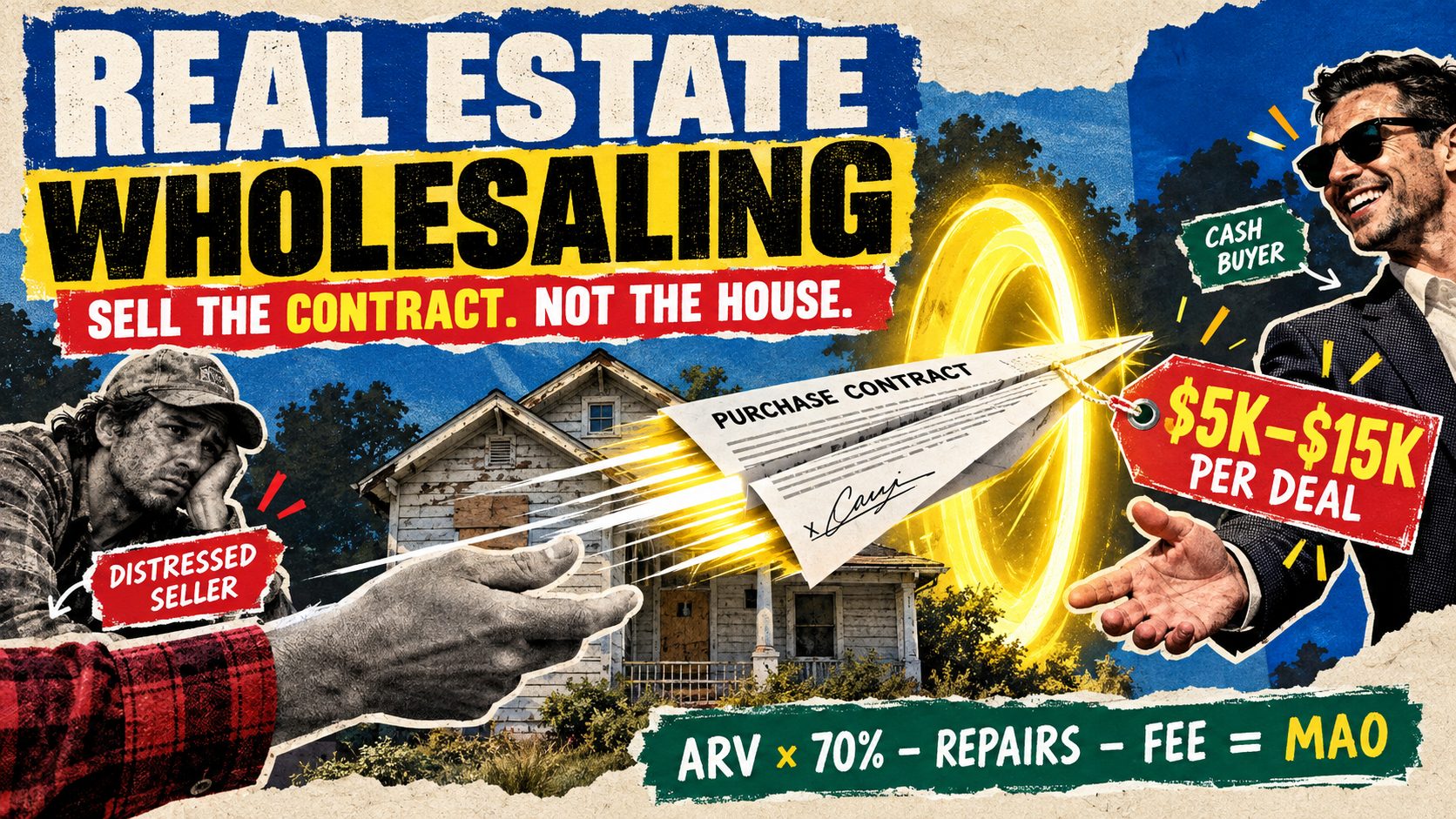
Real estate wholesaling is the art of getting a distressed property under contract and then selling that contract to a cash buyer before you ever close on the property yourself. You’re not buying the house. You’re not fixing it up. You find a seller who needs out fast, lock in a purchase price below market value, and then assign the contract to an investor who’ll do the rehab. Your profit — called the wholesale fee — is the spread between what you put the property under contract for and what your buyer pays.
Typical wholesale fees run $5,000 to $15,000 per deal. On a clean, well-priced assignment in a hot market, some wholesalers pocket $20,000 or more. It’s not passive income — you’re earning that fee through hustle, phone calls, and knowing how to read numbers fast.
Here’s the critical legal point: you’re selling the contract, not the property. You hold an equitable interest in the deal — the right to purchase at a specified price — and you transfer that interest to your buyer. That distinction matters both legally and practically. You never need to own the home, get a mortgage, or go through underwriting. The cash buyer closes directly with the seller (or through a title company in a double close — more on that later).
Compare this to flipping: a flipper buys the property, spends months and serious capital on rehab, then resells. Flippers take on ownership risk, contractor headaches, holding costs, and carrying costs. A wholesaler takes none of that. The tradeoff is that wholesale fees are smaller than flip profits, but the timeline is measured in weeks, not months, and you don’t need $150,000 sitting in a bank account to play.
Wholesaling also differs from buy-and-hold investing. A landlord buys, holds, rents, builds equity over years. That’s a long game with consistent cash flow. Wholesaling is a sprint — find it, contract it, flip the paper, get paid, repeat. Many wholesalers eventually transition into flipping or buy-and-hold once they’ve built capital and relationships.
How Wholesaling Works — Step by Step
The process sounds simple. In practice, it takes skill at each stage. Here’s how every wholesale deal flows from start to payday.
Step 1: Find Motivated Sellers
This is where most new wholesalers either succeed or stall out. You need sellers who have genuine motivation to sell below market — not just people who want a quick close at retail price. Motivated sellers include homeowners facing foreclosure, probate heirs who don’t want to manage a property, landlords burned out on tenants, divorce situations, and people dealing with tax liens or code violations.
Direct mail is the classic approach. You pull a list of pre-foreclosures, absentee owners, or out-of-state landlords from your county records or a list service like PropStream, and you mail them yellow letters or postcards. Response rates are low — 1% to 3% is realistic — but the quality of responses is high because the people calling you have a reason to sell.
Driving for dollars means physically driving neighborhoods looking for distressed properties: tall grass, boarded windows, peeling paint, mail overflowing the box. You log those addresses with an app like DealMachine, skip-trace the owners, and reach out. It’s time-intensive but free and effective in areas where the best deals don’t show up on any list.
Probate leads come from the county courthouse when someone dies and their property goes through the probate process. Heirs often want to settle the estate quickly rather than manage repairs or a tenant. These are some of the most motivated sellers you’ll encounter.
Tax lien auctions can reveal owners who’ve fallen behind on property taxes — a strong sign of financial distress. You can contact these owners before the auction and offer to solve their problem before they lose the property entirely.
Step 2: Analyze the Deal
Before you make any offer, you need three numbers: ARV (After Repair Value), estimated repair costs, and your target wholesale fee. These three numbers drive your Maximum Allowable Offer (MAO). Run the ARV Calculator to set a realistic after-repair value using recent comparable sales — not Zillow, not your gut. Pull comps that sold within 90 days, within a half mile, similar square footage and condition.
Repair estimates are harder. Get a contractor walkthrough if you can. If the property is vacant and accessible, 15 minutes with a contractor you trust gives you a number you can actually use. If you can’t get inside, use a rough cost-per-square-foot estimate based on condition — light cosmetic rehab runs $15 to $25 per square foot, moderate rehab $30 to $50, full gut $60 to $100+.
Then apply the 70% Rule to back-calculate your offer. More on that formula in the next section.
Step 3: Get the Property Under Contract
Once you’ve verified the numbers make sense, you present an offer to the seller and get the property under contract. You’ll use a standard real estate purchase agreement with a few additions: an inspection contingency, an assignment clause (“and/or assigns” on the buyer line), and an exit clause in case you can’t find a buyer. That last piece is non-negotiable — never tie up a property without a way out.
Your earnest money deposit is typically $500 to $2,000 on a wholesale deal. Some wholesalers put up as little as $100 with a motivated seller. The key is speed — get the signed contract in hand so you can start marketing the deal to your buyers list.
Step 4: Find a Cash Buyer
This is where your buyers list pays off. A well-built list of active cash buyers — fix-and-flip investors, landlords, buy-and-hold investors — means you can move a deal in days. You send out the property details: address, ARV, estimated repairs, your asking price, and photos. Serious buyers respond fast. The best wholesalers I know have deals under contract for less than 24 hours before buyers are calling.
If you don’t have a list yet, you’ll need to hustle: post on Craigslist, BiggerPockets, Facebook investor groups, or bring the deal to your local REIA meetup. Don’t let the contract expire while you’re still hunting for a buyer — that’s how you burn bridges with sellers.
Step 5: Assign the Contract (or Double Close)
You’ve got a buyer. Now you transfer your contractual rights to them for your wholesale fee. In an assignment, you sign an assignment agreement, the buyer pays you the fee (often at closing), and they proceed to close with the original seller. In a double close, there are two separate transactions. You briefly purchase the property yourself, then immediately sell it to your buyer. Your fee is the difference in the two prices, and it stays private.
Worked Example: You find a 3-bed/1-bath in Dayton, Ohio. ARV is $160,000 based on three comps in the past 60 days. Repairs are $32,000 for new kitchen, bathroom, flooring, and HVAC. Applying the 70% Rule: $160,000 × 0.70 = $112,000 minus $32,000 repairs = MAO of $80,000. You offer $78,000, seller accepts at $79,000. You market it to your buyers list at $89,000. A local flipper jumps on it. You assign the contract and collect a $10,000 fee at closing. Total time: 3 weeks from first call to payday.
The 70% Rule and MAO in Wholesaling
The 70% Rule is the backbone of wholesaling math. It gives you a ceiling on what you can pay for any deal, accounting for the flipper’s profit margin and rehab costs. The formula is:
MAO = ARV × 0.70 − Repair Costs − Wholesale Fee
Run the MAO Calculator to get this number fast on any deal. Let’s walk through a concrete example.
Say you’re looking at a distressed ranch house. Comparable sales put the ARV at $220,000. Your contractor walks the property and quotes $35,000 in repairs. You want a $10,000 wholesale fee.
MAO = $220,000 × 0.70 − $35,000 − $10,000
MAO = $154,000 − $35,000 − $10,000
MAO = $109,000
That means you can pay no more than $109,000 for this property and still deliver a deal that works for a flipper running the same 70% math. If the seller wants $130,000, the numbers don’t work. Walk away. If you offer $100,000 and they accept at $105,000, you’ve got room for a $4,000 fee instead of $10,000 — your call on whether that’s worth your time.
The 70% Rule Guide on this site goes deep on the formula, including when flippers push it to 75% or even 80% in competitive markets with light rehab. For wholesaling purposes, stick to 70% until you know your buyers’ specific criteria cold. Some buyers in hot markets will pay more; some in slower markets need 65%.
When to bend the rule: In extremely hot markets where ARV is climbing fast and rehab is cosmetic only, some buyers will stretch to 72% to 75%. If you’re selling to an experienced flipper who can do the work themselves and cut labor costs, they may accept tighter spreads. Get to know your buyers’ numbers personally — ask them directly what they need. That conversation is more valuable than any formula.
Also check the MAO Calculator page for a full breakdown of how each variable shifts your maximum offer.
Wholesaling vs Flipping vs Buy-and-Hold
Each strategy has a place. The right one depends on your capital, your time, your skills, and what stage of the investing journey you’re at. Here’s a direct comparison:
| Strategy | Capital Needed | Risk Level | Time to Profit | Skill Level | Typical Return |
|---|---|---|---|---|---|
| Wholesaling | $500–$2,000 (earnest money) | Low | 2–6 weeks | Beginner–Intermediate | $5K–$15K per deal |
| Fix and Flip | $30K–$150K+ | Medium–High | 3–9 months | Intermediate–Advanced | $20K–$80K per deal |
| Buy-and-Hold | 20–25% down + reserves | Low–Medium | Years (cash flow) | Beginner–Advanced | $200–$600/mo cash flow |
Wholesaling makes the most sense when you’re starting out without a big capital base, when you want to learn a market fast, or when you’re generating leads that don’t fit your personal buy criteria. Flipping makes sense when you’ve got capital, a reliable contractor, and the stomach for execution risk. Buy-and-hold is the long-term wealth builder — you want a Cash on Cash Return above 8% to 10% to make the leverage worthwhile.
Here’s the part most people miss: wholesalers and flippers aren’t competitors — they’re partners. A flipper needs a constant pipeline of deals. A wholesaler provides exactly that. The best wholesalers I’ve seen build deep relationships with 3 to 5 serious flippers and feed them deals consistently. Those flippers, in turn, send referrals and move fast when the wholesaler calls. Use the Fix and Flip Calculator to understand what your flipper buyers need to see on the numbers before they’ll pull the trigger.
Read the full Flipping Guide to understand the flipper’s perspective — it’ll make you a better wholesaler because you’ll know exactly how your buyers think about deals.
How to Find Wholesale Deals
Finding deals is the job. Everything else is execution. Here are the main channels, with honest assessments of each.
Driving for Dollars is the most underrated method. You spend two hours a week driving specific zip codes and photographing distressed properties. Free apps like DealMachine let you tap on a property, instantly see ownership information, and add it to a mail campaign. You’re building a hyper-local list that nobody else has because they’re not willing to do the legwork. The deals are often unlisted, off-market, and price-flexible.
Direct Mail Campaigns work at scale. The formula is simple: buy a list (PropStream, ListSource, or USPS Every Door Direct Mail), design a simple postcard or yellow letter, mail consistently over 3 to 6 months, and answer every call. Don’t expect immediate results — most sellers call back on the 4th or 5th contact. Consistency matters more than creativity.
Probate Leads require some courthouse legwork but the quality is exceptional. When someone dies intestate or with a small estate, the heirs often want to liquidate quickly and split the proceeds. Pull probate filings from your county’s probate court, skip-trace the personal representative (executor), and call them. Be respectful and direct. These sellers aren’t in distress emotionally — they’re just problem-solving.
Pre-Foreclosure Lists are public record. When a lender files a Notice of Default (NOD) or Lis Pendens, it’s recorded at the county. That homeowner has 60 to 180 days to cure the default before a foreclosure sale. During that window, they’re highly motivated. The challenge is competition — everyone else is mailing these people too. Phone calls outperform letters in this category.
Tax Lien Auctions tell you who’s behind on taxes. Call them before the auction. They may have equity and just need someone to take the problem off their hands.
MLS can work, but rarely. You’re looking for expired listings, properties with price reductions, days-on-market over 90, or estate sales. You won’t get deep discounts on listed properties often, but it happens — especially with inherited properties where the heirs are out of state and just want it gone.
REI Meetups and Networking are where relationships get built. Go to your local REIA (Real Estate Investors Association) monthly meeting. Bring cards, listen more than you talk, and let people know you’re a wholesaler with deals. Within three to four meetings you’ll have a buyers list and probably a referral or two for motivated sellers.
Bandit Signs — “We Buy Houses” signs posted near intersections — still generate calls in many markets. Check local ordinances first. Some cities fine you for them. But a $20 sign that generates 10 calls per month is one of the highest-ROI marketing tools in wholesaling when it’s legal.
For screening which deals are actually worth pursuing, the Screening Deals Guide gives a useful filter framework even if you’re not buying to hold.
How to Build a Cash Buyers List
Your buyers list is worth more than any deal you’ll ever find. A deal without a buyer is just a contract with an expiration date. A buyers list means deals move in hours. Here’s how to build one from scratch.
County Records are your first stop. Pull a list of all cash transactions (no mortgage recorded) in the past 6 to 12 months in your target zip codes. Anyone who’s bought a property with cash in that timeframe is a cash buyer. Call them. Most will talk to you if you explain you’re a wholesaler with deal flow in the area. Your local title company can pull this data or point you to the right source.
Title Companies are actually an underused resource. Introduce yourself to the escrow officers at title companies that handle investor transactions. They see who’s closing cash deals, and they can often make introductions. They also want your business as a wholesaler — every deal you send their way is a commission. That alignment works in your favor.
Facebook Groups and REI Meetups are where you find active investors quickly. Search Facebook for “real estate investors [your city]” and join 5 to 10 active groups. Post once a week that you’re a wholesaler with off-market properties and ask buyers to DM you with their criteria. Attend your local REIA monthly. Bring a simple one-page with your name, number, and what types of deals you bring.
Craigslist and Marketplace still work. Search “I buy houses” or “cash buyer” in your area. These people are already raising their hand. Reach out, introduce yourself, and add them to your list.
BiggerPockets Forums have thousands of active investors who are explicit about their investment criteria. Use the search function to find investors in your market, reach out through the platform, and add qualified buyers to your list.
Once you’ve got names, document their criteria: property type, zip codes, ARV range, max repair tolerance, price point, and how fast they close. The more specific you are, the more targeted your outreach when you have a deal. A well-curated list of 20 serious buyers beats a spray-and-pray list of 200 tire-kickers every time.
Assignment vs Double Close
When it comes time to monetize your contract, you have two options: assignment or double close. Each has legitimate uses, and knowing when to use which one keeps deals from falling apart.
Assignment of Contract is the simpler method. You sign an assignment agreement with your buyer, transferring your rights in the purchase contract to them in exchange for your fee. There’s one closing — the buyer closes with the original seller. Your wholesale fee shows up on the closing disclosure, visible to both parties. The buyer typically pays your fee either at signing of the assignment agreement or at the closing table.
Costs for an assignment are minimal: a basic assignment agreement (often just a one-page form), and title fees handled by the title company at the single closing. Some title companies charge a small assignment fee — $100 to $500 is typical.
The downside: your fee is disclosed. If the seller sees you’re making $15,000 on a deal where they’re selling for $85,000, some get cold feet. That’s human nature. It doesn’t invalidate the deal — you provided a real service — but it can create friction with certain sellers.
Double Close (Simultaneous Close) involves two separate transactions. First, you close the purchase from the seller (A-to-B transaction). Then, you close the sale to your buyer (B-to-C transaction). Your fee is the spread between the two prices, and it stays private because each closing statement only shows the respective transaction.
Double closes are more expensive: you’re paying title and closing costs twice, which can run $1,500 to $3,000 extra. You also need to fund the A-to-B transaction, even briefly. Some title companies will handle both closes back-to-back on the same day using the buyer’s funds for the first close through a process called “dry funding.” Others require you to bring your own transactional funding — short-term loans at 1% to 2% of the loan amount per day.
Use assignment when: your fee is modest, the seller is comfortable, and you want to keep it simple. Most wholesale deals close via assignment.
Use double close when: your fee is large (above $20,000 or so), when the seller is potentially squeamish about the spread, or when state law in your market creates complications with assignment disclosure. Also use it when your buyer doesn’t want an assignment — some lenders won’t lend to a buyer on an assigned contract.
Wholesaling Laws by State
Wholesaling exists in a legal gray area in some states. The core question regulators keep asking is: does marketing a property you have under contract constitute “brokering real estate” — which requires a license? The answer depends on your state and how you structure your activity.
Most states allow wholesaling without a license as long as you’re selling your equitable interest in a contract, not acting as a broker representing the seller or buyer. The National Association of Realtors has pushed for tighter regulations, and several states have responded.
States with notable restrictions or disclosure requirements:
- Illinois — Passed legislation in 2023 requiring wholesalers to disclose their role in the transaction and that they are not a licensed agent. Failure to disclose can void the contract.
- Oklahoma — Has moved toward requiring wholesalers to hold a real estate license or use a licensed broker to market properties.
- Virginia — Requires disclosure language in wholesale contracts and places restrictions on how wholesale deals are marketed to the public.
- Arizona, Georgia, Texas — Currently more permissive; wholesale activity without a license is generally accepted as long as you’re not acting as a broker.
- California — Complex; consult a real estate attorney before wholesaling here.
Laws change. What was acceptable practice in 2022 may carry fines or license requirements in 2026. The practical solution: talk to a local real estate attorney before you close your first deal. A one-hour consultation costs $200 to $400. That’s cheap insurance against a $10,000 fine or a voided contract.
You should also understand your entity structure. Operating through an LLC provides liability protection and can simplify your tax treatment. The LLC Guide covers entity setup for real estate investors in detail. The IRS may treat your wholesale fees as self-employment income — you’ll want to understand that before tax season. The IRS Form 1099-S guidance explains how real estate proceeds get reported.
For consumer protection angle, the Consumer Financial Protection Bureau publishes resources relevant to distressed homeowners — understanding their perspective helps you operate ethically and legally.
5 Mistakes New Wholesalers Make
Most wholesalers who fail in the first six months make the same handful of errors. Here they are, bluntly.
1. Overestimating ARV
This is the fastest way to poison your relationship with buyers. If your ARV is inflated — based on Zillow’s Zestimate or optimistic “potential” value rather than actual closed comps — your buyers will run their own numbers, find the real ARV, and either pass or counter your price. Do it twice and you stop getting calls. Use the ARV Calculator with real MLS data. Stick to sold comps within 90 days, within half a mile, and similar square footage. Read the ARV Guide for a full walkthrough on pulling accurate comps.
2. Underestimating Repair Costs
New wholesalers consistently lowball repair numbers because they don’t want to kill a deal. But inflated repair estimates given to buyers destroy trust faster than anything. Get a real contractor walkthrough. If you can’t get inside the property, get a contractor to estimate from photos and exterior. Alternatively, add a 15% contingency to whatever you estimate on your own. Buyers know the numbers. If your repair estimate is $20,000 and the real number is $45,000, that deal is dead — and so is your credibility.
3. No Escape Clause in the Contract
Every wholesale purchase contract needs an inspection contingency or an explicit right to assign. Without it, you’re legally obligated to close the purchase yourself or face default. That’s a bad spot. Make sure your contract includes language like: “Subject to buyer’s inspection within 10 days” or “Buyer reserves the right to assign this contract.” Work with a real estate attorney in your state to draft a contract template you can use repeatedly.
4. Marketing to Non-Motivated Sellers
Wholesaling works because you buy at a discount. Sellers who aren’t motivated don’t give discounts. Stop wasting time on people who just want retail value but prefer a cash buyer. Qualify every lead fast: “Why are you selling? What’s your timeline? Would you consider a cash offer below market value in exchange for a quick close?” If the answer to that last question is no, move on. The deal math will never work.
5. Not Building a Buyers List Before Finding Deals
This is the biggest operational mistake. You find a great deal, get it under contract, and then spend three weeks scrambling for a buyer while the contract clock ticks. That’s backwards. Build your buyers list first — spend the first two to four weeks of your wholesaling career doing nothing but networking with investors and collecting criteria. Once you have 10 to 15 serious cash buyers who trust you, go find deals. You’ll move them in days, not weeks.
Worked Example — A Complete Wholesale Deal
Let’s walk through a real scenario from start to finish. Everything here uses conservative, realistic numbers for a midwestern market.
The Property: Single-family residence in Columbus, Ohio. 3 bed / 1.5 bath, 1,450 sq ft. Built 1962. Roof is 18 years old, kitchen and baths are original, carpet throughout is destroyed, HVAC is old but functional. Owner inherited from deceased parent, lives in Arizona, wants to settle the estate.
Step 1 — Pull Comps and Set ARV:
Three comparable sales in the last 60 days, within 0.4 miles, all 3-bed/1-2 bath, fully renovated: $176,000, $182,000, $184,000. Average ARV: $180,000. This gets confirmed using the ARV Calculator.
Step 2 — Estimate Repairs:
Contractor walkthrough yields: new roof ($8,500), full kitchen remodel ($14,000), bathroom update ($6,000), flooring throughout ($7,500), fresh paint inside/out ($4,000), total: $40,000. Add 10% contingency: $44,000 is the safe number. We’ll use $40,000 for MAO calculation and present $44,000 to buyers.
Step 3 — Run the MAO:
MAO = ARV × 0.70 − Repairs − Wholesale Fee
MAO = $180,000 × 0.70 − $40,000 − $10,000
MAO = $126,000 − $40,000 − $10,000
MAO = $76,000
Check the math with the 70% Rule Guide. The flipper who pays $85,000 (our contract price + wholesale fee) will have: $85,000 purchase + $40,000 rehab = $125,000 all-in. At $180,000 ARV and 8% selling costs, net profit lands around $24,000 — solid for a 5-month flip.
Step 4 — Negotiate and Contract:
You call the Arizona heir and explain you buy properties as-is, cash, fast close, no realtor commissions, no repairs. You offer $80,000 — slightly above MAO to have a negotiating buffer. She counters at $90,000. You come up to $85,000 and she accepts. You get the signed purchase agreement with a 30-day inspection contingency. Earnest money: $1,000.
Step 5 — Market to Buyers:
Within 2 hours of signing the contract, you email your buyers list:
Off-market SFR Columbus, OH. ARV $180K. Repairs $40-44K. Asking $95,000. 3/1.5 ba, 1,450 sqft. Inherited estate, motivated heir, 21 days to close. Photos attached. Call me.
Three buyers respond same day. Two pass after running their numbers. One — a local flipper who’s bought three deals from you in the past year — says yes at $95,000.
Step 6 — Assignment and Closing:
You sign a one-page assignment agreement. The flipper pays $1,000 of your fee upfront as non-refundable assignment consideration. The remaining $9,000 comes at closing. The title company handles the rest.
| Deal Summary | Amount |
|---|---|
| Property ARV | $180,000 |
| Seller Contract Price | $85,000 |
| Buyer Assignment Price | $95,000 |
| Estimated Repairs (to buyer) | $40,000–$44,000 |
| Wholesale Fee Earned | $10,000 |
| Earnest Money (returned at close) | $1,000 |
| Out-of-Pocket Expenses (marketing, gas, etc.) | ~$300 |
| Net Profit to Wholesaler | ~$9,700 |
| Timeline (Found → Closed) | 28 days |
That’s the whole deal. Twenty-eight days, $9,700 net, no rehab, no mortgage, no ownership. Use the Deal Analysis Guide to see how your buyer evaluates the hold side if they decide to rent instead of flip.
FAQ
Do I need money to start wholesaling?
Not much. Most wholesalers start with $500 to $2,000 for earnest money deposits, some marketing budget (direct mail, driving for dollars apps), and a few hundred dollars for a real estate attorney consultation and a contract template. You don’t need to buy properties, get financing, or put significant capital at risk. That said, zero-money-down wholesaling is largely a myth promoted by gurus. You’ll need a little cash for earnest money, and having a few thousand in reserve for marketing and professional costs makes the early days far less stressful.
Is wholesaling legal?
Yes, in most states, when structured correctly. You’re selling your equitable interest in a purchase contract — not brokering real estate on behalf of another party. The key is transparency: your contract should include an assignment clause, you shouldn’t misrepresent yourself as a licensed agent, and you should disclose your role when required by state law. States like Illinois, Oklahoma, and Virginia have added disclosure requirements since 2022. Check with a local real estate attorney before your first deal. The cost of that consultation is far less than the cost of a voided contract or a regulatory fine.
How long does a wholesale deal take?
From first contact with a motivated seller to payday, most wholesale deals close in 2 to 6 weeks. The fastest deals — where you have a strong buyers list and a clear property — can move in 10 to 14 days. Complex situations (estate sales, title issues, slow sellers) can stretch to 60 to 90 days. Your contract’s inspection and closing deadline controls your timeline, so set it realistically: 21 to 30 days gives you enough runway without pressuring the seller.
Can I wholesale properties in any state?
You can wholesale in most states without a license, but the rules vary. Some states require disclosures. A few have moved toward licensing requirements. You don’t have to be a resident of the state where the property is located — remote wholesaling across state lines is common. What matters is complying with that state’s specific laws. If you’re scaling up and operating in multiple states, building relationships with real estate attorneys in each market is worth the investment.
What’s the average wholesale fee?
Most wholesale fees fall between $5,000 and $15,000 per deal. Deals in higher-priced coastal markets can yield $20,000 to $30,000. Deals in lower-priced midwestern or southeastern markets might net $4,000 to $8,000. The fee is driven by how much room is in the deal — the spread between what the seller accepts and what a buyer will pay. Newer wholesalers often leave money on the table by under-pricing deals. Once you know your buyers’ criteria deeply, you can price assignments more confidently and maximize what you earn on each transaction.
Related Calculators
Every wholesale deal starts and ends with numbers. These calculators do the heavy lifting:
- ARV Calculator — Set your after-repair value from comps before making any offer
- 70% Rule Calculator — Quick sanity check on any deal in seconds
- Maximum Allowable Offer Calculator — Precise MAO including your wholesale fee
- Fix and Flip Calculator — Understand your buyer’s numbers so you price deals they’ll actually buy
- Cash on Cash Return Calculator — For buyers who might hold as rentals instead of flipping
Leave a Reply