
Published: September 29, 2026 · By Alex Petrov
Michigan closing costs for investment property typically run 2.5–4% of the purchase price for buyers and 7–9% for sellers (including agent commission). The state transfer tax alone is $9.70 per $1,000 — higher than Ohio, Indiana, or Texas — and Detroit adds another $7.50 per $1,000 on top of that. Run the numbers before you make an offer with the Michigan closing costs calculator.
Michigan Closing Costs Overview
Michigan is a title state, not an attorney state — meaning a title company handles the closing, though most experienced investors hire a real estate attorney anyway. The state has no standard who-pays-what rule for transfer tax; it’s negotiable, but custom has the seller paying it. On investment property specifically, that matters because you’re not getting a Principal Residence Exemption (PRE), so property tax prorations at closing reflect the full non-homestead millage rate.
Here’s the 30-second summary before we go line by line:
| Cost Category | Buyer | Seller | Notes |
|---|---|---|---|
| Transfer Tax | Negotiable | $9.70 per $1,000 | Detroit adds $7.50 per $1,000 |
| Title Insurance | $400–$800 (lender) | $1,000–$2,500 (owner’s) | Varies by price |
| Agent Commission | — | 5–6% of sale price | Seller typically pays both agents |
| Loan Origination | 1–2% of loan | — | Investment loans often 1.5% |
| Recording Fees | $30–$60 | $30–$60 | Per document |
| Attorney | $500–$1,000 | $500–$750 | Recommended, not required |
| Total Typical Range | 2.5–4% | 7–9% | Excl. Detroit premium |
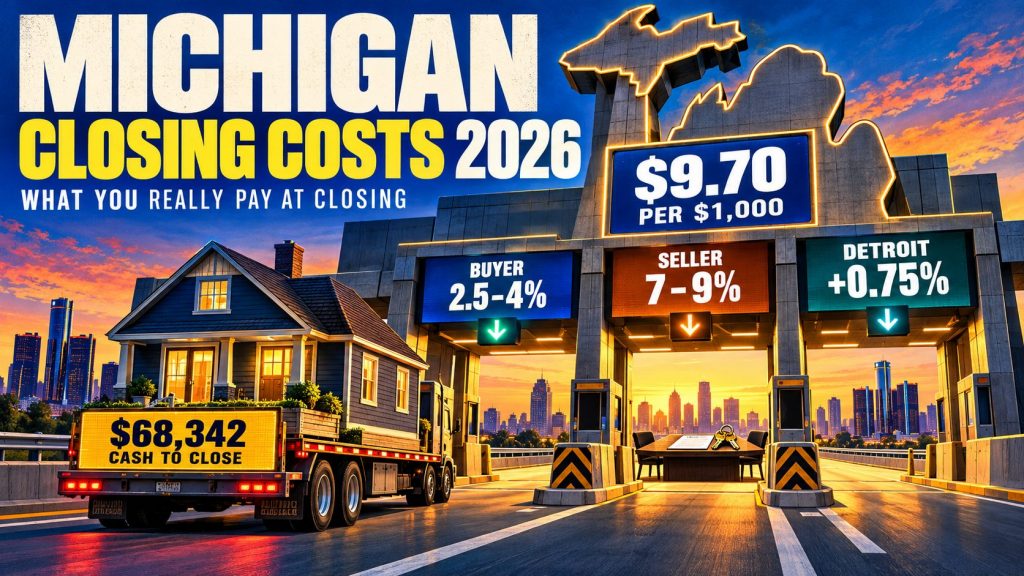
Michigan’s transfer tax at 0.97% combined (state + county) ranks among the highest in the Midwest. Compare that to Indiana at 0.2% or Ohio at 0.1% base. For a $300,000 duplex, that’s $2,910 in transfer tax versus $600 in Indiana. If you’re doing volume, that difference adds up fast. Check your deal margins with the Michigan rental property calculator.
Buyer Closing Costs — Full Breakdown
Investment property purchases in Michigan almost always require 20–25% down, which means a larger loan base and higher dollar amounts on percentage-based fees. Here’s every line item you’ll see on a Loan Estimate or closing disclosure (see CFPB closing disclosure guide):
| Line Item | Typical Range | Notes |
|---|---|---|
| Loan Origination Fee | 1–2% of loan amount | Investment loans skew toward 1.5%; shop lenders |
| Appraisal | $400–$600 | Multifamily appraisals run higher ($600–$900) |
| Home Inspection | $300–$500 | Add $150–$200 for sewer scope, radon |
| Title Search | $200–$400 | Abstractor fee; included in some title packages |
| Lender’s Title Insurance | $400–$800 | Required by lender; protects only the lender |
| Owner’s Title Insurance | $1,000–$2,500 | Optional but strongly recommended for investment property |
| Recording Fees | $30–$60 | County register of deeds; per document |
| Transfer Tax (buyer share) | Varies / negotiated | Custom is seller pays; buyers can negotiate concession |
| Property Tax Proration | Varies by timing | Michigan calendar year; buyer credits or debits depending on closing date |
| HOA Proration / Transfer Fee | $0–$500 | If applicable; some HOAs charge separate transfer fees |
| Escrow Setup / Attorney Fee | $500–$1,000 | Title company or attorney settlement fee |
| Survey | $300–$500 | Not always required; needed for rural or unclear boundary properties |
| Flood Certification | $15–$25 | Lender requirement; one-time fee |
| Credit Report | $25–$75 | Lender pulls your report; shows on Loan Estimate |
| Prepaid Interest | Varies | Per diem interest from closing date to end of month |
| Insurance Prepaid | $800–$1,800 | First year landlord policy due at closing |
| Escrow Reserves | 2–4 months | Tax + insurance cushion for lender escrow account |
The two wildcards on this list are property tax proration and escrow reserves. Michigan runs on a calendar year for taxes, and investment properties don’t get the PRE exemption. Non-homestead millage rates run 18–45 mills depending on the city — Detroit is around 67 mills total. That means your escrow reserves and proration amounts are materially higher than what a homeowner buying in the same market would see. Use the Michigan cap rate calculator to model how taxes affect your net operating income before you close.
Seller Closing Costs — Full Breakdown
Sellers take the bigger hit at the closing table in Michigan, primarily because of agent commissions plus the transfer tax. If you’re selling a Detroit property, add the city transfer tax on top and you can easily lose 10–11% of your gross sale price to closing costs.
| Line Item | Typical Amount | Notes |
|---|---|---|
| Agent Commission | 5–6% of sale price | Includes listing agent + buyer’s agent split |
| State Transfer Tax | $8.60 per $1,000 | MCL 207.505; seller pays by custom |
| County Transfer Tax | $1.10 per $1,000 | All Michigan counties; total with state = $9.70/$1,000 |
| Detroit City Transfer Tax | $7.50 per $1,000 | Detroit only; separate from state/county |
| Owner’s Title Insurance | $1,000–$2,500 | Seller pays in some Michigan markets; negotiable |
| Recording Fees | $30–$60 | Discharge of mortgage, deed recording |
| Attorney Fee | $500–$750 | Closing/settlement fee if seller uses counsel |
| Property Tax Proration | Varies | Seller owes taxes accrued through closing date |
| Outstanding Liens / Violations | Varies | Michigan cities actively issue blight violations; clear before closing |
| HOA Balance | Varies | Any unpaid dues must be paid at closing |
| Concessions (if negotiated) | Up to 6% | Seller may credit buyer for repairs or closing costs |
One thing that trips up Detroit sellers specifically: city blight violations and water bill balances. Detroit has a lien on unpaid water bills — these have to be satisfied at or before closing or the title company won’t insure the transaction. If you’re selling a rental that’s been occupied, pull a water bill balance and any blight violation history before you list. Factor those payoffs into your net sheet. The Michigan closing costs calculator can help you build a realistic seller net sheet from current market data.
Michigan Transfer Tax Explained
Michigan’s transfer tax is set by two statutes operating simultaneously. The state portion (MCL 207.505) is $8.60 per $1,000 of sale price. Every county collects an additional $1.10 per $1,000 under MCL 207.525. These stack to $9.70 per $1,000 combined, or 0.97% of the purchase price.
Detroit adds a separate city real estate transfer tax at $7.50 per $1,000 (0.75%), bringing the total to $17.20 per $1,000 (1.72%)** in Detroit.
Here’s what that looks like on real numbers:
| Sale Price | State/County Tax (0.97%) | Detroit City Tax (0.75%) | Total — Detroit | Total — Non-Detroit |
|---|---|---|---|---|
| $100,000 | $970 | $750 | $1,720 | $970 |
| $150,000 | $1,455 | $1,125 | $2,580 | $1,455 |
| $200,000 | $1,940 | $1,500 | $3,440 | $1,940 |
| $300,000 | $2,910 | $2,250 | $5,160 | $2,910 |
| $500,000 | $4,850 | $3,750 | $8,600 | $4,850 |
Who pays? By custom in Michigan, the seller pays the full state and county transfer tax. Detroit’s city transfer tax is also typically paid by the seller. That said, everything is negotiable on investment property — especially in a buyer’s market or distressed sale. If you’re buying an REO or short sale, you may get the seller (bank or servicer) to absorb the transfer tax as a term of the deal.
Exemptions: Michigan law exempts certain transfers from the state transfer tax, including transfers between family members (parent-child, siblings), transfers to or from a trust where the grantor is a beneficiary, foreclosure deeds, and deeds in lieu of foreclosure. The county transfer tax has separate (but similar) exemption provisions under MCL 207.526. Check both statutes — MCL 207.505 for state and MCL 207.526 for county — before assuming any exemption applies. Your title company will calculate both.
For the official state guidance on transfer tax rates and forms, see the Michigan Department of Treasury — Real Estate Transfer Tax page.
Worked Example: Buying a $235K Grand Rapids Duplex
Grand Rapids is one of Michigan’s strongest rental markets — low vacancy, stable rent growth, strong employer base. Here’s what closing looks like on a real deal.
Deal parameters: $235,000 purchase price, 25% down ($58,750), loan amount $176,250, rate 7.25%, Kent County.
| Line Item | Amount | How It’s Calculated |
|---|---|---|
| Loan Origination (1%) | $1,762 | $176,250 × 1% |
| Appraisal | $500 | Duplex standard; could reach $600 |
| Home Inspection | $425 | 2-unit building |
| Title Search | $300 | Kent County abstractor |
| Lender’s Title Insurance | $600 | $176,250 loan; varies by title company |
| Owner’s Title Insurance | $1,800 | $235,000 price; recommended for investment |
| Recording Fees | $60 | Deed + mortgage, 2 documents |
| Property Tax Proration | $1,175 | Half-year at 1.2% non-homestead rate on $235K; paid to seller for taxes accrued |
| Insurance Prepaid (1 year) | $1,400 | Landlord policy; first year due at closing |
| Escrow Reserves | $800 | 2 months tax + insurance buffer |
| Attorney / Settlement Fee | $750 | Real estate attorney review |
| Flood Certification | $20 | Standard lender requirement |
| Total Buyer Closing Costs | $9,592 | 4.1% of $235,000 purchase price |
Total cash needed at closing: $68,342 ($58,750 down + $9,592 closing costs). That’s before any repair reserves you’d want to keep liquid post-close.
The property tax proration is the item that surprises first-time Michigan investment buyers most. Because the duplex has no PRE, the millage rate is higher than what a homeowner would pay. The $1,175 figure assumes a mid-year close — if you close in October, the proration could be $2,100+. Time your closing accordingly, or at least model both scenarios in your Michigan rental property calculator.
To model DSCR and loan qualification on this deal, see the Michigan DSCR calculator. At $176,250 / 7.25%, your monthly PI payment is approximately $1,203. To qualify at a 1.25 DSCR, you need $1,504 in monthly gross rents — easily cleared on a Grand Rapids duplex at current market rents of $900–$1,100 per unit.
Worked Example: Selling a $185K Detroit SFR
Detroit is a different beast. The combination of city transfer tax, higher millage rates, and the need to clear any outstanding water bills or blight violations makes Detroit seller closing costs routinely hit 10%+.
Deal parameters: $185,000 sale price, Wayne County, seller is an investor (not owner-occupant).
| Line Item | Amount | How It’s Calculated |
|---|---|---|
| Agent Commission (6%) | $11,100 | $185,000 × 6% |
| State Transfer Tax (0.86%) | $1,591 | $185,000 × $8.60/$1,000 |
| County Transfer Tax (0.11%) | $204 | $185,000 × $1.10/$1,000 |
| Detroit City Transfer Tax (0.75%) | $1,388 | $185,000 × $7.50/$1,000 |
| Owner’s Title Insurance | $1,200 | Seller pays in this transaction |
| Recording Fees | $45 | Deed recordation, Wayne County |
| Attorney Fee | $600 | Closing counsel |
| Property Tax Proration | $2,590 | Half-year at ~2.8% effective rate (Detroit millage); owed to buyer for unpaid future taxes |
| Total Seller Closing Costs | $18,718 | 10.1% of $185,000 sale price |
Net to seller: $166,282 ($185,000 − $18,718). If you bought this property for $140,000 and put in $20,000 of work, your effective net profit is $6,282 on a $160,000 total investment — a 3.9% return before accounting for holding costs and rent collected. That math is why running closing costs before you model exit is non-negotiable. Use the investment property closing costs guide to build this into your deal analysis workflow.
Detroit’s property tax proration is particularly heavy because effective tax rates on non-homestead Detroit properties can run 2.5–3.5% of assessed value annually, and Michigan assesses at 50% of true cash value. On a $185,000 property with a State Equalized Value of $92,500, that’s roughly $5,000–$6,500 per year in property taxes. Half-year proration: $2,500–$3,250. The $2,590 used above is conservative.
How to Reduce Michigan Closing Costs
You can’t negotiate away the transfer tax rate, but you can control several other variables:
1. Shop title insurance. Title insurance rates in Michigan are filed with the state but individual companies can and do price differently. Get quotes from at least two title companies before you go under contract. Prices on a $235,000 policy can vary $400–$700 between companies. That’s real money. Over 10 deals, you’ve saved $5,000–$7,000 just from picking up the phone twice per transaction.
2. Negotiate seller concessions. On conventional investment loans, sellers can contribute up to 2% of the purchase price toward buyer closing costs when the buyer puts 25%+ down. That’s $5,875 on a $235,000 deal — enough to cover origination, appraisal, inspection, and title search. In a soft market or on a distressed listing, this is easy to get. Seller concessions directly reduce your cash-at-close without touching the purchase price (though they do appear on the HUD). More on negotiating closing costs on investment property here.
3. Skip the owner’s title insurance — but know the risk. Owner’s title insurance on a $235,000 property costs $1,800. You can decline it. The lender won’t care since their policy is separate. But if there’s a defect in the chain of title — an old judgment lien, a forged deed in the property’s history, a missing probate — you’re personally on the hook with no insurance backstop. For investment property bought out of probate, foreclosure, or estate sales in Michigan, this is a real risk, not a theoretical one. Factor the risk profile of the specific property before skipping coverage.
4. Use a flat-fee attorney rather than hourly. Several Michigan real estate attorneys offer flat-fee closing review services for $350–$500 instead of the full-service $750–$1,000 range. You still get document review and counsel on title issues, but you’re not paying for the settlement coordination that the title company already handles. Ask specifically for a “limited scope” engagement if you go this route.
5. Close at end of month. Prepaid interest is charged from your closing date through the last day of that month. Close on the 28th instead of the 3rd and you owe 3 days of interest instead of 28 days. On a $176,250 loan at 7.25%, that’s the difference between $99 and $921 in prepaid interest at closing. It’s not the biggest line item, but it costs nothing to time the close.
6. Ask the seller to pay transfer tax. Transfer tax is technically negotiable in Michigan. In a buyer’s market — or on a motivated seller situation — you can structure the offer with the seller absorbing transfer tax even on deals where you’re the buyer. This is more common on distressed sales and off-market deals than on MLS listings. For BRRRR deals and wholesaler assignments, it’s worth asking.
For more strategies on controlling acquisition costs, see the rental property tax deductions guide — some closing costs are immediately deductible and others get added to basis.
Michigan vs Other States: Closing Cost Comparison
How does Michigan stack up against neighboring states that investors commonly compare?
| State | Transfer Tax Rate | Buyer Costs (Typical) | Seller Costs (Typical, no agent) | Attorney Required |
|---|---|---|---|---|
| Michigan | 0.97% (state + county); +0.75% Detroit | 2.5–4% | 2–3% | No (recommended) |
| Ohio | 0.1–0.4% + city tax (Cleveland up to 1.48%) | 2–3.5% | 0.5–1.5% | No |
| Indiana | 0.2% | 2–3% | 0.5–1% | No |
| Florida | 0.7% (doc stamps) | 2.5–5% | 1–2% | No |
| Texas | None | 2–3.5% | 0–0.5% | No |
Michigan’s transfer tax is the highest among these five states when you look at the statewide rate — and Detroit makes it materially worse. Texas has no transfer tax at all, which is one reason Texas seller net sheets look so clean. Indiana’s 0.2% rate means a $200,000 sale costs $400 in transfer tax versus Michigan’s $1,940.
That said, Michigan’s title insurance costs and attorney fees are not out of line with neighboring states. The title insurance pricing is set by a rate schedule filed with the state — it’s not a free market like Texas. So the opportunities to save are narrower on that line item than in some other states.
If you’re comparing deals across state lines, the best states for rental property analysis covers net-of-closing-cost returns by market.
BRRRR Double Close — Extra Costs in Michigan
The BRRRR strategy (Buy, Rehab, Rent, Refinance, Repeat) means two closings on the same property within 12–18 months. Every Michigan investor running BRRRR needs to budget both sets of closing costs explicitly — not just the acquisition closing. The refinance is a closing too.
Acquisition closing (first close): Full buyer closing costs as described above — origination, title insurance, appraisal, inspection, recording. On a $200,000 acquisition with 25% down, budget $7,000–$9,000 in closing costs.
Refinance closing (second close): You’re pulling equity out via a cash-out refi. This triggers a new set of costs:
| Refinance Cost Item | Typical Range | Notes |
|---|---|---|
| Loan Origination | 0.5–1% of new loan | Refi loans usually cheaper than purchase; shop aggressively |
| Appraisal | $400–$600 | Required to establish ARV; this is the number everything depends on |
| Lender’s Title Insurance | $400–$800 | New policy required for new loan; can’t use the old one |
| Recording Fees | $30–$60 | New mortgage recorded |
| Title Search / Update | $100–$250 | Date-down search to verify no new liens since acquisition |
| Settlement Fee | $300–$600 | Title company or attorney closing fee |
| Total Refinance Closing | $2,500–$4,000 | On a $150K–$200K refi loan |
Total BRRRR two-close cost on a $200,000 acquisition: $9,500–$13,000. That’s money that has to come back out in the refinance, or it cuts into your recapture. If you’re targeting 70–75% LTV on the refi and the numbers only work at exactly 75%, the closing cost drag can push you underwater on the recapture.
Model this before you buy. The Michigan BRRRR calculator accounts for two-close costs explicitly — you input purchase closing costs and refi closing costs separately. If you’re new to BRRRR, the BRRRR strategy guide walks through how to build the full holding cost and closing cost stack into your ARV analysis. Separately, compare BRRRR vs. fix and flip using the full deal comparison tools when evaluating your exit.
One more Michigan-specific BRRRR note: the seasoning requirement. Most conventional lenders want 6–12 months of seasoning after acquisition before they’ll do a cash-out refi. Some DSCR lenders waive seasoning. Confirm your refi path before you close the acquisition. A 12-month hold adds carrying costs (taxes, insurance, utilities) that belong in your BRRRR stack right alongside the double closing costs. Run full BRRRR numbers in the Michigan rental property calculator with a realistic hold period.
Michigan Closing Costs FAQ
How much are closing costs in Michigan?
Buyers pay 2.5–4% of the purchase price in closing costs on Michigan investment property. That’s $5,875–$9,400 on a $235,000 purchase. Sellers pay 7–9% including agent commission, or roughly 1.5–3% excluding commissions. Detroit properties run higher due to the additional 0.75% city transfer tax. Use the Michigan closing costs calculator for a property-specific estimate.
Who pays transfer tax in Michigan?
By custom, the seller pays the Michigan transfer tax — both the state portion ($8.60 per $1,000) and the county portion ($1.10 per $1,000). Detroit’s additional $7.50 per $1,000 city transfer tax is also typically paid by the seller. None of this is mandated by law; it’s all negotiable. On investment property sales, motivated sellers, REOs, and off-market deals sometimes agree to buyer-favorable splits. See the Michigan Department of Treasury transfer tax page for official rate information.
Are closing costs higher in Detroit?
Yes, significantly. Detroit adds a city transfer tax of $7.50 per $1,000 (0.75%) on top of the standard Michigan state/county rate of $9.70 per $1,000. On a $185,000 sale, that’s an extra $1,388 in transfer tax alone. Detroit also has higher effective property tax rates (the non-homestead millage runs around 67 mills total), which means larger property tax prorations at closing. Factor in potential water bill payoffs and blight violation clearances and Detroit seller closing costs routinely hit 10%+ of sale price.
Can I roll closing costs into my loan in Michigan?
Not on a purchase loan — you can’t add closing costs to the loan amount above the appraised value. What you can do is negotiate seller concessions (up to 2% of purchase price on conventional investment loans with 25%+ down) and use those to cover closing costs at the table. On a refinance, lenders sometimes allow “no-closing-cost” structures where closing costs are rolled into the rate — you pay a higher rate but bring less cash to close. This is worth modeling in the Michigan DSCR calculator to see the net cash flow impact of a higher rate vs. the upfront cash outlay.
How do Michigan closing costs compare to Ohio?
Michigan’s transfer tax at 0.97% is substantially higher than Ohio’s base rate of 0.1–0.4%. However, Ohio’s city transfer taxes can be brutal — Cleveland charges up to 1.48% city transfer tax, making it more expensive than standard Michigan markets. Outside of Cleveland, Ohio sellers generally pay less at closing than Michigan sellers. Both states are non-attorney closing states, so settlement fees are similar. Indiana is cheaper than both, with a 0.2% transfer tax and no major city surcharges. For a full head-to-head, see the state comparison table above.
Related Michigan Investment Property Calculators
Closing costs are one piece of the investment analysis. Here are the tools to run the full deal:
- Michigan Closing Costs Calculator — estimate every line item by purchase price, county, and close date
- Michigan Rental Property Calculator — full cash flow, NOI, and annual return analysis
- Michigan Cap Rate Calculator — benchmark your deal against market cap rates by city
- Michigan DSCR Calculator — qualify your deal for DSCR loan programs
- Michigan BRRRR Calculator — two-close cost stack, ARV, and equity recapture analysis
Relevant guides and deeper analysis:
- Michigan Rental Property Investment Guide — market overview, best cities, rent-to-price ratios
- Michigan Cap Rate by City (2026) — current market benchmarks for Detroit, Grand Rapids, Lansing, Ann Arbor
- Investment Property Closing Costs — National Guide — how Michigan compares across all 50 states
- Rental Property Tax Deductions — which closing costs are deductible, which get added to basis (see also IRS Publication 527 for rental property expense rules)
- BRRRR Strategy Guide — full methodology including two-close cost modeling
For Census data on Michigan housing and rental market characteristics referenced in this article, see the U.S. Census Bureau American Community Survey.
Leave a Reply