Last updated: September 15, 2026 · Originally published: July 23, 2026 · By Alex Petrov
<!– SEO Meta (inject into via WP or theme) –>
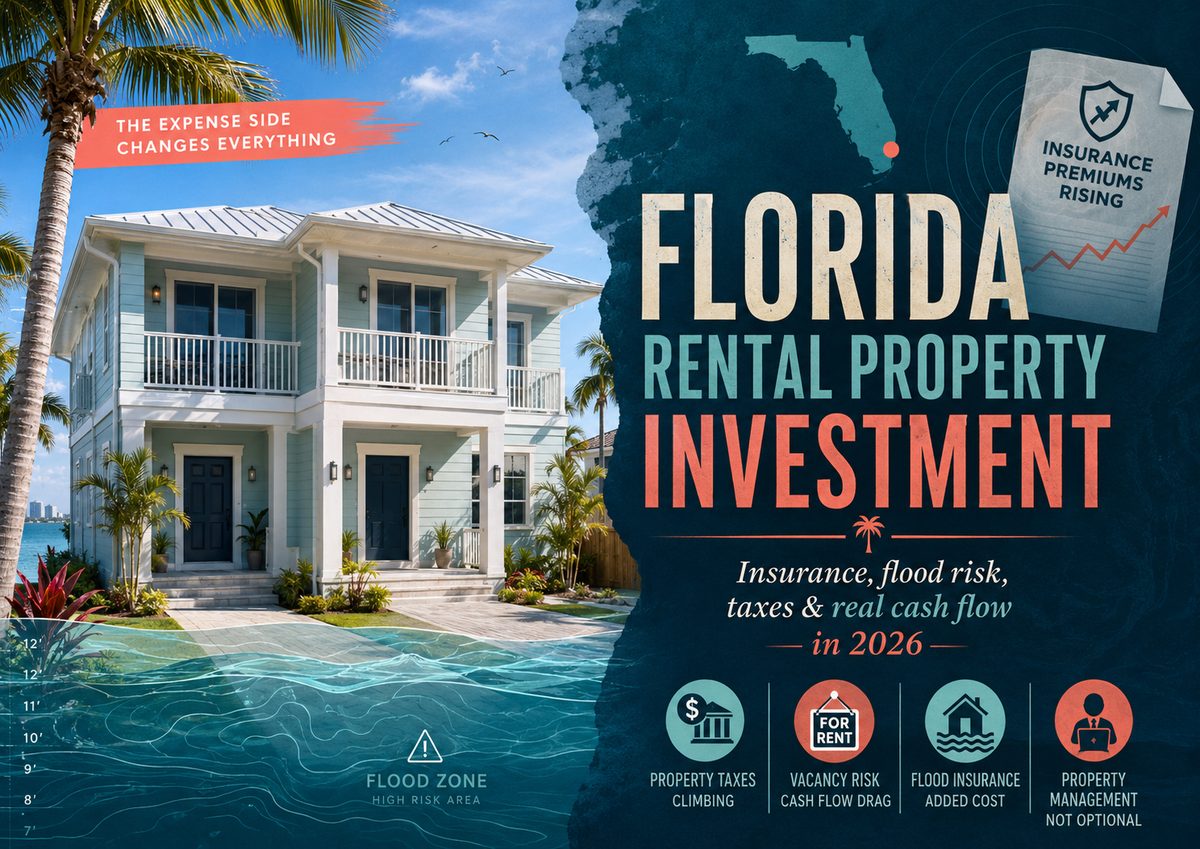
You find a Tampa duplex listed at $340,000. Both units rent for $1,250 each — $2,500 per month combined. On paper, that looks like a 8.8% gross yield. You make an offer. Then the insurance quote comes in: $7,200 per year. The flood zone designation adds another $3,400 in required flood coverage. Suddenly, that “great deal” barely breaks even. This scenario plays out constantly for investors who underestimate what florida rental property investment actually costs on the expense side. This guide walks through the real numbers — insurance, taxes, vacancy, property management — so you can analyze any Florida deal before you commit.
Why Florida Still Attracts Rental Property Investors in 2026
Florida added more than 300,000 residents in 2024 alone, according to U.S. Census Bureau data. That population growth is one of the core arguments for florida rental property investment — persistent rental demand, particularly in Tampa, Orlando, and Jacksonville where job markets have diversified beyond tourism. Miami remains a global city with its own supply constraints.
There is also a meaningful tax advantage. Florida has no state income tax, which means rental income is taxed only at the federal level. For investors in high-tax states, relocating or investing here creates a real after-tax difference. The Tax Foundation ranks Florida among the top five most tax-competitive states for business and investment.
That said, Florida is not a low-cost market anymore. Median home prices have risen sharply since 2020. Cap rates have compressed. And property insurance — more on this shortly — is the highest in the country by a wide margin. Profitable florida rental property investment in 2026 requires discipline on the numbers, not just optimism about appreciation.
Before diving into metro comparisons and worked examples, use the Florida Rental Property Calculator to run your own deal with Florida-specific defaults already loaded.
Florida-Specific Costs That Change the Math
Property Insurance: The Biggest Variable
Florida carries the highest homeowner and landlord insurance premiums in the United States. After multiple major insurers left the state between 2021 and 2024, the remaining carriers repriced risk aggressively. A single-family rental in coastal Pinellas County now routinely costs $6,000–$9,000 per year just for the base dwelling policy. Inland properties in the Orlando or Jacksonville metro run lower — $3,500–$5,500 — but are still well above national averages.
Windstorm coverage is often written as a separate policy or endorsement, and it carries its own deductible — typically 2%–5% of the insured dwelling value, not a flat dollar amount. On a $340,000 property, a 3% windstorm deductible means you absorb the first $10,200 of storm damage out of pocket. Check the Florida Office of Insurance Regulation for current market data and approved carrier lists by county.
Watch out: Many out-of-state investors pull insurance estimates from national sites like Insurify or Policygenius and see quotes of $1,800–$2,400 per year. These figures are rarely accurate for Florida landlord policies. Always get a real quote from a Florida-licensed agent before closing on any deal. Getting this wrong by $3,000–$5,000 per year can flip a cash-flowing property into a money loser overnight.
Flood Insurance and Zone Designations
Flood insurance is separate from hazard insurance and is required by lenders on properties in FEMA Special Flood Hazard Areas (Zone A or AE). Florida has more SFHA-designated land than any other state. Policies through the National Flood Insurance Program typically run $1,500–$4,500 per year for residential rental properties, depending on elevation and construction type. Private flood carriers sometimes offer lower premiums but with stricter coverage terms.
Before making any offer, look up the property’s FEMA flood zone on the FEMA Map Service Center. If it is in Zone X (minimal risk), you may skip mandatory flood coverage — but lenders can still require it, and voluntary coverage is worth considering in Florida regardless.
Property Taxes at 1.1% Effective Rate
Florida’s effective property tax rate averages about 1.1% of assessed value statewide, though rates vary by county. Miami-Dade runs higher (around 1.0–1.2%), while rural counties can be lower. For anyone pursuing florida rental property investment, the key tax trap is the homestead exemption. Florida offers a $50,000 homestead exemption and Save Our Homes (SOH) assessment cap (3% annual maximum increase) — but only for owner-occupied primary residences. Rental properties do not qualify. If you buy a property that was previously owner-occupied, expect the assessed value to reset to market value at sale, and budget taxes accordingly from day one.
Use the Florida Cap Rate Calculator to model the impact of different tax assessments on your net operating income.
Documentary Stamp Tax
Florida charges a documentary stamp tax on deed transfers at $0.70 per $100 of purchase price (Miami-Dade is $0.60 per $100 on the deed but adds a surtax). On a $340,000 purchase, that is $2,380 in transfer taxes — a closing cost unique to Florida that out-of-state investors sometimes miss. Budget for this in your acquisition cost. The Florida Closing Costs Calculator breaks down every line item including doc stamps, title insurance, and intangible tax on the mortgage.
Worked Example 1: Tampa Duplex at $340K
Let’s run the full math on a realistic Tampa deal. These are actual Florida market defaults, not national averages.
| Item | Monthly | Annual |
|---|---|---|
| Gross Rental Income (2 × $1,250) | $2,500 | $30,000 |
| Vacancy Loss (7%) | –$175 | –$2,100 |
| Effective Gross Income | $2,325 | $27,900 |
| Property Taxes (1.1% of $340K) | –$312 | –$3,740 |
| Hazard Insurance | –$375 | –$4,500 |
| Flood Insurance | –$200 | –$2,400 |
| Property Management (9%) | –$209 | –$2,511 |
| Repairs & Maintenance (8%) | –$186 | –$2,232 |
| Net Operating Income (NOI) | $1,043 | $12,517 |
| Mortgage P&I (25% down, 7.25%, 30yr) | –$1,747 | –$20,964 |
| Monthly Cash Flow | –$704 | –$8,447 |
Cap Rate: 3.68% (NOI ÷ $340,000). DSCR: 0.60 (NOI ÷ annual debt service).
This deal does not cash flow at today’s mortgage rates and this purchase price. The cap rate is below what most lenders and experienced investors want to see. A DSCR of 0.60 means the property generates only 60 cents of NOI for every dollar of debt service — no conventional DSCR lender will touch this. Does that mean you walk away? Not necessarily. If rents in this submarket are rising, if you can add a third unit, or if you have the ability to self-manage and eliminate the PM fee, the math shifts. But go in clear-eyed. Check your financing options with the Florida DSCR Calculator.
Worked Example 2: Jacksonville SFR at $280K
Jacksonville offers a different risk-return profile. It is inland from the Gulf, so wind exposure is lower, insurance is more manageable, and the price-to-rent ratio is tighter. Here is the same analysis on a single-family rental at $280,000 with $1,600 per month rent.
| Item | Monthly | Annual |
|---|---|---|
| Gross Rental Income | $1,600 | $19,200 |
| Vacancy Loss (7%) | –$112 | –$1,344 |
| Effective Gross Income | $1,488 | $17,856 |
| Property Taxes (1.0% of $280K) | –$233 | –$2,800 |
| Hazard Insurance (inland) | –$292 | –$3,500 |
| Property Management (9%) | –$134 | –$1,602 |
| Repairs & Maintenance (8%) | –$119 | –$1,428 |
| Net Operating Income (NOI) | $710 | $8,526 |
| Mortgage P&I (25% down, 7.25%, 30yr) | –$1,440 | –$17,280 |
| Monthly Cash Flow | –$730 | –$8,754 |
Cap Rate: 3.04%. DSCR: 0.49. Still negative cash flow. The Jacksonville deal is actually worse on DSCR even though the absolute numbers are smaller, because the price-to-rent ratio is not meaningfully better than Tampa at these price points. The lesson: price alone does not make a good deal. You need the rent-to-price ratio to work. A general rule of thumb — often called the 1% rule — says monthly rent should equal at least 1% of purchase price. At $1,600 rent on $280,000, you are at 0.57%. Neither Florida example clears this threshold at current prices.
For buy-and-hold investors planning a refinance strategy, run the full cycle through the Florida BRRRR Calculator to see if a value-add approach improves returns.
Worked Example 3: Jacksonville Value-Add Duplex That Cash Flows
The previous two examples show that straight purchases at today’s prices rarely cash flow. This is where value-add — specifically the BRRRR strategy (Buy, Rehab, Rent, Refinance, Repeat) — changes the florida rental property investment equation. Here is a realistic Jacksonville deal that actually works.
The acquisition: A distressed duplex purchased for $230,000 (below market due to deferred maintenance). Rehab budget: $30,000. After-repair value (ARV): $310,000. Combined rents after rehab: $1,900 per month.
| Item | Monthly | Annual |
|---|---|---|
| Gross Rental Income ($1,900/mo combined) | $1,900 | $22,800 |
| Vacancy Loss (7%) | –$133 | –$1,596 |
| Effective Gross Income | $1,767 | $21,204 |
| Property Taxes (1.1% of $230K) | –$211 | –$2,530 |
| Hazard Insurance (inland duplex) | –$317 | –$3,800 |
| Property Management (9%) | –$159 | –$1,908 |
| Maintenance + CapEx Reserve | –$288 | –$3,450 |
| Net Operating Income (NOI) | $792 | $9,516 |
Phase 1 — Initial financing: 25% down on $230,000 = $57,500 down payment + $30,000 rehab = $87,500 total capital invested. Mortgage on $172,500 at 7.5% over 30 years = approximately $14,470 per year in debt service.
At this stage, annual cash flow = $9,516 NOI – $14,470 debt service = –$4,954. Still negative. But the deal is not done yet.
Phase 2 — Cash-out refinance after rehab: The property now appraises at $310,000 (the ARV). A DSCR lender will lend up to 75% LTV = $232,500 new loan. This pays off the original $172,500 mortgage and returns approximately $60,000 in cash back to the investor.
After the refinance, total capital remaining in the deal = $87,500 originally invested – $60,000 returned = $27,500 left in the deal.
The new debt service on $232,500 at 7.5% = approximately $19,534 per year. Revised cash flow = $9,516 NOI – $19,534 = –$10,018. The operating cash flow is now negative due to higher debt. But the investor pulled out $60,000 in capital and still controls a $310,000 appreciating asset with only $27,500 of their own money at risk. On a net present value basis — accounting for equity build and appreciation — this deal pencils for patient investors with adequate reserves.
For investors who want the deal to actually cash flow on operations: they can accept higher-yielding rents in a tighter submarket, self-manage to eliminate the PM fee ($1,908/yr savings), or wait for rates to fall before refinancing. At 6.5% rates, debt service on $232,500 drops to $17,632/yr and the cash flow gap narrows substantially.
The key takeaway: florida rental property investment through a value-add BRRRR cycle can dramatically improve returns compared to buying at retail. The investor recycled most of their capital into the next deal while retaining ownership of a renovated asset. Run your own version through the Florida BRRRR Calculator.
Florida Metro Comparison: Miami, Tampa, Orlando, Jacksonville
Cap rates, insurance costs, and rent levels vary significantly across Florida’s major metros. Here is a side-by-side snapshot based on 2025–2026 market data and Zillow Research median home values.
| Metro | Median SFR Price | Median Rent (SFR) | Est. Cap Rate | Annual Insurance Est. |
|---|---|---|---|---|
| Miami | $675,000 | $2,950 | 2.2%–3.0% | $7,500–$12,000 |
| Tampa | $443,000 | $2,100 | 2.8%–3.8% | $5,000–$8,500 |
| Orlando | $402,000 | $1,950 | 3.0%–4.2% | $3,800–$6,000 |
| Jacksonville | $315,000 | $1,700 | 3.2%–4.5% | $3,200–$5,500 |
Miami offers the lowest cap rates in the state but benefits from strong appreciation history and international demand. Orlando and Jacksonville, with lower insurance exposure and better rent-to-price ratios, are where most cash flow-focused florida rental property investment activity is concentrated in 2026. Run any of these metros through the Cap Rate Calculator with your specific expense inputs before drawing conclusions.
Common Florida Rental Property Investment Mistakes to Avoid
1. Using National Insurance Estimates
This mistake deserves the top spot because it is the most expensive. Insurance on a Florida rental property can be 3–5 times the national average. Always get a real quote from a Florida-licensed surplus lines broker before making an offer, not after. Some investors build in $1,800 per year based on their experience in Ohio or Texas and get a $7,000 quote at closing. By then, backing out costs them their earnest money.
2. Ignoring Flood Zone Status
Florida has roughly 3.5 million properties in flood-prone areas. Buying in Zone AE without accounting for flood insurance premium — or without understanding that FEMA is actively repricing flood risk through its Risk Rating 2.0 system — can add $3,000–$6,000 per year in unexpected costs. Some properties in high-risk zones are also increasingly difficult to insure at any price.
3. Assuming the Homestead Exemption Transfers
New investors frequently look at a seller’s property tax bill and assume their taxes will be similar. If the seller has lived in the home for 15 years and benefited from the Save Our Homes assessment cap, their assessed value may be $90,000 on a property you are buying for $340,000. Your taxes will be calculated on the new assessed value (usually close to purchase price). The difference can be $2,500–$4,000 per year in additional taxes that never appeared in the seller’s history.
4. Overestimating Rent and Underestimating Vacancy
Florida’s rental market has softened in many submarkets after the 2021–2023 surge. New multifamily supply delivered in 2024–2025 has pushed vacancy rates higher in Tampa, Orlando, and Jacksonville suburbs. Using peak 2022 rents in your underwriting and assuming 2–3% vacancy will make most deals look better than they are. Use 6–8% vacancy as a starting point, and verify current rents on active listings — not what closed leases show from 18 months ago.
5. Neglecting CapEx Reserves for Florida’s Climate
Florida’s heat, humidity, and storm exposure age roofs, HVAC systems, and exterior materials faster than in most other states. A roof in Florida may need replacing every 15–20 years versus 25–30 years in a milder climate. Expect HVAC replacement every 10–12 years. Budget at least 10–12% of gross rents annually for maintenance, repairs, and capital reserves — higher than the 5–8% commonly used in other markets. Get a deeper breakdown through the guide to analyzing rental property investments.
Financing Florida Rental Properties in 2026
Conventional investment property loans require 20–25% down and will price in a 0.50–0.75% rate premium over primary residence rates. At 7.25% on a 30-year fixed, debt service is substantial relative to rents in most Florida markets.
DSCR loans — where qualification is based on the property’s income, not the borrower’s personal tax returns — have become the default financing tool for Florida real estate investors. Most DSCR lenders require a minimum ratio of 1.0–1.25, meaning the NOI must equal or exceed annual debt service. As shown in the worked examples above, most Florida SFRs at today’s prices and rates fail this threshold without a large down payment, creative structuring, or rents well above market median.
According to FRED mortgage rate data, 30-year fixed rates have remained in the 6.75%–7.50% range through mid-2026. Every 50 basis point move in rates materially changes cash flow. Model rate sensitivity — what happens to your cash flow if rates rise another half point — before committing.
Use the DSCR Calculator to test whether your financing structure meets lender minimums, or the Florida-specific DSCR Calculator for state-adjusted expense defaults.
Florida Investment Property Loan Comparison
| Feature | Conventional | DSCR Loan | Portfolio Loan |
|---|---|---|---|
| Typical Rate | 7.00%–7.50% | 7.25%–8.25% | 7.50%–9.00% |
| Down Payment | 20%–25% | 20%–25% | 20%–35% |
| Qualification | Personal income + credit | Property cash flow (DSCR ≥ 1.0–1.25) | Lender discretion, relationship-based |
| Typical Max LTV | 75%–80% | 75%–80% | 65%–80% |
| Best For | W-2 investors, first 1–4 properties | Self-employed investors, scaling portfolios | Experienced investors, non-warrantable deals |
What Makes a Florida Deal Actually Work in 2026?
Given all of the above, is profitable florida rental property investment still possible? Yes — but the deals that work share specific characteristics. They tend to be multifamily properties where the rent-to-price ratio is better than SFRs. They are in submarkets where new supply is limited and employer growth is strong. The buyer either has a large down payment (30%+) that lowers debt service, a value-add plan that raises rents above market, or is self-managing and eliminating the 8–10% property management fee. Short-term rental (STR) operators in high-demand tourist markets like Anna Maria Island or 30A can achieve yields that long-term rental numbers cannot — but STR brings its own regulatory and operational complexity.
Appreciation has historically been strong in Florida, and many investors accept below-market cash flow in exchange for equity growth. That is a legitimate approach to florida rental property investment — as long as you can service negative cash flow from other income sources and are not betting everything on continued appreciation in a market that has already moved significantly.
Frequently Asked Questions About Florida Rental Property Investment
Is florida rental property investment profitable in 2026?
Florida rental property investment can be profitable in 2026, but cash flow from leveraged purchases is difficult at current prices and rates. Investors using value-add strategies, larger down payments, or below-market acquisitions are finding deals that work. Passive investors expecting easy returns without a disciplined approach to expenses — especially insurance — are likely to be disappointed.
What is a realistic cap rate for Florida rental properties?
Cap rates in Florida’s major metros range from 2.2%–3.0% in Miami to 3.2%–4.5% in Jacksonville. Secondary markets and suburban submarkets can offer 4.5%–6.0% cap rates on multifamily properties with strong rental history. For most investors, a cap rate below the local borrowing rate (currently around 7.25%) means the property will not cash flow with typical leverage.
How much does landlord insurance cost in Florida?
Landlord insurance in Florida typically runs $3,200–$12,000+ per year depending on location, construction type, and coverage level. Coastal properties in high wind-exposure zones carry the highest premiums. Inland markets like Orlando and Jacksonville are lower but still 2–3 times the national average. Flood insurance is additional and ranges from $1,200–$5,000+ depending on the FEMA flood zone designation.
Does Florida’s no state income tax benefit rental investors?
Yes, meaningfully. Florida has no state income tax, so rental income is only taxed at the federal level. For investors in states like California (13.3% top rate) or New York (10.9%), this is a significant advantage — particularly on properties generating $50,000+ of annual net rental income. The benefit compounds over time as equity and income grow.
What is the documentary stamp tax in Florida and who pays it?
Florida’s documentary stamp tax is charged on deed transfers at $0.70 per $100 of purchase price statewide ($0.60 per $100 in Miami-Dade, plus a surtax). By custom, the seller typically pays this cost, but it is negotiable. Also, there is an intangible tax on new mortgages of $0.002 per dollar of loan amount — paid by the buyer. On a $255,000 loan, that is $510 in additional closing costs.
Which Florida city is best for rental property investors?
There is no single answer — it depends on your strategy. Jacksonville and certain Orlando suburbs offer the best rent-to-price ratios and the lowest insurance burden. Tampa has strong job market fundamentals and population growth. Miami offers appreciation potential and international demand, but entry prices are very high relative to rents. For most first-time Florida investors focused on cash flow, Jacksonville or Orlando’s eastern suburbs are the starting point.
What DSCR do Florida lenders require for investment property loans?
Most DSCR lenders in Florida require a minimum ratio of 1.0–1.25. Some lenders will go as low as 0.75 on DSCR products with higher rates and fees. To hit a 1.25 DSCR on a $340,000 property financed at 7.25%, you would need NOI of approximately $26,200 per year — which requires gross rents of roughly $3,400–$3,600 per month depending on your expense ratio. That is a very high bar in most Florida markets at current prices.
Related Calculators for Florida Rental Property Analysis
- Florida Rental Property Calculator — Full cash flow analysis with FL-specific tax, insurance, and vacancy defaults
- Florida Cap Rate Calculator — Calculate NOI and cap rate using Florida expense benchmarks by county
- Florida DSCR Calculator — Check if your deal qualifies for investor financing based on property income
- Florida BRRRR Calculator — Model buy-rehab-rent-refinance-repeat cycles with FL market assumptions
- Florida Closing Costs Calculator — Estimate documentary stamp tax, title, intangible tax, and all buyer costs
- Cap Rate Calculator — General cap rate tool for any market
- DSCR Calculator — General debt service coverage ratio calculator for any financing scenario
All figures are estimates based on 2025–2026 market data and are for educational purposes only. Insurance premiums, tax assessments, and rental rates vary by property, location, and market conditions. Always obtain current quotes and conduct independent due diligence before making any investment decision.
Leave a Reply