Last updated: September 24, 2026 · Originally published: August 3, 2026 · By Alex Petrov
Real Estate InvestingAug 3, 202613 min read3,141 words
{
“@context”: “https://schema.org”,
“@type”: “FAQPage”,
“mainEntity”: [
{
“@type”: “Question”,
“name”: “How much tax does a 1031 exchange capital gains deferral actually save?”,
“acceptedAnswer”: {
“@type”: “Answer”,
“text”: “It depends on your gain, tax bracket, and accumulated depreciation. On a $170,000 capital gain with $70,000 of depreciation recapture, a full 1031 exchange can defer $53,500 or more in federal taxes. Use a 1031 exchange capital gains calculator to get your exact number.”
}
},
{
“@type”: “Question”,
“name”: “Does a 1031 exchange eliminate capital gains tax?”,
“acceptedAnswer”: {
“@type”: “Answer”,
“text”: “No. A 1031 exchange defers capital gains tax — it does not eliminate it. You carry the deferred gain into your replacement property. Tax is eventually owed when you sell without doing another 1031 exchange. The only permanent escape is holding the property until death, when heirs receive a stepped-up basis.”
}
},
{
“@type”: “Question”,
“name”: “What is the capital gains tax rate on real estate in 2026?”,
“acceptedAnswer”: {
“@type”: “Answer”,
“text”: “Federal long-term capital gains rates are 0%, 15%, or 20% depending on your taxable income. High earners also pay a 3.8% Net Investment Income Tax (NIIT) on top. Depreciation recapture is taxed at a maximum 25% rate. State taxes vary widely — California adds up to 13.3%, while states like Texas and Florida have no state income tax.”
}
},
{
“@type”: “Question”,
“name”: “What counts as ‘boot’ in a 1031 exchange?”,
“acceptedAnswer”: {
“@type”: “Answer”,
“text”: “Boot is any value received in a 1031 exchange that is not like-kind property. Common examples include cash received at closing, debt relief (net mortgage reduction), and personal property received. Boot is taxable in the year of exchange, up to the amount of your total realized gain.”
}
},
{
“@type”: “Question”,
“name”: “Do I have to reinvest 100% of the proceeds in a 1031 exchange?”,
“acceptedAnswer”: {
“@type”: “Answer”,
“text”: “To defer 100% of your capital gains tax, you must reinvest all net proceeds and acquire a replacement property of equal or greater value. If you reinvest less, the difference (boot) is taxable. You don’t have to do a 100% exchange — a partial exchange is allowed, but you’ll owe tax on whatever boot you receive.”
}
},
{
“@type”: “Question”,
“name”: “How is depreciation recapture calculated in a 1031 exchange?”,
“acceptedAnswer”: {
“@type”: “Answer”,
“text”: “Depreciation recapture is the total depreciation you claimed on the property over your holding period. It is taxed at a maximum rate of 25% (Section 1250 unrecaptured gain), separate from the regular capital gains rate. In a full 1031 exchange, this is fully deferred. In a partial exchange, recapture is often the first portion of gain that becomes taxable.”
}
},
{
“@type”: “Question”,
“name”: “Can I use a 1031 exchange calculator to estimate my tax deferral?”,
“acceptedAnswer”: {
“@type”: “Answer”,
“text”: “Yes. A 1031 exchange capital gains calculator lets you input your sale price, original purchase price, accumulated depreciation, mortgage balances, and replacement property value to estimate the exact tax deferred and any boot owed. This is the fastest way to model different scenarios before committing to an exchange.”
}
}
]
}
When an investor sells a rental property for $450,000 that they bought for $280,000, the first question is almost always the same: how much of that gain do I actually have to pay tax on right now? Understanding 1031 exchange capital gains mechanics — what gets deferred, what doesn’t, and what the numbers look like — is the difference between keeping tens of thousands of dollars working in real estate and writing a large check to the IRS this April.
This guide breaks down the full picture: federal rates, depreciation recapture, worked examples with real math, and the scenarios where a 1031 fails to defer everything. Use the 1031 exchange calculator alongside this guide to model your own deal.
Quick Answer
A completed 1031 exchange defers all capital gains tax and depreciation recapture — provided you reinvest in a like-kind property of equal or greater value and carry no cash out. On a $170,000 capital gain with $70,000 of accumulated depreciation, that means deferring roughly $25,000–$53,500 in federal taxes depending on your bracket. Run your exact numbers in the 1031 exchange capital gains calculator.
Last updated: August 4, 2026 · Data verified against IRS Publication 544 and 2026 federal tax brackets.
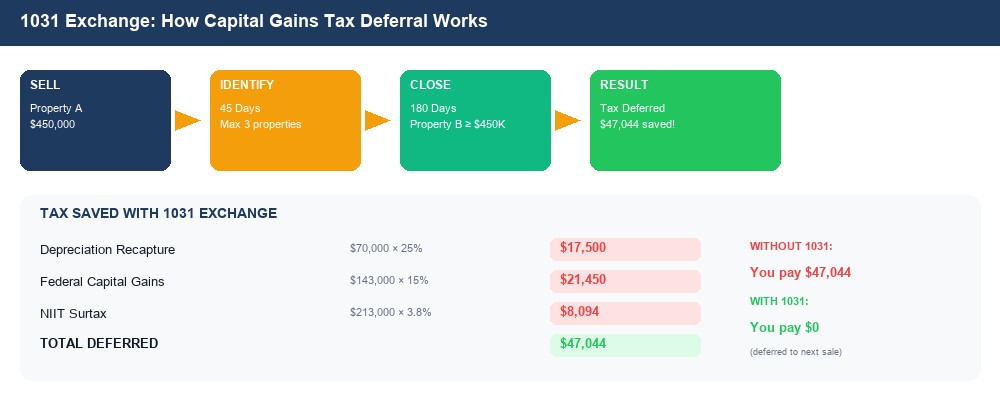
How a 1031 exchange defers capital gains: sell → identify → close → tax deferred
Under IRS Publication 544, Section 1031 of the Internal Revenue Code allows a property owner to sell investment real estate and defer recognition of the gain — as long as the proceeds are reinvested in “like-kind” property within specific time limits. The IRS explains the full framework on its like-kind exchanges page.
The mechanics work like this: you sell your relinquished property, the net proceeds go to a qualified intermediary (not you directly), you identify a replacement property within 45 days, and you close on that replacement within 180 days. The gain is not recognized for tax purposes in the year of sale — it is deferred and “embedded” in the lower adjusted basis of the replacement property.
This is the most important thing to understand: a 1031 exchange is not tax elimination. It is tax deferral. You do not get out of the tax permanently — you push it forward. Every time you do another 1031 exchange on the replacement, the deferred gain grows and travels with you. The only way to make the deferred tax disappear permanently is to hold the property until death, at which point your heirs receive a stepped-up basis and the accumulated gain is wiped out. (Congress has discussed eliminating this benefit, but as of 2026 the step-up basis rule remains in place.)
For a deeper to how exchanges are structured, the 1031 exchange real estate guide covers timelines, qualified intermediaries, and eligible property types in full detail.
Capital Gains Tax Rates for Real Estate (2026)
Before you can calculate what a 1031 defers, you need to know what rate applies to each component of your gain. Real estate gain has three distinct layers, each taxed differently.
Tax Component
Rate
Who Pays It
Long-Term Capital Gains (federal)
0%, 15%, or 20%
All investors; rate depends on taxable income
Net Investment Income Tax (NIIT)
3.8%
Single filers >$200K; MFJ >$250K AGI
Depreciation Recapture (Sec. 1250)
Up to 25%
Anyone who claimed depreciation deductions
State Capital Gains Tax
0%–13.3%
Varies by state (CA highest; TX, FL, NV = 0%)
For 2026, the 15% bracket applies to single filers with taxable income between roughly $48,350 and $533,400, and married filing jointly between $96,700 and $600,050. Above those thresholds, the 20% rate kicks in. The Tax Foundation’s capital gains rate summary provides updated threshold tables each year.
Depreciation recapture deserves special attention. When you sell, the IRS “recaptures” every dollar of depreciation you claimed — and taxes it at up to 25%, regardless of your normal capital gains rate. On a property held for many years, this can easily exceed the regular capital gain itself. The depreciation calculator can help you estimate how much recapture you have accumulated.
The capital gains tax calculator lets you model federal rates, NIIT, and depreciation recapture together in one place.
Worked Example 1: Full 1031 Exchange — Complete Deferral
Let’s use a realistic scenario and trace every dollar. An investor purchased a rental property in 2014 for $280,000. They’ve held it for 12 years, claimed $70,000 in depreciation deductions (roughly $5,833/year on a 27.5-year schedule for the building portion), and are now selling for $450,000.
Step 1: Determine adjusted basis
Original purchase price: $280,000
Less accumulated depreciation: ($70,000) Adjusted basis: $210,000
Step 2: Calculate realized gain
Sale price: $450,000
Less selling costs (6%): ($27,000)
Net sale proceeds: $423,000
Less adjusted basis: ($210,000) Total realized gain: $213,000
Step 3: Break gain into components
Depreciation recapture gain: $70,000 (taxed at 25%)
Regular capital gain: $143,000 (taxed at 15% or 20%)
Step 4: Calculate tax owed without a 1031
Assume the investor is in the 15% long-term capital gains bracket and subject to NIIT (3.8%).
Depreciation recapture: $70,000 × 25% = $17,500
Regular capital gains: $143,000 × 15% = $21,450
NIIT: $213,000 × 3.8% = $8,094
Total federal tax without 1031: $47,044
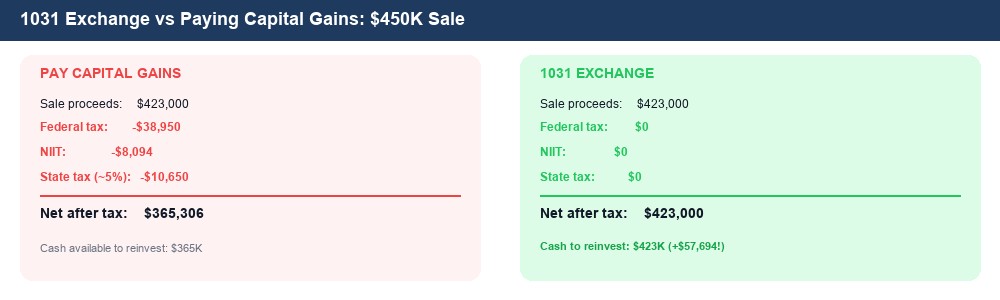
Add state taxes (at even 5%), and you’re looking at $57,694 or more out of pocket.
Step 5: Do a full 1031 exchange — buy a $500,000 replacement
The investor buys a replacement property for $500,000 — above the sale price and the outstanding mortgage balance. No cash is taken out. All proceeds flow through the qualified intermediary.
Federal tax deferred: $47,044 State tax deferred (at 5%): ~$10,650 Total tax deferred: ~$57,694
That is $57,694 that stays in the investment, compounding over the holding period of the next property. The deferred gain is now embedded in the replacement property’s basis ($500,000 acquisition cost minus the $213,000 carried-over gain), which affects future depreciation deductions.
Use the 1031 exchange calculator to run this same analysis with your specific numbers — it handles state tax, NIIT, and depreciation recapture automatically.
Worked Example 2: Partial Exchange — Boot Creates a Tax Bill
Not every 1031 exchange is a clean, full deferral. Sometimes investors take cash out, buy down, or carry less debt on the replacement. That triggers “boot” — and boot is taxable.
Using the same property from Example 1 (sold for $450,000, adjusted basis $210,000, realized gain $213,000):
Suppose the investor buys a replacement property for only $380,000 — $70,000 less than the net sale proceeds. That $70,000 difference is cash boot received.
Boot calculation:
Net proceeds: $423,000
Replacement property cost: $380,000
Boot (cash received): $43,000
Tax on boot (recognized gain):
The IRS taxes boot up to the amount of your total gain. The $43,000 boot is recognized in the year of sale. Because depreciation recapture is typically recognized first:
(Remaining $27,000 in recapture deferred; regular capital gain fully deferred)
Total federal tax owed this year: approximately $10,750 (plus NIIT on the $43,000 = ~$1,634). Tax due on boot: ~$12,384 vs. $47,044 without any exchange.
The partial exchange still saved roughly $34,660 in federal taxes — just not the full amount. For more on how boot works and strategies to minimize it, see the 1031 exchange boot guide.
1031 Exchange Capital Gains: Depreciation Recapture: The Hidden Tax Most Investors Underestimate
Depreciation is one of the most valuable tax benefits in real estate — it lets you deduct a portion of the building’s value each year (residential: 27.5 years; commercial: 39 years), reducing your taxable rental income. The catch comes at sale.
When you sell, the IRS recaptures every dollar of depreciation you claimed — or were entitled to claim, even if you didn’t. This is taxed as “unrecaptured Section 1250 gain” at a maximum rate of 25%, which is often higher than the 15% rate investors pay on regular long-term capital gains.
On a property with $70,000 of accumulated depreciation, the recapture tax alone can be $17,500 — before you even get to the regular capital gain. Investors who have held properties for a decade or more often find their depreciation recapture exceeds their appreciation gain.
A 1031 exchange defers the recapture entirely — but carries it forward into the replacement property’s basis. This means the replacement property has a lower depreciable basis, and you claim less depreciation going forward. It’s a trade-off: you defer the 25% tax today, but you lose some future deductions. For most investors in the 15%–20% bracket, the deferral is still far ahead financially.
Pay tax: keep $365K. 1031 exchange: keep $423K (+$58K more to reinvest)
1031 Exchange vs. Paying Capital Gains: Side-by-Side
Factor
Pay Capital Gains Tax
Full 1031 Exchange
Tax owed at sale
$47,044+ (federal)
$0
Capital available to reinvest
$375,956 (after $47K tax)
$423,000 (full proceeds)
Buying power for next property
Lower
Higher (full equity preserved)
Flexibility
No 45/180-day deadlines, any property type
Must meet strict IRS timeline
Future tax liability
Clean slate — tax already paid
Deferred gain grows with each exchange
Best if you plan to…
Exit real estate, diversify into stocks/bonds
Keep wealth in real estate long-term
Step-up basis at death
N/A (basis already reset)
Deferred gain permanently eliminated for heirs
The math almost always favors the 1031 exchange for investors who plan to stay in real estate — the compounding effect of keeping $47,000 more invested over 10+ years typically dwarfs the deferred tax liability. But the flexibility cost is real: you’re locked into real estate, a 180-day window, and like-kind property rules. Use the 1031 exchange capital gains calculator to model your break-even point.
5 Ways to Reduce 1031 Exchange Capital Gains Tax Without a 1031 Exchange
A 1031 exchange isn’t always possible or practical. Here are five alternative strategies — some of which can be combined with a 1031.
1. Installment Sale
Instead of receiving all proceeds at closing, you carry a seller note and receive payments over multiple years. Each payment is partially gain, partially return of basis. This spreads the tax bill across several tax years — potentially keeping you in a lower bracket each year. The risk: you’re a creditor, not a property owner, and you depend on the buyer’s ability to pay.
2. Opportunity Zone Investment
Investing capital gains into a Qualified Opportunity Fund (QOF) defers the gain until the end of 2026 and can reduce it. Any appreciation inside the QOF is tax-free after a 10-year hold. This works for any capital gain — not just real estate — and doesn’t require like-kind property. The National Association of Realtors’ opportunity zone resource covers current rules.
3. Primary Residence Exclusion (Section 121)
If you’ve lived in the property as your primary residence for at least 2 of the last 5 years, you can exclude up to $250,000 of gain ($500,000 married). Combining Section 121 with a 1031 on the remaining gain is allowed under specific conditions. This is one reason some investors convert rental properties to primary residences before sale.
4. Charitable Remainder Trust (CRT)
You contribute the appreciated property to a CRT, which sells it tax-free and invests the proceeds. The trust pays you an income stream for life (or a term of years), and the remaining assets go to charity at the end. You get an immediate partial charitable deduction, defer capital gains, and receive an ongoing income stream. Complex to set up but effective for large gains. Read more in our guide on how to avoid capital gains tax on real estate.
5. Hold Until Death (Stepped-Up Basis)
Under current law, when you die holding appreciated real estate, your heirs inherit it at its fair market value on the date of death — not your original basis. All accumulated gain, including decades of deferred 1031 exchange gains, is permanently eliminated. This is why long-term 1031 exchange investors often treat the deferral as permanent: they plan to never sell, or to hold until the estate gets the step-up. This provision has faced legislative threats but remains intact as of 2026.
5 Common 1031 Exchange Mistakes That Trigger Capital Gains Tax
Even investors who understand the rules can lose their exchange on procedural errors. These are the five most costly mistakes.
1. Missing the 45-day identification deadline. You have exactly 45 calendar days from closing on the relinquished property to identify potential replacement properties in writing. No extensions are granted except in declared federal disasters. Missing this deadline — even by one day — disqualifies the entire exchange. The 1031 exchange timeline guide lays out every critical date.
2. Taking constructive receipt of funds. If the sale proceeds touch your bank account — even briefly — before going to the qualified intermediary, the exchange fails. You must use a QI who holds the funds and never give yourself access to them during the exchange period.
3. Buying down in debt without buying up in value. Reducing your mortgage on the replacement property creates “mortgage boot” — treated as if you received cash. You must either replace all debt carried on the relinquished property or add equivalent equity. Many investors are blindsided by this when they try to buy a lower-leveraged replacement.
4. Identifying too many or improperly described properties. You may identify up to three properties without value limit (the “3 property rule”) or any number of properties as long as their combined value doesn’t exceed 200% of the relinquished property (the “200% rule”). Identification must be in writing and specific — a street address or legal description. “A property in Phoenix” doesn’t qualify.
5. Using the exchange for personal-use property. The relinquished property and replacement must both be held for investment or productive use in a trade or business. A vacation home you use personally, or a primary residence, generally doesn’t qualify. The IRS has issued safe harbor rules for vacation rentals, but they require careful documentation of rental use percentages.
For a complete walkthrough of the exchange process, the 1031 exchange calculator guide covers how to use the calculator alongside your QI’s paperwork.
Frequently Asked Questions
How much tax does a 1031 exchange capital gains deferral actually save?
It depends on your gain, tax bracket, and accumulated depreciation. On a $170,000 capital gain with $70,000 of depreciation recapture, a full 1031 exchange can defer $47,000–$57,000 in total tax. Use the 1031 exchange capital gains calculator to get your exact figure.
Does a 1031 exchange eliminate capital gains tax?
No. It defers the tax indefinitely — but does not eliminate it. You carry the gain forward into the replacement property’s basis. The tax is owed when you eventually sell without exchanging. The only permanent elimination occurs at death, when heirs receive a stepped-up basis.
What is the capital gains tax rate on real estate in 2026?
Federal long-term rates are 0%, 15%, or 20% depending on taxable income. High earners add 3.8% NIIT. Depreciation recapture is taxed up to 25%. State taxes range from 0% (TX, FL, NV) to 13.3% (CA). The capital gains tax calculator handles all layers together.
What counts as “boot” in a 1031 exchange?
Boot is any non-like-kind value you receive: cash at closing, net debt reduction, or personal property. Boot is taxable in the year of exchange, up to the amount of your total realized gain. Depreciation recapture is typically recognized first within the boot amount.
Do I have to reinvest 100% of proceeds?
To defer 100% of the tax, yes — you must reinvest all net proceeds and buy equal or greater value. A partial exchange is allowed, but any shortfall is treated as boot and taxed. You can choose how much to exchange and how much to take as taxable cash.
How is depreciation recapture calculated in a 1031 exchange?
Add up all depreciation you claimed (or could have claimed) over your holding period. That total is your recapture amount, taxed at up to 25% on sale. In a full exchange, it is entirely deferred. In a partial exchange, recapture is typically the first gain recognized on the boot received.
Can I use a 1031 exchange capital gains calculator to estimate my deferral?
Yes — that is exactly what the 1031 exchange calculator is built for. Enter your sale price, original basis, accumulated depreciation, mortgage balances, and replacement property value to see exact tax deferred, any boot owed, and your replacement property basis going forward.
Bottom Line
A 1031 exchange can defer $25,000 to $55,000+ in federal capital gains and depreciation recapture taxes on a typical rental property sale. The math is straightforward — but the execution requires a qualified intermediary and strict adherence to the 45-day identification and 180-day closing deadlines.
Run your specific numbers through the 1031 Exchange Calculator to see exactly how much tax you can defer on your next sale.
Related Calculators and Guides
Model your full investment scenario with these tools:

Leave a Reply