
Last updated: September 24, 2026 · Originally published: August 10, 2026 · By Alex Petrov
Use a real estate depreciation calculator and you can find your annual deduction in under two minutes — no spreadsheet, no accountant call required. The IRS lets you deduct the cost of a residential rental property over 27.5 years or a commercial building over 39 years. On a $310,000 purchase with $60,000 in land value, that’s $9,090 written off every year without spending a dollar. This guide shows you exactly how to run the numbers, what the IRS rules say, and how to turn depreciation into real tax savings.
What Is Real Estate Depreciation?
Depreciation is an accounting deduction that lets property owners recover the cost of a building over time. The IRS treats buildings as assets that wear out — they depreciate. You get to deduct a portion of that loss each year against rental income, even if the property is actually going up in value.
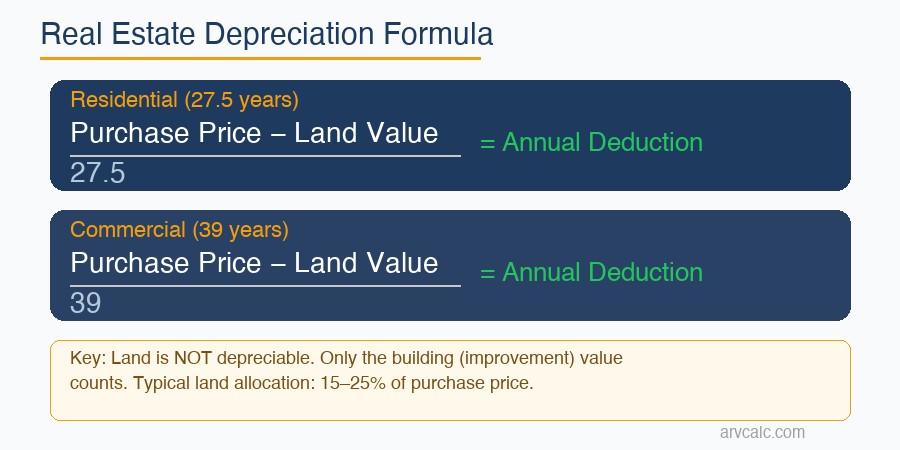
The land under a building never wears out, so it is never depreciable. Only the structure counts. That distinction matters every time you run the numbers.
IRS Rules: 27.5 Years vs. 39 Years
The IRS uses a system called Modified Accelerated Cost Recovery System (MACRS). Under MACRS, residential rental properties use a 27.5-year straight-line recovery period. Commercial properties use a 39-year recovery period. Both rules come from IRS Publication 946, the definitive reference for depreciation.
Residential rental property means any property where 80% or more of gross rental income comes from dwelling units. Single-family rentals, duplexes, triplexes, and apartment buildings all qualify. Mixed-use commercial buildings, office parks, and retail centers fall under the 39-year rule.
IRS Publication 527 covers residential rental property in detail, including what counts as depreciable, how to determine your basis, and when the depreciation clock starts.
When Does Depreciation Start?
Depreciation begins when the property is placed in service — meaning it is available and ready for rental, not necessarily the day a tenant moves in. If you buy a rental in July and it sits vacant while you find a tenant, depreciation starts in July. If you buy it in December but spend three months renovating before it is rentable, it starts when the renovation is complete.
Depreciation uses a mid-month convention in year one. You get a half-month of depreciation for the month you place the property in service, regardless of which day of the month that is. This affects only the first and last years of the schedule.
Depreciable Basis: What You Can Deduct
Your depreciable basis is typically your purchase price minus the value of the land, plus any capital improvements. It is not just the purchase price.
- Purchase price: What you paid at closing
- Minus land value: Land is never depreciated
- Plus closing costs: Legal fees, title insurance, recording fees attributable to the property
- Plus capital improvements: Roof replacement, HVAC system, additions — not repairs
How do you determine land value? The most common method is using your county property tax assessment. Most assessments break out land value from improvement value. Alternatively, you can get a formal appraisal or use a percentage based on comparable sales. Whatever method you use, document it.
How to Use Our Depreciation Calculator
The depreciation calculator runs three modes depending on what you need to find. Here is how each one works.
Mode 1: Calculate Annual Depreciation
This is the standard mode. You enter the property details and get the full depreciation schedule.
Step 1 — Enter the purchase price. Use the full closing price, not the financed amount. Whether you paid cash or took out a mortgage does not change your depreciable basis.
Step 2 — Enter the land value. Pull the figure from your county tax assessment or appraisal. The rental property depreciation calculator subtracts this from your purchase price automatically to get the depreciable basis.
Step 3 — Select property type. Choose residential (27.5-year MACRS) or commercial (39-year MACRS). The calculator applies the correct recovery period and mid-month convention for year one.
Step 4 — Enter the in-service date. The month and year you placed the property in service. This determines your first-year partial deduction based on the mid-month convention.
Hit calculate. The depreciation calculator returns your annual deduction, your year-one deduction (adjusted for mid-month), and a full depreciation schedule showing cumulative deductions through the end of the recovery period.
Mode 2: Cost Segregation Analysis
Cost segregation accelerates depreciation by reclassifying components of a building into shorter recovery periods — 5, 7, or 15 years instead of 27.5 or 39. The result is larger deductions in the early years of ownership.
Enter your property details plus estimates for personal property components (appliances, carpet, fixtures) and land improvements (parking lots, landscaping, sidewalks). The real estate depreciation calculator shows you the difference between straight-line and a cost segregation scenario side by side — including the net present value of accelerating those deductions.
Mode 3: Reverse — Find the Depreciable Basis
You know how much annual depreciation you want to claim. What purchase price and land allocation do you need to hit that number? Enter the target annual deduction, property type, and land percentage, and the calculator works backward to show the required depreciable basis. Useful for back-of-envelope underwriting before you have a full property appraisal.
For a complete picture of how depreciation fits into your overall investment returns, pair this with the rental property calculator and the real estate ROI calculator.
Worked Example 1: Single-Family Rental in Dallas, TX
Property type: Single-family rental, 3 bed / 2 bath
Location: Dallas, TX
Purchase price: $310,000
Land value (per county assessment): $60,000
In-service date: March 2026
Recovery period: 27.5 years (residential)
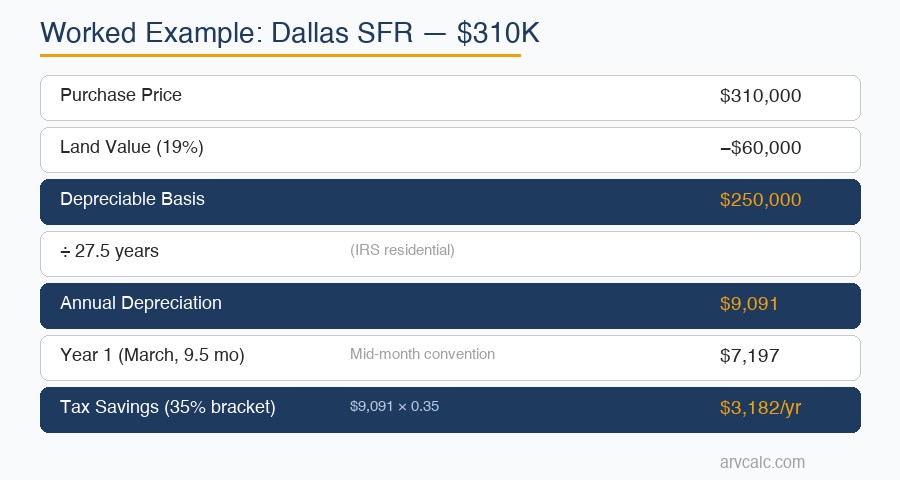
Step 1: Calculate Depreciable Basis
Depreciable basis = Purchase price − Land value
Depreciable basis = $310,000 − $60,000 = $250,000
Step 2: Calculate Annual Straight-Line Depreciation
Annual depreciation = Depreciable basis ÷ Recovery period
Annual depreciation = $250,000 ÷ 27.5 = $9,090.91 per year
Step 3: Calculate Year-One Depreciation (Mid-Month Convention)
Property placed in service in March. The mid-month convention gives you credit for half of March, then April through December = 9.5 months out of 12.
Year-one factor = 9.5 ÷ 12 = 0.7917
Year-one depreciation = $9,090.91 × 0.7917 = $7,196.97
Step 4: Full Depreciation Schedule (First 5 Years)
| Year | Depreciable Basis | Annual Deduction | Cumulative Deduction | Remaining Basis |
|---|---|---|---|---|
| 2026 (Year 1) | $250,000 | $7,197 | $7,197 | $242,803 |
| 2027 (Year 2) | $250,000 | $9,091 | $16,288 | $233,712 |
| 2028 (Year 3) | $250,000 | $9,091 | $25,379 | $224,621 |
| 2029 (Year 4) | $250,000 | $9,091 | $34,470 | $215,530 |
| 2030 (Year 5) | $250,000 | $9,091 | $43,561 | $206,439 |
Run this exact scenario in the depreciation calculator and you get the complete 27.5-year schedule with every line filled in. You can also export it to PDF for your tax records or hand it to your CPA.
To see how this deduction interacts with your cash flow, plug these numbers into the property cash flow calculator and the NOI calculator.
Worked Example 2: Small Office Building
Property type: Small office building (commercial)
Location: Phoenix, AZ
Purchase price: $520,000
Land value (per appraisal): $130,000
In-service date: June 2026
Recovery period: 39 years (commercial)
Step 1: Calculate Depreciable Basis
Depreciable basis = $520,000 − $130,000 = $390,000Step 2: Calculate Annual Straight-Line Depreciation
Annual depreciation = $390,000 ÷ 39 = $10,000.00 per yearStep 3: Calculate Year-One Depreciation (Mid-Month Convention)
Property placed in service in June. Mid-month convention gives you credit for half of June, then July through December = 6.5 months out of 12.
Year-one factor = 6.5 ÷ 12 = 0.5417
Year-one depreciation = $10,000 × 0.5417 = $5,417
Step 4: Full Depreciation Schedule (First 5 Years)
| Year | Depreciable Basis | Annual Deduction | Cumulative Deduction | Remaining Basis |
|---|---|---|---|---|
| 2026 (Year 1) | $390,000 | $5,417 | $5,417 | $384,583 |
| 2027 (Year 2) | $390,000 | $10,000 | $15,417 | $374,583 |
| 2028 (Year 3) | $390,000 | $10,000 | $25,417 | $364,583 |
| 2029 (Year 4) | $390,000 | $10,000 | $35,417 | $354,583 |
| 2030 (Year 5) | $390,000 | $10,000 | $45,417 | $344,583 |
The commercial schedule runs longer at 39 years versus 27.5, but the annual dollar amount depends entirely on your depreciable basis. This office building produces a larger annual deduction ($10,000) than the Dallas SFR ($9,091) simply because the depreciable basis is higher, even though the recovery period is longer. Use the real estate depreciation calculator to test different land allocations and see how they shift your annual deduction.
For the commercial property, also check the cap rate calculator and the cash-on-cash calculator to make sure the income side of the deal justifies the price.
Straight-Line vs. Cost Segregation: Which Is Right for You?
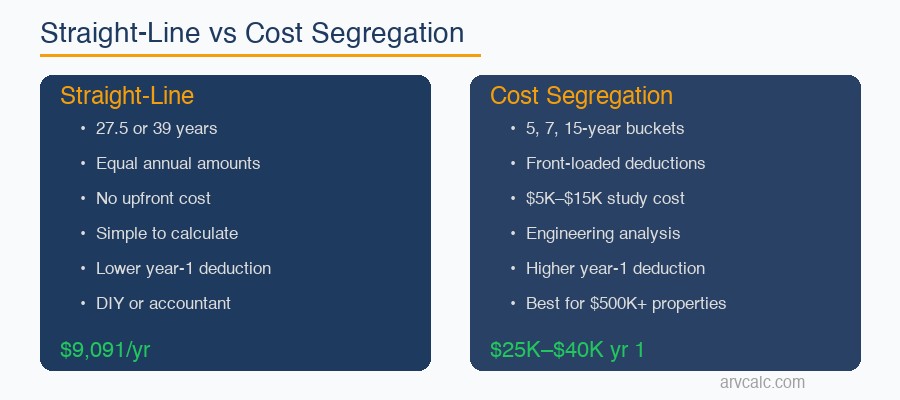
Straight-line depreciation is the default. Every investor gets it automatically. Cost segregation is an advanced strategy that front-loads deductions by reclassifying building components. Here is how they compare.
| Factor | Straight-Line | Cost Segregation |
|---|---|---|
| Recovery period | 27.5 or 39 years | 5, 7, 15 years for reclassified components; 27.5/39 for remainder |
| Annual deduction (early years) | Equal every year | Significantly larger in years 1–5 |
| Cost to implement | $0 — automatic | $5,000–$15,000 for a cost segregation study |
| Break-even property value | Any value | Generally $250,000+ in improvements to justify study cost |
| IRS audit risk | Very low | Low-moderate if study is done by a qualified engineer |
| Best for | All investors, lower-value properties, passive income offsetting | High-income investors, large properties, bonus depreciation years |
| Recapture treatment | Section 1250 (25% max rate) | Section 1245 for personal property (ordinary income rates) |
| Requires specialist | No | Yes — qualified engineer or cost segregation firm |
The Tax Foundation’s primer on cost recovery provides a solid overview of how cost segregation interacts with bonus depreciation rules under current law. The interplay between cost segregation and bonus depreciation (currently phased down from 100%) is where the biggest decisions are made.
The depreciation calculator runs both scenarios side by side so you can see the NPV difference without paying for a study first. If the NPV of accelerated deductions is meaningfully larger than the cost of the study, cost segregation is worth exploring with a specialist.
For more depth on the strategy, read the complete guide to real estate depreciation.
How Depreciation Reduces Your Tax Bill
Depreciation is a non-cash deduction. You do not write a check — you just reduce taxable income on paper. That makes it one of the most effective tax tools in real estate.
Concrete Dollar Savings: Dallas SFR at 35% Tax Bracket
Back to the Dallas property. Annual depreciation: $9,091. Tax bracket: 35%.
Annual tax savings = Annual depreciation × Marginal tax rate
Annual tax savings = $9,091 × 0.35 = $3,181.85 per year
Over 10 years of ownership, that is $31,818 in cumulative tax savings — without selling, without refinancing, without doing anything except owning the property. In 27.5 years (full recovery period), the total tax savings at 35% equals:
Lifetime tax savings = $250,000 × 0.35 = $87,500That $87,500 comes back to you as reduced tax payments spread over nearly three decades. The cash you keep each year can be reinvested, reducing the effective cost of the asset significantly.
Depreciation and Passive Activity Rules
There is a catch that catches many new investors off guard. Rental income is generally classified as passive income. Depreciation losses are passive losses. You can only offset passive losses against passive income, unless you qualify for an exception.
The two main exceptions:
- Active participation exception: If you actively participate in managing the rental (you make management decisions, approve tenants, authorize repairs), you can deduct up to $25,000 in rental losses against ordinary income. This phases out between $100,000 and $150,000 of adjusted gross income (AGI).
- Real estate professional status: If more than 50% of your work time and over 750 hours per year are spent in real property trades or businesses in which you materially participate, your rental losses are not subject to the passive activity rules at all. This is how high-income investors get full benefit of large depreciation deductions.
Passive losses that cannot be used in the current year are suspended and carried forward. They offset future passive income or release entirely when you sell the property. For more on this, see the complete depreciation calculator guide.
Depreciation Shelter: Month-by-Month Cash Flow Impact
On the Dallas SFR generating $2,000/month in rent with $800/month in expenses (excluding depreciation), taxable income without depreciation would be:
Annual rental income = $24,000
Annual operating expenses = $9,600
Taxable income (no depreciation) = $14,400
Tax at 35% = $5,040 per year
Add the $9,091 depreciation deduction:
Taxable income (with depreciation) = $14,400 − $9,091 = $5,309
Tax at 35% = $1,858 per year
Annual tax savings from depreciation = $5,040 − $1,858 = $3,182
The depreciation deduction cuts the tax bill by 63% in this scenario. Run the full cash flow in the rental property calculator to see how this plays out across different rent and expense assumptions.
Depreciation Recapture: What Happens When You Sell
Depreciation is not a free lunch. When you sell the property, the IRS collects depreciation recapture tax on all the deductions you took. This is the part most investors do not plan for until they are looking at a closing statement.
Section 1250 Recapture
For real property depreciated under straight-line MACRS (which is the standard method for residential and commercial property), depreciation recapture falls under Section 1250. The recapture tax rate on unrecaptured Section 1250 gain is a maximum of 25% — not your ordinary income rate, but not the lower long-term capital gains rate either.
Here is how it works on the Dallas SFR if you sell after 10 full years:
Cumulative depreciation taken (Years 1–10):
Year 1: $7,197
Years 2–10: $9,091 × 9 = $81,819
Total depreciation = $7,197 + $81,819 = $89,016

Original depreciable basis: $250,000
Adjusted basis at sale: $250,000 − $89,016 = $160,984

If you sell for $450,000:
Total gain = $450,000 − ($310,000 − $89,016) = $450,000 − $220,984 = $229,016

Of that gain:
Unrecaptured Section 1250 gain (taxed at max 25%) = $89,016
Remaining long-term capital gain (taxed at 0/15/20%) = $229,016 − $89,016 = $140,000
The recapture tax on $89,016 at 25% equals $22,254. That is real money. Factor it into every hold/sell analysis. The capital gains tax calculator handles recapture math and shows the full tax picture on a sale.
1031 Exchange: Defer Recapture Indefinitely
A 1031 exchange lets you roll the proceeds from one investment property into another of equal or greater value without triggering capital gains tax or depreciation recapture — in the year of the exchange. Recapture is deferred, not eliminated. But deferring it for decades while your basis in the new property generates fresh depreciation is a effective wealth-building strategy.
See the 1031 exchange calculator to model a potential exchange and quantify the tax deferral. The 1031 exchange guide covers the identification and closing timeline rules. Also useful: how to avoid capital gains tax on investment property and the 1031 exchange capital gains calculator guide.
Cost Segregation Recapture: A Different Rate
Personal property components reclassified through cost segregation are subject to Section 1245 recapture, taxed at ordinary income rates — potentially higher than the 25% Section 1250 rate. This is a real consideration when modeling whether cost segregation makes sense for your specific situation. The NPV analysis in the depreciation calculator accounts for recapture assumptions in the cost segregation mode.
5 Common Depreciation Mistakes
1. Depreciating the Land
What happens: Investors enter the full purchase price as their depreciable basis, including land value. The IRS does not allow depreciation on land.
Why it matters: Claiming depreciation on land is an error that can trigger an audit and require you to repay deductions with interest and penalties.
Fix: Always get a separate land value from your county tax assessment, appraisal, or a supportable allocation method. Document your basis calculation and keep it in your records for the life of the property.
2. Starting Depreciation on the Purchase Date Instead of the In-Service Date
What happens: Investors start the depreciation clock on the closing date. If the property is not immediately available for rent — because of renovation, permitting, or other delays — the correct date is when it is placed in service.
Why it matters: Starting too early inflates deductions. Starting too late (through ignorance) means you lose deductions you were entitled to.
Fix: Document the date the property was ready and available for rent. Keep photos, emails with contractors, or listing dates as evidence. Run the date through the depreciation calculator to confirm year-one deductions using the correct in-service date.
3. Forgetting to Depreciate Capital Improvements Separately
What happens: Investors add a new roof ($18,000) or HVAC system ($9,000) to the property and either expense it or ignore it for depreciation. Capital improvements must be depreciated separately over their own recovery periods — not folded into the original purchase basis mid-ownership.
Why it matters: A roof replacement has a 27.5-year recovery period (residential). An HVAC system may qualify for a 5-year or 15-year period depending on classification. Depreciating each improvement on its own schedule maximizes deductions and avoids errors.
Fix: Track every capital improvement with its own depreciation schedule. When you sell, your adjusted basis must account for all improvements added and all depreciation taken — on the original structure and on each improvement separately. The depreciation explainer covers improvements in detail.
4. Ignoring Depreciation Recapture in Hold/Sell Decisions
What happens: Investors look at the sale price and their original purchase price to estimate profit. They do not account for the adjusted basis after depreciation, which means they underestimate the taxable gain and the recapture tax.
Why it matters: On a property held for 10 years with $89,000 in cumulative depreciation, the adjusted basis is $89,000 lower than the original purchase price. That $89,000 is taxed at up to 25% when you sell — a $22,250 bill that is easy to miss in a back-of-envelope calculation.
Fix: Use the capital gains tax calculator before deciding to sell. It factors in adjusted basis, recapture, and your bracket. Also run the 1031 exchange calculator to compare keeping the gain deferred versus paying tax now.
5. Skipping a Cost Segregation Analysis on High-Value Properties
What happens: Investors with properties over $500,000 default to straight-line depreciation and leave tens of thousands of dollars in early-year deductions on the table.
Why it matters: On a $600,000 commercial property, a cost segregation study might reclassify $80,000–$120,000 of assets into 5-year or 15-year property. At 35% marginal rate and bonus depreciation, that can produce an additional $28,000–$42,000 in deductions in year one alone — far exceeding the $8,000–$12,000 cost of the study.
Fix: Run the cost segregation mode in the real estate depreciation calculator to get a rough NPV comparison before commissioning a formal study. If the numbers look promising, hire a qualified cost segregation engineer. The American Society of Cost Segregation Professionals maintains a directory of qualified practitioners.
Frequently Asked Questions
Can I use a real estate depreciation calculator for any property type?
Yes. The real estate depreciation calculator handles residential rental property (27.5-year MACRS), commercial real property (39-year MACRS), and cost segregation scenarios for both. For residential, enter single-family, duplex, triplex, fourplex, or apartment buildings where at least 80% of gross rental income comes from dwelling units. For commercial, enter office buildings, retail, industrial, or mixed-use properties that do not meet the residential threshold.
How do I find the land value for my rental property?
What is the depreciation recapture rate when I sell?
Does depreciation reduce my taxable income even if the property is cash flow positive?
What happens to unused depreciation losses if my income is too high?
How does a 1031 exchange interact with accumulated depreciation?
Is cost segregation worth it for a property under $300,000?
Related Calculators
Depreciation is one input into a broader investment analysis. These calculators work together to give you the full picture on any rental or commercial property.
- Depreciation Calculator — Annual deduction, full depreciation schedule, cost segregation comparison
- Rental Property Calculator — Full pro forma: NOI, cash flow, CoC, cap rate in one place
- Capital Gains Tax Calculator — Models recapture, long-term gains, and net proceeds on sale
- 1031 Exchange Calculator — Quantifies tax deferral and compares exchange vs. sell scenarios
- Property Cash Flow Calculator — Monthly and annual after-tax cash flow with depreciation shelter built in
- NOI Calculator — Net operating income before depreciation and debt service
- Cap Rate Calculator — Property value and return on a debt-free basis
- Cash-on-Cash Calculator — Annual return on your actual cash invested
- Real Estate ROI Calculator — Total return including appreciation, cash flow, and tax benefits
- All Calculators — Full library of free real estate investment tools
For further reading: the net operating income guide covers how depreciation fits into property valuation, and the investment property down payment guide shows how your financing structure affects depreciable basis and overall returns. The IRS Publication 946 PDF is the primary reference for all MACRS depreciation rules and tables.
Leave a Reply