Last updated: October 7, 2026 · Originally published: August 26, 2026 · By Alex Petrov
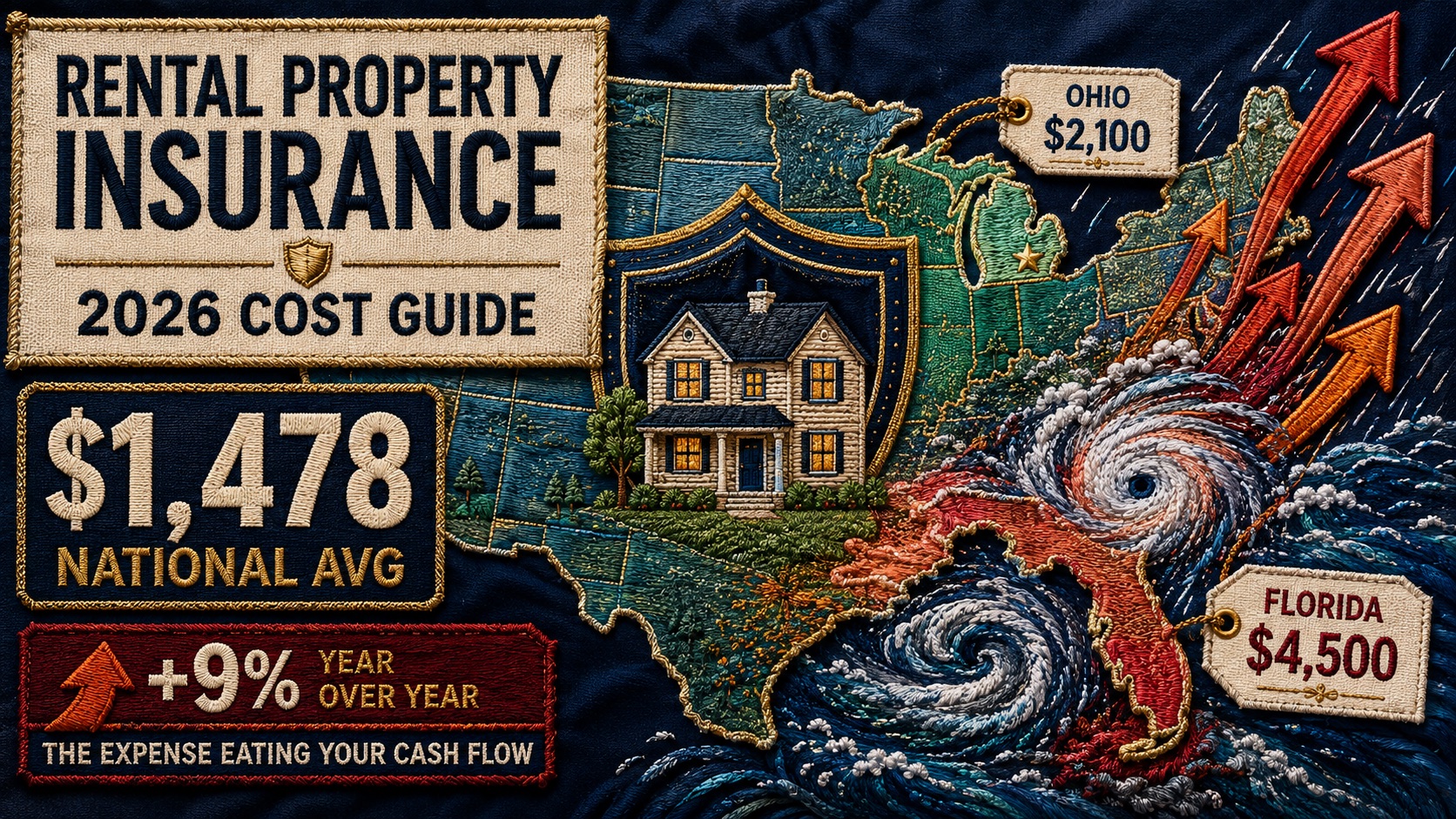
Rental property insurance cost averages $1,478 per year nationally in 2026 — but that number is misleading. If you invest in Texas, you pay $3,300. In Florida, $4,500. In Ohio, $2,100. Insurance is the fastest-rising expense in real estate investing, up 9% year over year and 20%+ in disaster-prone states. It is now the #1 cost concern for rental property investors, ahead of property taxes and vacancy. Here is what landlord insurance actually costs in every major investment state, how it impacts your cash flow, and how to reduce it without cutting coverage.
What Does Rental Property Insurance Cover?
Rental property insurance (also called landlord insurance or a DP-3 policy) covers three things that standard homeowner insurance does not cover for investment properties:
- Dwelling coverage — structural damage from fire, wind, hail, lightning, vandalism. This is the biggest component and determines your premium.
- Liability coverage — if a tenant or visitor is injured on your property. Standard: $100K–$300K per occurrence. Recommended: $500K+ for investment properties.
- Loss of rental income — replaces rent payments if the property becomes uninhabitable due to a covered event. Typically covers 12 months of fair market rent.
What landlord insurance does NOT cover: tenant belongings (that is renter’s insurance), flood damage (requires separate NFIP or private flood policy), normal wear and tear, or intentional damage by tenants. Mold, pest infestations, and sewer backups often require separate riders at $50–$200/year each. If your property is in a FEMA flood zone, add $500–$2,500/year for flood coverage on top of the numbers below. Always ask about sewer backup coverage — it is the fastest-growing claim category and costs only $50–$75/year as a rider.
How Much Does Rental Property Insurance Cost in 2026?
The national average rental property insurance cost is $1,478 per year ($123/month) for a basic DP-3 landlord policy. However, this average hides massive variation:
| Policy Type | Annual Cost | Monthly | Notes |
|---|---|---|---|
| Basic DP-1 (named perils) | $800–$1,200 | $67–$100 | Cheapest but covers only listed perils |
| Standard DP-3 (open perils) | $1,200–$2,500 | $100–$208 | Recommended — covers all perils except exclusions |
| Premium DP-3 + umbrella | $2,500–$5,000+ | $208–$417+ | Higher liability limits, umbrella policy |
| Coastal/high-risk | $3,500–$8,500 | $292–$708 | FL, TX Gulf, NC coast — includes windstorm |
Landlord insurance costs 15–25% more than homeowner insurance on the same property. A $200K home with $1,600/year homeowner insurance will cost $1,840–$2,000/year as a rental. The premium reflects higher claim frequency (tenants are less careful than owners), broader liability exposure, and loss-of-rent coverage.
Model your insurance cost impact on monthly cash flow in the cash flow calculator. Insurance is one of the inputs that most investors underestimate.
Rental Property Insurance Cost by State
Here is what rental property investors actually pay in the 10 most popular investment states, based on 2026 data from state insurance departments and industry aggregators:
| State | Avg Annual | Monthly | Range | Trend |
|---|---|---|---|---|
| Ohio | $2,100 | $175 | $1,400–$2,800 | Stable (+3%) |
| Indiana | $1,800 | $150 | $1,200–$2,500 | Stable (+4%) |
| Georgia | $2,100 | $175 | $1,400–$3,500 | Rising (+7%) |
| North Carolina | $3,000 | $250 | $2,000–$4,500 | Rising fast (+15%) |
| Tennessee | $2,200 | $183 | $1,500–$3,200 | Rising (+8%) |
| Texas | $3,300 | $275 | $2,200–$5,000 | Rising fast (+19%) |
| Florida | $4,500 | $375 | $3,200–$8,500 | Rising fast (+21%) |
| Louisiana | $2,484 | $207 | $1,800–$4,600 | Highest in US |
| Oklahoma | $2,800 | $233 | $2,000–$4,000 | Rising (+12%) |
| Oregon | $883 | $74 | $600–$1,400 | Lowest in US |
Key pattern: Midwest and inland states (Ohio, Indiana, Oregon) pay $150–$175/month. Gulf Coast and hurricane states (Texas, Florida, Louisiana) pay $275–$375/month. That is a $100–$200/month difference in insurance alone — enough to swing a deal from cash-flow positive to negative.
For state-specific analysis with verified insurance, tax, and vacancy data built into the calculators: Ohio, Georgia, North Carolina, Texas, Florida.
Why Rental Property Insurance Costs Are Rising in 2026
Insurance is rising faster than any other rental property expense. Per the National Association of Insurance Commissioners (NAIC), homeowner insurance premiums increased 20% nationally over the past two years. Landlord policies followed with a 9% year-over-year increase in 2026.
Four forces are driving costs up:
- Climate events. Hurricanes, hail storms, and wildfires are increasing in frequency and severity. Insured losses from natural catastrophes exceeded $100 billion globally in 2025. Reinsurers (the companies that insure insurance companies) raised their rates, and those costs flow directly to your premium.
- Rebuilding costs. Construction material costs are up 30%+ since 2020. Labor shortages persist. A roof replacement that cost $8,000 in 2020 costs $12,000–$15,000 in 2026. Insurance companies must increase premiums to cover higher replacement costs.
- Litigation and fraud. Florida and Texas lead in insurance litigation. Assignment of Benefits (AOB) abuse, inflated claims, and litigation costs add $500–$1,000 per policy in these states.
- Carrier exits. Several major insurers have pulled out of high-risk states (Florida, California, Louisiana). Less competition = higher premiums. In Florida, Citizens Property Insurance (the state insurer of last resort) now covers more properties than any private carrier.
For investors, this means insurance is no longer a “set it and forget it” line item. You need to re-quote your coverage annually and factor rising premiums into your hold period analysis. Use the ROI calculator to model increasing insurance costs over a 5–10 year hold.
How Insurance Impacts Your Cash Flow: Worked Example
Insurance can be the difference between a cash-flow positive deal and a money-losing one. Here is the same $180K rental property analyzed in three different states:
Assumptions: $180K purchase, 25% down, 6.7% mortgage rate, $1,500/month rent, 7% vacancy, 8% maintenance, 10% management.
| Line Item | Ohio | North Carolina | Florida |
|---|---|---|---|
| Gross Rent | $1,500 | $1,500 | $1,500 |
| − Vacancy (7%) | −$105 | −$105 | −$105 |
| − Property Tax | −$175 | −$99 | −$149 |
| − Insurance | −$175 | −$250 | −$375 |
| − Maintenance (8%) | −$120 | −$120 | −$120 |
| − Management (10%) | −$150 | −$150 | −$150 |
| = NOI | $775 | $776 | $601 |
| − Mortgage P&I | −$869 | −$869 | −$869 |
| = Cash Flow | −$94 | −$93 | −$268 |
Same property, same rent, same mortgage — but $200/month worse cash flow in Florida than Ohio, entirely due to insurance. Over a 5-year hold, that is $12,000 in additional insurance costs eating into your returns.
And this assumes insurance stays flat. If Florida premiums rise another 20% (as they did in 2024–2025), that $375/month becomes $450/month — an additional $900/year with no increase in rent or property value to offset it.
Run your specific deal with accurate insurance costs in the cash flow calculator. For state-specific breakdowns, see the closing costs guide.
Now consider insurance rising 9% annually for the next 5 years. In Florida, that $375/month becomes $577/month by year 5 — an additional $2,424/year eating into returns that most investors never model. In Ohio, the same 9% increase takes $175 to $269 — painful but manageable. This is why experienced investors run 5-year and 10-year projections, not just year-1 cash flow. Use the ROI calculator to model total returns over your planned hold period with increasing insurance costs each year.
7 Ways to Lower Your Rental Property Insurance Cost
1. Bundle Multiple Properties
Most insurers offer 10–15% multi-policy discounts when you insure 2+ properties. If you own 4 rentals at $2,000/year each, bundling saves $800–$1,200 annually. Ask your agent about portfolio policies — a single policy covering all properties, often cheaper than individual DP-3s.
2. Raise Your Deductible
Increasing your deductible from $1,000 to $2,500 typically reduces premiums by 10–15%. On a $2,100/year Ohio policy, that saves $210–$315/year. The trade-off: you pay more out of pocket per claim. For investors with reserves, the higher deductible almost always makes financial sense — you should not file small claims anyway (they raise your rates).
3. Shop Every Year
Insurance loyalty does not pay. Get 3–5 quotes annually from different carriers. Rates vary 30–50% between companies for the same property. Use landlord-specific insurers like Steadily, Obie, or NREIG — they often beat traditional carriers by 15–20% because they specialize in investment properties. One investor in our community switched from State Farm to Steadily on a Cleveland rental and saved $420/year with identical coverage — that is $35/month directly back into cash flow.
4. Improve the Property
A new roof can reduce premiums by 15–25%. Updated electrical and plumbing systems reduce fire risk. Impact-resistant windows lower windstorm premiums in coastal states. These improvements pay for themselves in lower insurance costs within 3–5 years — and they increase property value.
5. Require Tenant Renter’s Insurance
When tenants carry their own renter’s insurance ($15–$30/month), your liability exposure drops. Some landlord insurers offer 5–10% discounts when tenants are required to carry renter’s coverage. Add it as a lease requirement.
6. Install Security and Safety Features
Smoke detectors, security cameras, deadbolts, and monitored alarm systems can reduce premiums 5–15%. Smart water leak detectors prevent costly water damage claims — the #1 claim type for rental properties.
7. Avoid High-Risk States for Cash Flow Plays
If your strategy is cash flow (not appreciation), high-insurance states destroy returns. A Cleveland duplex at $2,100/year insurance produces better cash flow than a Tampa SFR at $4,500/year — even if Tampa has higher rents. Factor insurance into your market selection, not just after you find a deal. Compare markets in the cap rate calculator and deal comparison tool.
Landlord Insurance vs Homeowner Insurance
| Feature | Homeowner (HO-3) | Landlord (DP-3) |
|---|---|---|
| Cost | $1,200–$2,000/yr avg | $1,478–$2,500/yr avg (15–25% more) |
| Who lives there | Owner-occupied | Tenant-occupied |
| Personal property | Covers owner’s belongings | Does NOT cover tenant belongings |
| Loss of use | Covers alternative living costs | Covers lost rental income |
| Liability | Standard premises liability | Enhanced landlord liability (tenant injuries) |
| Vacancy clause | 30-day vacancy limit | 60-day vacancy limit (some carriers 90) |
| Required by lender? | Yes (mortgage requirement) | Yes (investment loan requirement) |
Critical mistake: Some new investors keep their homeowner policy after converting a primary residence to a rental. Homeowner insurance does NOT cover tenant-occupied properties. If a tenant is injured and you have HO-3 instead of DP-3, your claim will be denied. Always switch to a landlord policy before placing tenants. Per the Insurance Information Institute (III), the average homeowner claim is $15,000–$20,000 — denied claims on a wrong policy type can be financially devastating.
Frequently Asked Questions
How much does rental property insurance cost per month?
The average rental property insurance cost is $123/month ($1,478/year) nationally. However, costs range from $74/month in low-risk states like Oregon to $375/month in Florida. For a typical Midwest investment property (Ohio, Indiana, Georgia), expect $150–$175/month. For Gulf Coast and hurricane-prone states (Texas, Florida, Louisiana), expect $250–$375/month. These are averages for standard DP-3 policies on single-family rentals — multifamily, coastal, and older properties pay more.
Is landlord insurance more expensive than homeowner insurance?
Why is rental property insurance so expensive in Florida and Texas?
Do I need landlord insurance if I self-manage?
How do I estimate rental property insurance cost before buying?
Related Calculators and Guides
- Cash Flow Calculator — Model insurance impact on monthly cash flow
- Closing Costs Calculator — First-year insurance in closing estimate
- Cap Rate Calculator — Insurance affects NOI and cap rate
- ROI Calculator — Total return with rising insurance costs
- NOI Calculator — Insurance is a key operating expense
- Deal Comparison Tool — Compare markets with different insurance costs
- Rental Property Calculator — Full investment analysis
- All 30+ Calculators
State-specific calculators with verified insurance data:
- Ohio Calculators — $2,100/yr avg insurance
- Georgia Calculators — $2,100/yr avg insurance
- North Carolina Calculators — $3,000/yr avg insurance
- Texas Calculators — $3,300/yr avg insurance
- Florida Calculators — $4,500/yr avg insurance
Blog guides:
- Cash Flow Calculator Guide
- Closing Costs Calculator Guide
- Cap Rate Calculator Guide
- NOI Calculator Guide
- Cap Rate by State
Rental Property Insurance FAQ
How much is rental property insurance per month?
Rental property insurance averages $100-$375 per month ($1,200-$4,500 per year) depending on state, property value, and coverage. Florida and Texas are the most expensive due to hurricane and storm risk. Ohio and Indiana are among the cheapest.
Is landlord insurance more expensive than homeowner insurance?
Yes, typically 20-30% more. Landlord policies cover liability for tenants and include loss of rental income coverage. A home insured at $3,000/year as owner-occupied might cost $3,900-$4,200 as a rental property.
Do I need a separate policy for each rental property?
Yes. Each property needs its own landlord insurance policy. However, some insurers offer portfolio discounts for 3+ properties with the same company. Always get quotes from at least 3 carriers per property.
Is rental property insurance tax deductible?
Yes, rental property insurance premiums are 100% deductible as an operating expense on Schedule E. This reduces your taxable rental income dollar-for-dollar.
What does landlord insurance NOT cover?
Standard landlord policies do not cover tenant belongings (tenants need renter’s insurance), flood damage (requires separate flood policy), earthquake damage, or intentional damage by tenants. Vacancy beyond 30-60 days may also void coverage with some carriers.
Leave a Reply