Last updated: September 24, 2026 · Originally published: August 13, 2026 · By Alex Petrov
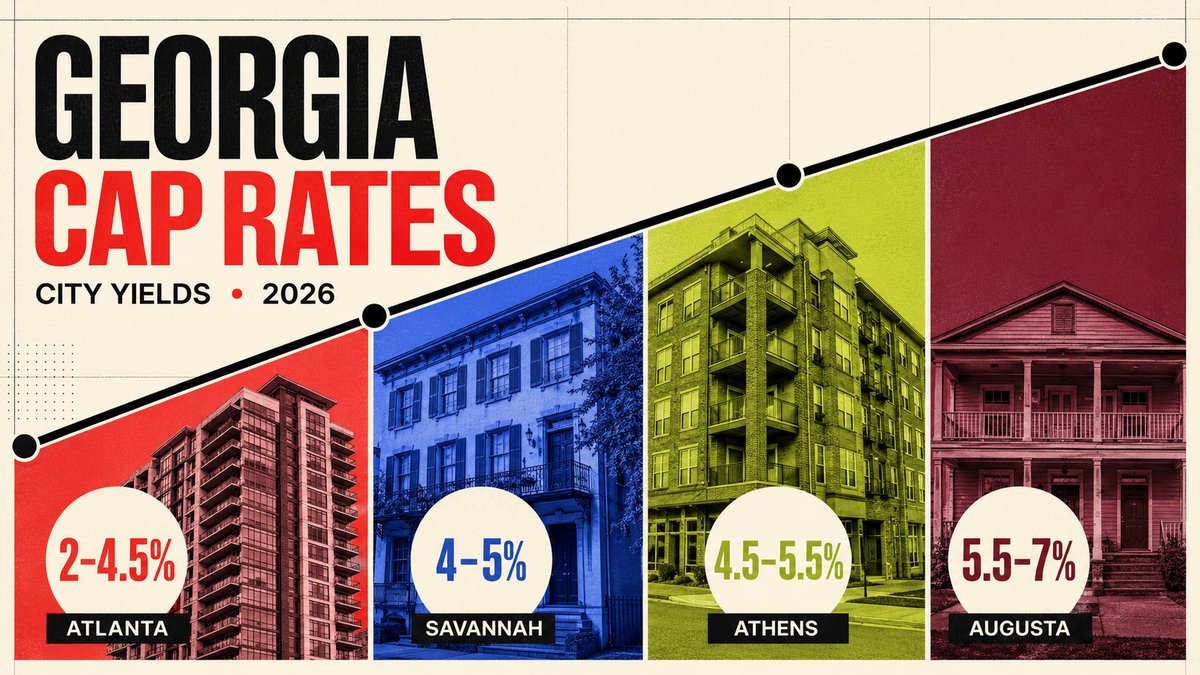
Georgia cap rates range from 4–5% in Atlanta to 6–7% in Augusta — driven by Georgia’s low 0.79% property tax that boosts NOI above most competing states. The Georgia cap rate calculator runs forward and reverse analysis with GA-specific tax, insurance, and vacancy defaults pre-loaded.
Georgia Cap Rates by City: 2026 Data
| Metro | Median Price | Median Rent | Typical Cap Rate | Vacancy | Property Tax |
|---|---|---|---|---|---|
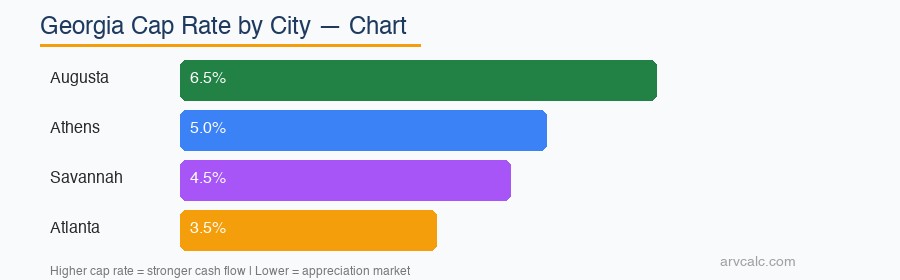
| Augusta | $210,000 | $1,200/mo | 5.5–7.0% | 8.0% | 1.0% |
| Athens | $280,000 | $1,400/mo | 4.5–5.5% | 5.0% | 0.9% |
| Savannah | $360,000 | $1,600/mo | 4.0–5.0% | 7.0% | 0.95% |
| Atlanta | $400,000 | $1,700/mo | 2.0–4.5% | 5.5% | 1.1% |
Augusta leads because of low prices and moderate rents — the rent-to-price ratio is the best in Georgia. Atlanta’s compressed cap rates reflect appreciation pricing, not poor income. The Tax Foundation confirms Georgia’s property tax advantage — at 0.79%, it is the lowest among major investor states.
What Drives Cap Rates in Georgia
Low property tax = higher NOI. Georgia’s 0.79% effective rate vs Texas 1.40% means $1,220 more NOI per year on a $200K property. That alone adds 0.6% to cap rate. Use county-specific rates in the Georgia cap rate calculator — Fulton County (1.1%) is 40% higher than statewide average.
Insurance varies dramatically. Atlanta inland: $2,000/yr. Savannah coastal: $2,800/yr. The $800 difference reduces Savannah cap rates by roughly 0.5% vs an identical property in Atlanta. Get real quotes from the Georgia Department of Insurance marketplace.
Military and university demand. Augusta (Fort Eisenhower) and Athens (UGA) have uniquely stable tenant pools that reduce vacancy risk and support consistent rents — factors that compress cap rates below what the raw numbers suggest. Lower risk = lower cap rate = more expensive per dollar of NOI.
Augusta: Highest Cap Rates
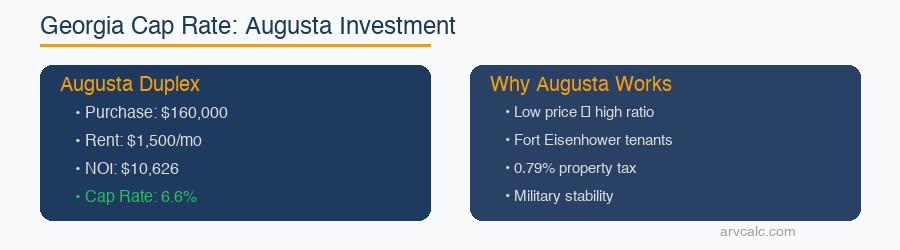
A $160K duplex renting for $1,500/month (two $750 units) produces roughly $10,600 NOI and a 6.6% cap rate. Fort Eisenhower and the Army Cyber Command provide a steady stream of military tenants. The Masters Tournament creates short-term rental demand every April. Cap rates in Augusta run 5.5–7% on stabilized SFR and small multifamily.
Atlanta: Lowest Cap Rates, Highest Growth
A $400K SFR renting for $1,700/month produces roughly $9,300 NOI and a 2.3% cap rate. Atlanta is priced for appreciation, not cash flow. Delta, Coca-Cola, UPS, Home Depot, and the film industry (Georgia is #1 in the US) drive demand. Vacancy at 5.5% is tight. For investors accepting thin cash flow in exchange for equity growth, Atlanta works. For cash flow, look to Augusta.
Georgia Cap Rate vs Other States
| State | Typical SFR Cap Rate | Property Tax | Insurance | Income Tax |
|---|---|---|---|---|
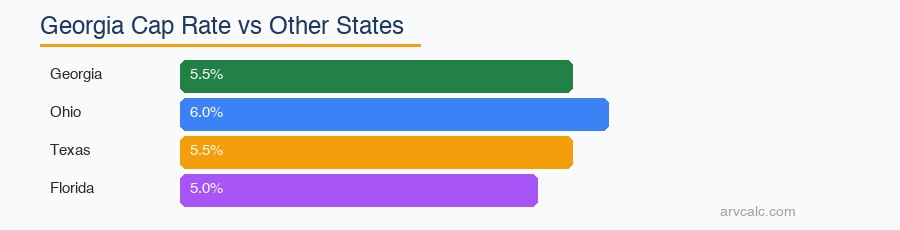
| Georgia | 4.0–7.0% | 0.79% | $2,100 | 4.99% |
| Ohio | 5.0–7.0% | 1.36% | $2,100 | 2.75% |
| Texas | 4.5–6.5% | 1.40% | $3,300 | 0% |
| Florida | 4.0–6.0% | 1.10% | $4,500 | 0% |
Georgia’s cap rate range is wide because Augusta ($210K) and Atlanta ($400K) are very different markets. The property tax advantage gives Georgia higher NOI per property dollar than any state in the table. For state-level cap rate comparisons, see the cap rate by state guide.
5 Georgia Cap Rate Mistakes
1. Using Statewide Tax Rate for Fulton/DeKalb
Why: 0.79% statewide vs 1.1–1.2% in metro Atlanta counties = $620–$820/yr difference on $200K.
Fix: County auditor website. The Georgia cap rate calculator defaults statewide — override for your county.
2. Ignoring Coastal Insurance Premium
Why: Savannah $2,800/yr vs Atlanta $2,000/yr = 0.5% cap rate difference on the same property.
Fix: Get real insurance quotes for any property within 50 miles of the coast.
3. Comparing Atlanta Cap Rates to Augusta
Why: 2.3% in Atlanta and 6.6% in Augusta are not the same risk profile. Atlanta has 5.5% vacancy and Fortune 500 employers. Augusta has 8% vacancy and military dependency.
Fix: Compare within the same metro. Use cap rate to evaluate deals in the same city, not across cities.
4. Forgetting 4.99% State Income Tax
Why: Cap rate is pre-income-tax. After 4.99% GA state tax, your effective after-tax yield drops. A 6% cap rate with 4.99% income tax delivers less than a 6% cap rate in Texas (0%).
Fix: Calculate after-tax cash flow separately using the cash flow calculator.
5. Not Accounting for Intangible Tax in Acquisition Cost
Why: 0.3% intangible tax on mortgage + 0.1% transfer tax + attorney fee adds $2,000–$3,000 that most out-of-state investors miss.
Fix: Use the Georgia closing costs calculator for accurate total acquisition cost.
Frequently Asked Questions
What is a good cap rate in Georgia?
Augusta: 5.5–7% (cash flow). Athens: 4.5–5.5% (student demand). Atlanta: 2–4.5% (appreciation). A “good” cap rate depends on whether you prioritize cash flow or growth. Use the Georgia cap rate calculator.
How does Georgia property tax affect cap rate?
Is Atlanta or Augusta better for cap rate investing?
Does Georgia have state income tax on rental income?
What insurance costs should I include in Georgia cap rate?
Related Georgia Tools
- Georgia Cap Rate Calculator
- Georgia Rental Property Calculator
- Georgia Closing Costs Calculator
- Georgia DSCR Calculator
- Georgia Calculator Hub
- What Is a Good Cap Rate?
- Cap Rate by State 2026
- All 30+ Calculators
Sources: Georgia DOR Property Tax · FRED Georgia Data · Georgia Office of Insurance
Leave a Reply