{
“@context”: “https://schema.org”,
“@type”: “FAQPage”,
“mainEntity”: [
{
“@type”: “Question”,
“name”: “What are the typical Florida closing costs for an investment property?”,
“acceptedAnswer”: {
“@type”: “Answer”,
“text”: “Florida closing costs for investment property typically run 2–4% of the purchase price for buyers. On a $400,000 property, expect $8,000–$16,000 in closing costs, which includes documentary stamp taxes, intangible tax on the mortgage, title insurance, appraisal, inspection, and prepaid escrow items.”
}
},
{
“@type”: “Question”,
“name”: “What are documentary stamp taxes in Florida?”,
“acceptedAnswer”: {
“@type”: “Answer”,
“text”: “Documentary stamp taxes (doc stamps) are Florida state transfer taxes. On the deed, the rate is $0.70 per $100 of the sale price (paid by the seller in most counties). On the mortgage/promissory note, the rate is $0.35 per $100 of the loan amount, paid by the buyer. Miami-Dade County is the exception — deed stamps are $0.60 per $100 but an additional surtax brings the effective total higher on certain transactions.”
}
},
{
“@type”: “Question”,
“name”: “Does Florida have an intangible tax on mortgages?”,
“acceptedAnswer”: {
“@type”: “Answer”,
“text”: “Yes. Florida charges an intangible tax of $0.002 (0.2%) on the original principal balance of any new mortgage. On a $320,000 loan, that’s $640. This is a one-time tax paid at closing by the borrower. Mortgage refinances and certain assumption transactions are also subject to this tax.”
}
},
{
“@type”: “Question”,
“name”: “Who pays closing costs in Florida — buyer or seller?”,
“acceptedAnswer”: {
“@type”: “Answer”,
“text”: “In Florida, the seller typically pays the deed doc stamps and the owner’s title insurance policy. The buyer pays the mortgage doc stamps, intangible tax, lender’s title insurance, appraisal, inspection, survey, recording fees, and prepaid items (escrow, prepaid interest). These are negotiable and can shift based on the purchase contract.”
}
},
{
“@type”: “Question”,
“name”: “How does Miami-Dade County differ for closing costs?”,
“acceptedAnswer”: {
“@type”: “Answer”,
“text”: “Miami-Dade County has a different documentary stamp rate on deeds: $0.60 per $100 instead of $0.70. However, Miami-Dade also imposes a surtax of $0.45 per $100 on all transfers except single-family homes that will be owner-occupied. For investment properties, the combined rate is $1.05 per $100 — making Miami-Dade more expensive than other Florida counties for deed taxes.”
}
},
{
“@type”: “Question”,
“name”: “Are Florida closing costs tax deductible for investment properties?”,
“acceptedAnswer”: {
“@type”: “Answer”,
“text”: “Some closing costs are deductible or must be capitalized. Prepaid mortgage interest (per diem interest at closing) is deductible in the year paid. Points may be deductible over the life of the loan. Most other costs — title fees, appraisal, recording fees — are added to your cost basis and recovered through depreciation. See IRS Publication 527 for investment property rules.”
}
},
{
“@type”: “Question”,
“name”: “How can I reduce closing costs on a Florida investment property?”,
“acceptedAnswer”: {
“@type”: “Answer”,
“text”: “Five effective strategies: (1) negotiate seller concessions in the purchase contract, (2) shop title insurance — Florida allows price competition on lender’s title, (3) use a simultaneous issue discount when buying both owner’s and lender’s policies together, (4) close at month-end to minimize prepaid interest days, (5) compare lenders’ loan estimates — origination fees and points vary widely between banks and DSCR lenders.”
}
}
]
}
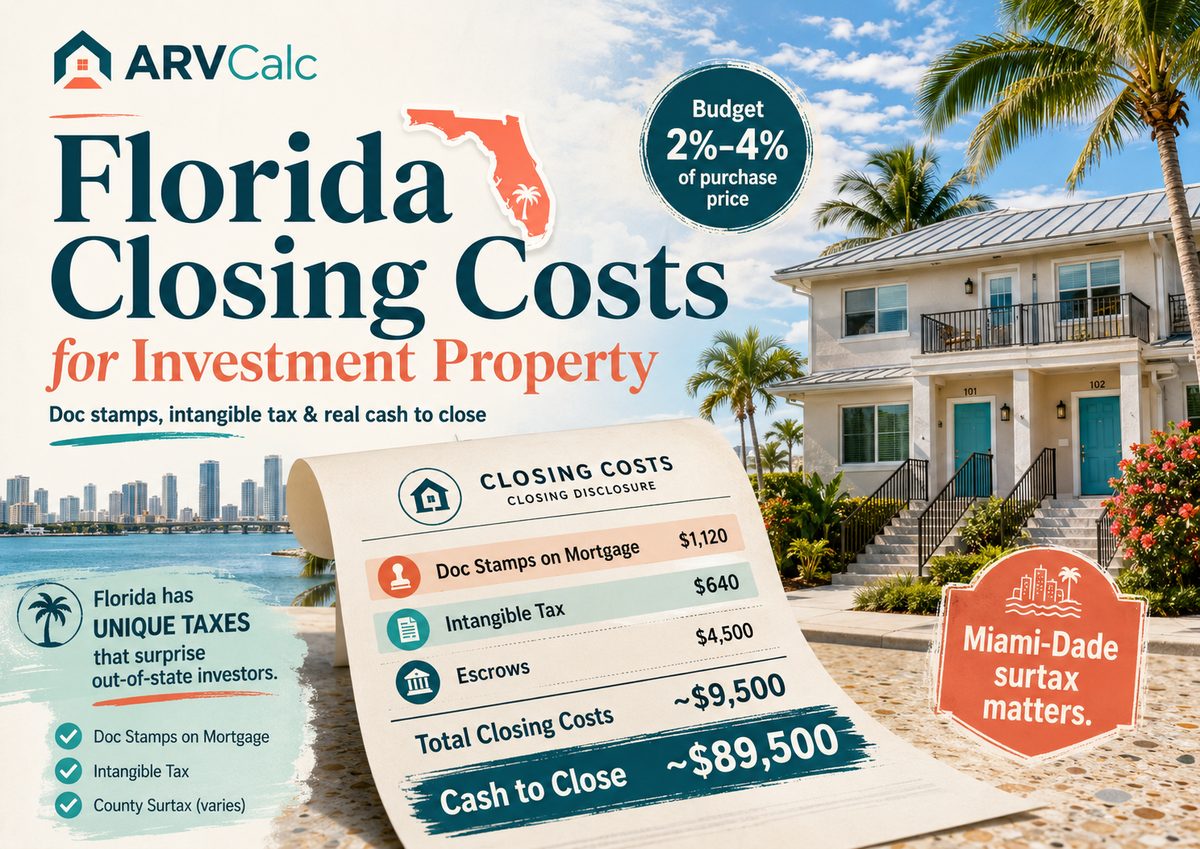
When it comes to florida closing costs, most investors from other states get caught off guard. A Tampa investor put a $400,000 single-family rental under contract last spring, ran the numbers on the down payment, and felt confident. Then the closing disclosure landed in her inbox. Right there, buried under lender fees, was a line item she had not budgeted: $1,120 in documentary stamp taxes on the mortgage, followed by a $640 intangible tax charge. She had heard about florida closing costs being “a few percent,” but she had not done the math on Florida’s unique state taxes. She almost came up short at the closing table. This guide exists so you do not have to scramble at the last minute.
Florida investment property buyers should budget 2%–4% of the purchase price in total closing costs. On a $400K property with 20% down, expect roughly $8,500–$10,500 out of pocket in closing costs alone, plus your $80,000 down payment. The two costs that surprise investors most are: (1) doc stamps on the mortgage at $0.35/$100 of the loan and (2) the intangible tax at 0.2% of the loan amount. Use the Florida closing costs calculator to model your exact deal before you make an offer.
How Florida Closing Costs Work for Investment Property
Florida is a title insurance state, which means the closing process runs through a title company or real estate attorney — not an escrow company the way it does in California. That distinction matters because the title company handles the settlement, disburses funds, and records the deed. Your closing disclosure will look different from what investors used to other states expect.
Florida also imposes two state-level taxes that most other states do not have in the same form: the documentary stamp tax and the intangible tax. Together, these two line items can add $1,500–$3,000 to a typical investment property transaction, and they catch out-of-state investors completely off guard.
Before you close on any Florida deal, run your numbers through the Florida closing costs calculator — it factors in both taxes automatically based on your purchase price and loan amount.
Documentary Stamp Tax: The Deed
The documentary stamp tax on the deed is charged on the sale price of the property. The standard Florida rate is $0.70 per $100 of the consideration (sale price). On a $400,000 purchase, that is $2,800. In Florida, the seller customarily pays the deed doc stamps, though this is negotiable in the purchase contract.
The Florida Department of Revenue administers and collects this tax. You can verify current rates and exemptions directly on the Florida Department of Revenue’s documentary stamp tax page.
Documentary Stamp Tax: The Mortgage
This is the one that surprises buyers. Florida also charges doc stamps on the promissory note (the mortgage). The rate is $0.35 per $100 of the original loan amount. The buyer pays this at closing. On a $320,000 loan (80% of a $400K purchase), that is $1,120.
Intangible Tax on Mortgages
On top of the mortgage doc stamps, Florida imposes an intangible tax of $0.002 (0.2%) on the original principal balance of any new mortgage secured by Florida real property. On that same $320,000 loan, the intangible tax is $640. The buyer pays this at closing, and it is non-negotiable with the state — though the lender controls how it appears on your closing disclosure.
Miami-Dade County: The Exception You Need to Know
Miami-Dade County operates under a different deed documentary stamp structure than every other Florida county. The base rate on deeds is $0.60 per $100 (lower than the statewide $0.70). However, Miami-Dade adds a surtax of $0.45 per $100 on transfers of property that is not a single-family home used as a primary residence by the buyer. For investment properties — rentals, duplexes, commercial — the combined Miami-Dade rate on the deed is $1.05 per $100.
That means buying a $400,000 investment property in Miami-Dade costs $4,200 in deed doc stamps (paid by the seller), compared to $2,800 in Tampa or Orlando. If you are negotiating seller concessions, this difference matters. The mortgage doc stamps and intangible tax rates are the same statewide — only the deed side differs in Miami-Dade.
For deals in South Florida, always model the Miami-Dade rates separately. The Florida closing costs calculator has a Miami-Dade toggle built in.
Florida Closing Costs Example: Tampa SFR at $400,000
Let’s put real numbers on a typical Florida investor scenario. You are buying a single-family rental in Tampa, purchase price $400,000, 20% down payment ($80,000), conventional investment property loan at 7.25% on a $320,000 balance.
| Closing Cost Item | Amount | Who Pays |
|---|---|---|
| Doc stamps on mortgage ($320K × $0.35/$100) | $1,120 | Buyer |
| Intangible tax on mortgage ($320K × 0.2%) | $640 | Buyer |
| Appraisal (investment property) | $550 | Buyer |
| Home inspection | $400 | Buyer |
| Lender’s title insurance | $625 | Buyer |
| Survey | $400 | Buyer |
| Recording fees (deed + mortgage) | $200 | Buyer |
| Escrow impounds (3 months taxes + insurance) | $4,500 | Buyer |
| Prepaid interest (~15 days at 7.25%) | $850 | Buyer |
| Lender origination / processing | ~$215 | Buyer |
| Total Closing Costs | ~$9,500 | Buyer |
| Cash to Close (down + closing costs) | ~$89,500 | Buyer |
Note: The seller separately pays deed doc stamps (~$2,800) and typically the owner’s title insurance (~$1,800–$2,200 on a $400K property), which are deducted from seller proceeds — not shown in the buyer’s cash to close above.
To model this deal’s ongoing returns, use the Florida rental property calculator once you have your closing costs locked in. Want to know if the numbers support your offer? Run the Florida cap rate calculator with your all-in cost basis (purchase price + closing costs).
Florida Closing Costs Example: Jacksonville Duplex at $290,000
Same exercise, different deal: a Jacksonville duplex at $290,000, 25% down payment ($72,500), DSCR loan at 7.75% on a $217,500 balance. DSCR loans have their own fee structure — no personal income verification, but lenders charge slightly higher origination.
| Closing Cost Item | Amount | Notes |
|---|---|---|
| Doc stamps on mortgage ($217.5K × $0.35/$100) | $761 | State rate, buyer pays |
| Intangible tax ($217.5K × 0.2%) | $435 | State, buyer pays |
| Appraisal (duplex, income approach) | $700 | Multi-unit costs more |
| Home inspection (2 units) | $500 | Both units inspected |
| Lender’s title insurance | $550 | Based on loan amount |
| Survey | $450 | Slightly higher, older property |
| Recording fees | $175 | Duval County fees |
| DSCR lender origination (1%) | $2,175 | DSCR lenders often charge 1–2 pts |
| Escrow impounds (3 months) | $2,800 | Lower taxes than Tampa SFR |
| Prepaid interest (~12 days at 7.75%) | $555 | Close near month-end |
| Total Closing Costs | ~$9,100 | |
| Cash to Close (down + closing costs) | ~$81,600 |
The DSCR origination point adds $2,175 here — something you avoid with a conventional loan. Before going the DSCR route, model the full deal with the Florida DSCR calculator to confirm the property’s rent income supports the loan. For broader context on the DSCR product structure, the closing costs calculator real estate guide covers how lender fees differ across loan types.
Florida Closing Costs: Who Pays What (Buyer vs Seller)
Florida follows well-established customs about who covers which closing costs, though everything is technically negotiable via the purchase contract. Here is how a standard investment property transaction splits:
| Cost Item | Buyer | Seller | Notes |
|---|---|---|---|
| Doc stamps on deed | — | ✓ | $0.70/$100 statewide; Miami-Dade: $1.05/$100 |
| Doc stamps on mortgage | ✓ | — | $0.35/$100 of loan amount |
| Intangible tax on mortgage | ✓ | — | 0.2% of original loan balance |
| Owner’s title insurance | — | ✓ | Custom; negotiable |
| Lender’s title insurance | ✓ | — | Required by lender |
| Appraisal | ✓ | — | Ordered by lender, paid by buyer |
| Home inspection | ✓ | — | Always buyer’s cost |
| Survey | ✓ | — | Sometimes negotiated to seller |
| Recording fees | ✓ | — | Deed and mortgage recording |
| Real estate agent commission | — | ✓ | Seller pays both sides traditionally |
| Prepaid interest | ✓ | — | Days from closing to month-end |
| Escrow impounds | ✓ | — | 2–3 months of taxes & insurance |
| Property tax proration | ✓ or ✓ | ✓ or ✓ | Prorated to closing date |
Florida Closing Costs vs Texas: Side-by-Side Comparison
Texas is the other major Sun Belt state where out-of-state investors frequently compare deals. The cost structures are quite different:
| Cost Item | Florida | Texas |
|---|---|---|
| Deed transfer tax | $0.70/$100 (seller) | None |
| Mortgage tax | $0.35/$100 + 0.2% intangible | None |
| Title insurance | Negotiated, seller pays owner’s | State-promulgated rates, buyer pays |
| Attorney at closing | Optional (title company handles) | Attorney required |
| Property taxes (annual) | ~1.0%–1.6% effective rate | ~1.7%–2.5% effective rate |
| State income tax | None | None |
| Typical buyer closing costs | 2%–4% of purchase price | 2%–5% of purchase price |
| Miami-Dade exception | $1.05/$100 on deed (investment) | N/A |
Florida’s higher closing costs (due to state mortgage taxes) are partially offset by significantly lower property tax rates compared to Texas. For long-hold strategies, Florida often wins on annual carrying costs even if the closing day is more expensive. The Florida rental property investment guide covers this trade-off in depth with cap rate data by metro.
Florida Closing Costs: Title Insurance for Investors
Florida has a unique title insurance dynamic: the state does not set mandatory rates the way Texas does, but it does provide a rate schedule that most title companies follow. This matters for investors because you can shop title — especially the lender’s title policy — between title companies.
The Florida Office of Insurance Regulation oversees title insurance in the state. Current promulgated rates and approved forms are available on the Florida OIR title insurance page.
Key points for investment buyers:
- Simultaneous issue discount: If you buy lender’s and owner’s title insurance at the same closing from the same company, you get a discount on the lender’s policy. On a $400K deal, this can save $200–$400.
- Reissue rate: If the seller bought a title policy within the last three years, you may be eligible for a reissue rate on the owner’s policy — ask the title company.
- Who chooses the title company: In Florida, the party paying for the owner’s title insurance typically selects the title company. Since the seller pays in most Florida transactions, the seller often picks the title company. You can negotiate this.
For investment deals, having your own trusted title company — one experienced with investor transactions, 1031 exchanges, and entity purchases — is worth paying slight attention to when negotiating the contract.
Tax Treatment of Florida Closing Costs for Investors
One of the most common questions from first-time Florida investors is whether they can deduct closing costs. The answer depends on the specific line item:
Deductible in the year paid:
- Prepaid mortgage interest (per diem interest from closing date to month-end)
- Prorated property taxes (if you pay any at closing)
Added to cost basis (recovered via depreciation over 27.5 years):
- Title insurance fees
- Recording fees
- Appraisal fee
- Survey
- Attorney fees
- Doc stamps (buyer’s portion on the mortgage)
- Intangible tax
Amortized over the life of the loan:
- Loan origination points (unless deducted under specific rules)
- Mortgage insurance premiums (if applicable)
The IRS provides detailed guidance for rental property owners in IRS Publication 527, Residential Rental Property. Given that the doc stamps, intangible tax, and title fees on a $400K deal total roughly $2,500–$3,500, the cost basis impact meaningfully affects your depreciation and eventual gain calculation. Work with a CPA familiar with Florida investment property on this — the treatment of closing costs at sale (capital gains calculation) is different from the treatment at purchase.
For financing strategy context, see the investment property down payment guide — it covers how your down payment choice (20% vs. 25% vs. 30%) affects both your loan amount and therefore your doc stamp / intangible tax exposure.
5 Ways to Reduce Florida Closing Costs
You cannot eliminate state taxes, but you can take real dollars off the table with smart negotiating and timing.
1. Negotiate Seller Concessions
In a buyer’s market, sellers in Florida regularly agree to contribute 2%–3% of the purchase price toward buyer closing costs. On a $400,000 investment property, that is $8,000–$12,000 that offsets your out-of-pocket burden. Note that conventional investment property loans cap seller concessions at 2% of the purchase price when the down payment is under 25%, and 6% when it is 25% or more.
2. Close Near the End of the Month
Prepaid interest runs from closing date to the end of the month. If you close on the 28th, you pay 3 days of interest. Close on the 5th and you pay 26 days. On a $320,000 loan at 7.25%, that is the difference between ~$185 and ~$1,600. For DSCR loans at 7.75%+, the daily interest is even higher.
3. Shop Title Insurance on the Lender’s Policy
The seller picks the title company for the owner’s policy in most Florida transactions, but you can negotiate. More importantly, you can sometimes shop the lender’s title policy separately — or at least compare fees between title companies before accepting the seller’s preferred vendor.
4. Compare Lenders’ Loan Estimates
Lender origination fees, processing fees, and underwriting fees vary significantly — especially between DSCR lenders and conventional banks. A 1-point origination fee on a $300K loan is $3,000 you are paying for the privilege of closing with that lender. Get at least three Loan Estimates and compare Section A (origination charges) carefully. The investment mortgage calculator can help you model the rate-vs.-points trade-off.
5. Request a Reissue Rate on Title Insurance
If the seller has a recent title insurance policy (within 3 years), ask the title company for a reissue rate on the owner’s policy. This discount is standard in Florida and can reduce the premium by 30%–40%. Many buyers never ask for it.
5 Common Mistakes Florida Investors Make with Closing Costs
Mistake 1: Forgetting the Intangible Tax Entirely
This is the number-one budget error. Investors from states without mortgage taxes (Texas, California, Illinois) do not know Florida charges 0.2% on the loan principal at closing. On a $500,000 loan, that is $1,000 — real money that is not in their spreadsheet. Always factor both the doc stamps on the note and the intangible tax before making an offer.
Mistake 2: Using Primary-Home Closing Cost Estimates for Investment Property
Closing cost estimates you find online are almost always based on owner-occupied transactions. Investment property loans have higher appraisal fees (income approach required), higher lender’s title premiums in some cases, and may carry origination points that primary home loans do not. Budget separately for your investment deals. The Florida closing costs calculator lets you toggle investment property mode.
Mistake 3: Ignoring Miami-Dade’s Surtax on Investment Properties
A buyer contracts a duplex in Miami at $350,000 and models closing costs based on the $0.70/$100 statewide rate. At closing, the deed shows $1.05/$100 — a $1,225 discrepancy. Know which county you are buying in and apply the right rate before you go under contract.
Mistake 4: Assuming Escrow Is Optional on Investment Loans
Conventional investment property loans typically require escrow accounts for taxes and insurance. At closing, you fund 2–3 months upfront. On a property with $8,000/year in taxes and $2,400/year in insurance, that is $2,600 in initial escrow deposits. Investors who only budget for the “hard” closing costs — taxes, title, appraisal — and forget escrow come up short on closing day.
Mistake 5: Not Modeling the Full Closing Cost Into the Cap Rate
Your actual cost basis for cap rate purposes is purchase price + closing costs, not just the purchase price. On a $400K purchase with $9,500 in closing costs, your real basis is $409,500. If the property generates $28,000 NOI, the cap rate is 6.84% on actual cost — not the 7% you calculated against the contract price. Use the Florida cap rate calculator with your full basis, and check the Florida cap rate by market article to benchmark against current market rates.
Florida Closing Costs by Property Type
Not all investment properties close with the same fee structure. Here is what varies by asset type:
Single-Family Rentals (SFR): Straightforward. Conventional or DSCR financing, standard appraisal ($450–$600), single inspection. The worked example above applies directly.
Duplexes and Small Multifamily (2–4 units): Appraisals use an income approach plus sales comparison — typically $600–$900. Inspections cover each unit. Conventional financing is available for 2–4 units with 20%–25% down.
5+ Unit Multifamily: Shifts to commercial lending. Closing costs are higher — environmental reports, commercial appraisals ($1,500–$3,000+), and commercial title insurance rates. Doc stamps and intangible tax still apply based on the loan amount.
Condos: Similar to SFR but add a condo questionnaire fee ($50–$200) and confirm the building is warrantable for conventional financing. Many Florida condo buildings — particularly in coastal markets — fail warrantability checks and require portfolio financing with higher rates and fees.
Vacant Land: No mortgage typically means no doc stamps on a note and no intangible tax — but buyers may face higher environmental due diligence and survey costs. Deed doc stamps still apply.
For a deep look at how Florida market specifics affect return projections across property types, the Florida rental property investment guide and the Florida cap rate overview provide market-level context by MSA.
Reading Your Florida Closing Disclosure
Federal law requires lenders to provide a Closing Disclosure at least three business days before closing. For investment property buyers in Florida, here is where to find the key Florida-specific charges:
Page 2, Section A — Origination Charges: Lender fees, points, origination fees. Compare this to your Loan Estimate — lenders cannot increase these without re-disclosing.
Page 2, Section B — Services You Cannot Shop For: Includes appraisal, credit report, flood determination. Fixed charges from your lender’s vendors.
Page 2, Section E — Taxes and Other Government Fees: This is where you find the documentary stamp taxes on the mortgage and the intangible tax. Verify the math: loan amount × $0.0035 for doc stamps, loan amount × 0.002 for intangible tax.
Page 2, Section F — Prepaids: Prepaid interest, homeowner’s insurance premium, prepaid property taxes.
Page 2, Section G — Initial Escrow Payment: The upfront escrow deposit. Confirm this matches your property tax and insurance estimates.
If something on the disclosure does not match your Loan Estimate and was not re-disclosed, you have grounds to push back before closing. The National Association of Realtors has published guidance on buyer transaction costs that can help frame what is typical vs. what to question.
Run a final check against the Florida closing costs calculator before you sign anything — discrepancies between what you estimated and what appears on the CD are worth flagging immediately.
Frequently Asked Questions About Florida Closing Costs
Do I pay doc stamps if I buy with cash in Florida?
Yes — the deed doc stamps still apply to cash transactions. At $0.70 per $100, a $400,000 all-cash purchase means $2,800 in deed doc stamps (paid by the seller under Florida custom). The buyer avoids the mortgage doc stamps and intangible tax since there is no loan, which can make cash deals meaningfully cheaper on the buyer side.
Can I roll closing costs into my investment property loan?
Not in the traditional sense. You cannot finance closing costs into a purchase loan — you must bring them to the table in cash. However, some investors use seller concessions (seller credits) to offset costs, or use a slightly higher loan amount via a rate-and-term refinance shortly after closing if the property appraises higher than the purchase price.
What is the difference between the owner’s title policy and the lender’s title policy?
The owner’s title policy protects the buyer against title defects (liens, fraud, boundary disputes) up to the purchase price — it lasts as long as you own the property. The lender’s title policy protects the lender’s interest in the loan, and it is required on any financed purchase. Its coverage declines as you pay down the loan. In Florida, the seller traditionally pays for the owner’s policy; the buyer pays for the lender’s policy.
Who pays closing costs in Florida — buyer or seller?
Both pay. The seller typically pays doc stamps on the deed ($0.70/$100 of sale price) and the owner’s title insurance policy. The buyer pays doc stamps on the mortgage ($0.35/$100 of loan), intangible tax (0.2% of loan), lender’s title insurance, appraisal, inspection, survey, recording fees, escrow reserves, and prepaid interest. The split is negotiable — but these are Florida customs.
How does Miami-Dade County differ for closing costs?
Miami-Dade charges $0.60 per $100 on deeds (not $0.70 like the rest of Florida) but adds a $0.45/$100 discretionary surtax on documents where the consideration exceeds $100. Also, in Miami-Dade (and several South Florida counties), the buyer — not the seller — customarily selects the closing agent and pays for both title policies. Always confirm local customs with your title company.
Are Florida closing costs tax deductible for investment properties?
Some are deductible, some are amortized, and some are added to your cost basis. Prepaid interest and prorated property tax are deductible in the year paid. Loan origination fees and points are amortized over the loan term. Recording fees, doc stamps, intangible tax, and title insurance get added to your cost basis — reducing capital gains when you sell. Consult a CPA for your specific situation. Reference: IRS Publication 527.
How can I reduce closing costs on a Florida investment property?
Five strategies: (1) Negotiate seller credits (up to 2% on investment loans). (2) Shop lenders — origination fees range 0.5% to 1.5%. (3) Ask about title insurance reissue rate if the seller’s policy is less than 3 years old — can save 20-40%. (4) Close at end of month to reduce prepaid interest. (5) Get quotes from multiple insurance companies before closing — the escrow deposit is based on your premium.
Leave a Reply