Last updated: September 15, 2026 · Originally published: August 21, 2026 · By Alex Petrov
The closing costs calculator estimates every fee you pay at closing — lender origination, title insurance, appraisal, escrow reserves, recording, and prepaid expenses. On a $300,000 investment property, buyer closing costs run $6,000–$12,000 (2–4%). Knowing this number before you make an offer prevents cash shortfalls at the closing table.
What Are Closing Costs on Investment Property
Closing costs are the fees paid to finalize a real estate purchase — separate from your down payment. For investment property, they are typically higher than primary residence because:
- No seller concession programs (FHA, VA not available for investors)
- Higher lender fees (investment rates carry a premium)
- Some states require attorney ($600–$1,500 in NC, GA)
- Transfer/excise taxes vary by state
The closing costs calculator itemizes every fee so you know your total cash-to-close: down payment + closing costs + reserves. For detailed state-specific breakdowns, use the state calculators: Ohio, Georgia, NC, Texas, Florida.
How to Use the Closing Costs Calculator
Step 1 — Purchase Details
Enter purchase price, down payment percentage, and loan type (conventional, DSCR, hard money). The calculator computes loan amount automatically. Different loan types have different fee structures — hard money charges 2–4 points upfront; conventional may charge 0–1 point.
Step 2 — Lender Fees
Origination fee (typically 0.5–1% of loan), appraisal ($400–$700), credit report ($30–$75). Some lenders charge application fees, underwriting fees, or processing fees — enter them in the “other lender fees” field.
Step 3 — Title and Recording
Owner’s title insurance (0.3–0.5% of purchase price), lender’s title insurance (0.1–0.2% of loan), recording fee ($75–$250). In some states, the seller pays owner’s title (Texas). In others, the buyer pays (Ohio, Georgia, NC). The calculator lets you toggle who pays what.
Step 4 — Taxes and Prepaids
Property tax escrow (2–3 months prepaid), insurance escrow (2–3 months prepaid), prepaid interest (per diem from closing to month end), and any transfer/excise tax. These vary dramatically by state — Texas has no transfer tax while Florida charges 0.7% in doc stamps.
Step 5 — Read Total
The closing costs calculator shows itemized costs, total buyer closing costs, and total cash-to-close (down payment + closing costs). Compare to your available cash — if you’re short, negotiate seller concessions or adjust down payment.
Worked Example: $300,000 Investment Property — Conventional
Purchase: $300,000 SFR · Down: 25% ($75,000) · Loan: $225,000 at 7.0%
State: Generic (no state-specific taxes)
| Cost Item | Amount | Basis |
|---|---|---|
| Lender Origination (0.5%) | $1,125 | $225,000 × 0.5% |
| Appraisal | $500 | Standard SFR |
| Inspection | $450 | Standard + pest |
| Title Insurance (Owner’s) | $1,500 | $300,000 × 0.5% |
| Title Insurance (Lender’s) | $338 | $225,000 × 0.15% |
| Recording Fee | $150 | County recorder |
| Escrow Reserves (3 months) | $1,500 | Tax $300/mo + Insurance $200/mo × 3 |
| Credit Report | $50 | |
| Prepaid Interest (15 days) | $647 | $225K × 7% ÷ 365 × 15 |
| Total Buyer Closing Costs | $6,260 | 2.1% of purchase price |
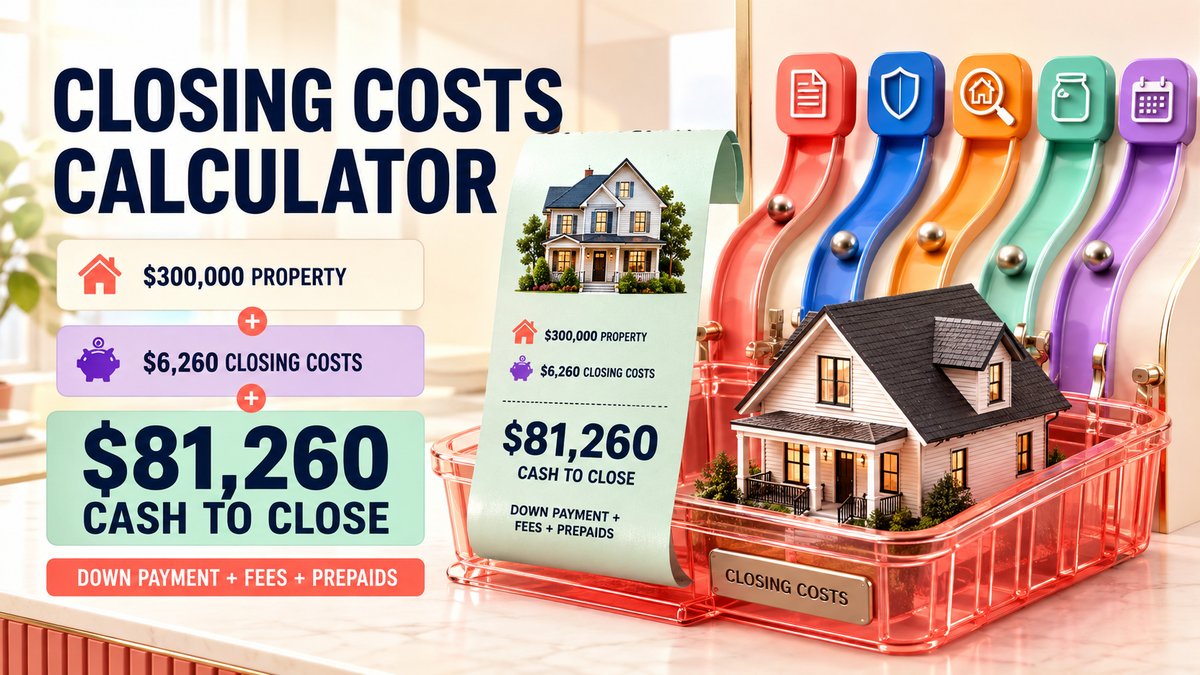
Total cash-to-close: $75,000 (down) + $6,260 (closing) = $81,260. This is the check you write at closing. Many investors budget only the down payment — the $6,260 surprise can delay or kill a deal.
Plug your specific numbers into the closing costs calculator. For NOI analysis with closing costs factored into total cash invested, use the cash-on-cash calculator — closing costs increase your denominator and reduce CoC.
Closing Costs by Loan Type
| Loan Type | Typical Closing Costs | Unique Fees | Speed |
|---|---|---|---|
| Conventional | 2–3% | PMI if <20% down | 30–45 days |
| DSCR | 2–4% | Higher origination (0.5–1.5%) | 21–30 days |
| Hard Money | 4–6% | 2–4 points upfront + higher rate | 5–10 days |
| FHA/VA | 2–4% | Not available for investment property | 30–45 days |
Hard money closing costs are 2–3x conventional because of points. A $200K hard money loan at 3 points = $6,000 in origination alone — before any other fees. Model hard money costs in the hard money calculator. Compare DSCR vs conventional in the DSCR comparison guide.
Closing Costs by State
| State | Buyer Total | Transfer Tax | Attorney | Unique Cost |
|---|---|---|---|---|
| Texas | 2–4% | None | Not required | Seller pays owner’s title |
| Florida | 2.5–5% | 0.7% doc stamps | Not required | Highest transfer tax |
| Ohio | 2–4% | 0.1–0.4% | Not required | Cleveland city tax 1.18% |
| Georgia | 2.5–5% | 0.1% + 0.3% intangible | Required | Intangible tax on mortgage |
| North Carolina | 2–4.5% | 0.2% | Required | Dare County +1% |
State-specific costs can add $1,000–$5,000 to your closing. Use the state calculators for accurate estimates: TX, FL, OH, GA, NC. For state-specific guides, see Ohio closing costs, Georgia closing costs, NC closing costs. Per CFPB, lenders must provide a Loan Estimate within 3 business days of application.
How to Reduce Closing Costs
- Negotiate seller concessions. Sellers can contribute 3–6% toward buyer closing costs (varies by loan type). On $300K = $9,000–$18,000. Request 2–3% in your offer — especially in markets with 20+ days on market.
- Shop lender fees. Origination fees range 0.5–1.5%. The difference on $225K = $1,125–$3,375. Get 3+ quotes. Per Fannie Mae, shopping saves $1,500 on average.
- Compare title companies. Title insurance rates vary. In states without regulated rates, shopping can save $500–$1,000.
- Close at end of month. Prepaid interest = per diem from closing to month end. Close on the 28th = 2 days prepaid ($86). Close on the 5th = 25 days ($1,079).
- Ask about no-closing-cost loans. Some lenders offer zero closing costs at a higher rate (+0.25–0.50%). May make sense for short holds. Compare in the mortgage calculator.
5 Closing Cost Mistakes
1. Not Budgeting Closing Costs at All
Why: First-time investors budget $75K for 25% down on $300K and bring exactly $75K. Closing costs add $6,000–$12,000. The deal falls apart at the closing table.
Fix: Always budget purchase price × 3% for closing costs on top of down payment. Use the closing costs calculator for exact numbers.
2. Forgetting Attorney Fees in Attorney States
Why: Georgia ($800–$1,500) and NC ($600–$1,200) require attorney at closing. Texas and Florida don’t. Out-of-state investors miss this.
Fix: Check whether your state is an attorney-closing state before budgeting. See our closing costs guide.
3. Ignoring State-Specific Transfer Taxes
Why: FL doc stamps (0.7%) on $400K = $2,800. Cleveland city tax (1.18%) on $145K = $1,711. GA intangible tax (0.3%) on $262K loan = $788. These are not in generic calculators.
Fix: Use state-specific calculators. Or add transfer tax manually in the general calculator.
4. Assuming Seller Pays Title Insurance
Why: In Texas, seller pays owner’s title. In Ohio, Georgia, NC — buyer pays. This $1,000–$2,500 swing catches out-of-state investors.
Fix: Confirm local convention. Toggle who pays in the calculator.
5. Not Including Closing Costs in Total Cash Invested
Why: If you calculate cash-on-cash as Cash Flow ÷ Down Payment, you overstate returns by 8–15%. Your real denominator = down payment + closing costs.
Fix: The cash-on-cash calculator has a closing costs field. Always include it. See down payment guide for total cash requirements.
Worked Example 2: $180K Duplex — DSCR Loan
Purchase: $180,000 duplex · Down: 25% ($45,000) · DSCR loan: $135,000 at 8.0%
| Cost Item | Amount | vs Conventional |
|---|---|---|
| Lender Origination (1.0%) | $1,350 | +$675 higher |
| Appraisal + Rent Survey | $750 | +$250 (1007 form) |
| Inspection | $400 | Same |
| Title Insurance | $1,103 | Same ratio |
| Recording + Credit + Escrow | $1,000 | Same |
| Prepaid Interest (15 days) | $444 | +$100 (higher rate) |
| Total | $5,047 | vs $3,800 conventional |
DSCR closing costs: $5,047 (2.8%) vs conventional $3,800 (2.1%). The $1,247 premium comes from higher origination and rent survey. Compare in the DSCR calculator. For DSCR details, see DSCR calculator guide.
Buyer vs Seller Closing Costs
| Paid By | Typical Costs | Amount on $300K |
|---|---|---|
| Buyer | Origination, appraisal, inspection, lender title, recording, escrow | $6,000–$12,000 (2–4%) |
| Seller | Agent commission (5–6%), transfer tax, prorations | $16,000–$21,000 (5–7%) |
| Negotiable | Title choice, home warranty, survey, repair credits | $1,000–$3,000 |
Sellers pay 2–3x more than buyers — primarily agent commissions. Asking for $6,000 in seller credits (2%) is a small concession. Per NAR, 42% of sellers paid buyer closing costs in 2025.
Frequently Asked Questions
How much are closing costs on investment property?
Buyer closing costs typically run 2–4% of the purchase price for conventional loans, 2–4% for DSCR, and 4–6% for hard money (due to points). On a $300K property with conventional financing, expect $6,000–$12,000. State-specific fees (attorney, transfer tax) can add $1,000–$5,000. Use the closing costs calculator for your specific deal.
Are closing costs higher for investment property than primary residence?
Can the seller pay my closing costs?
What is the difference between closing costs and prepaids?
Do I need an attorney to close on investment property?
Should I include closing costs in my cash-on-cash return calculation?
Related Calculators and Guides
- Closing Costs Calculator — Estimate buyer + seller costs
- Texas Closing Costs
- Florida Closing Costs
- Ohio Closing Costs
- Georgia Closing Costs
- NC Closing Costs
- Cash-on-Cash Calculator
- Mortgage Calculator
- Hard Money Calculator
- DSCR Calculator
- All 30+ Calculators
Blog guides:
Leave a Reply