Last updated: August 24, 2026 · Originally published: August 23, 2026 · By Alex Petrov
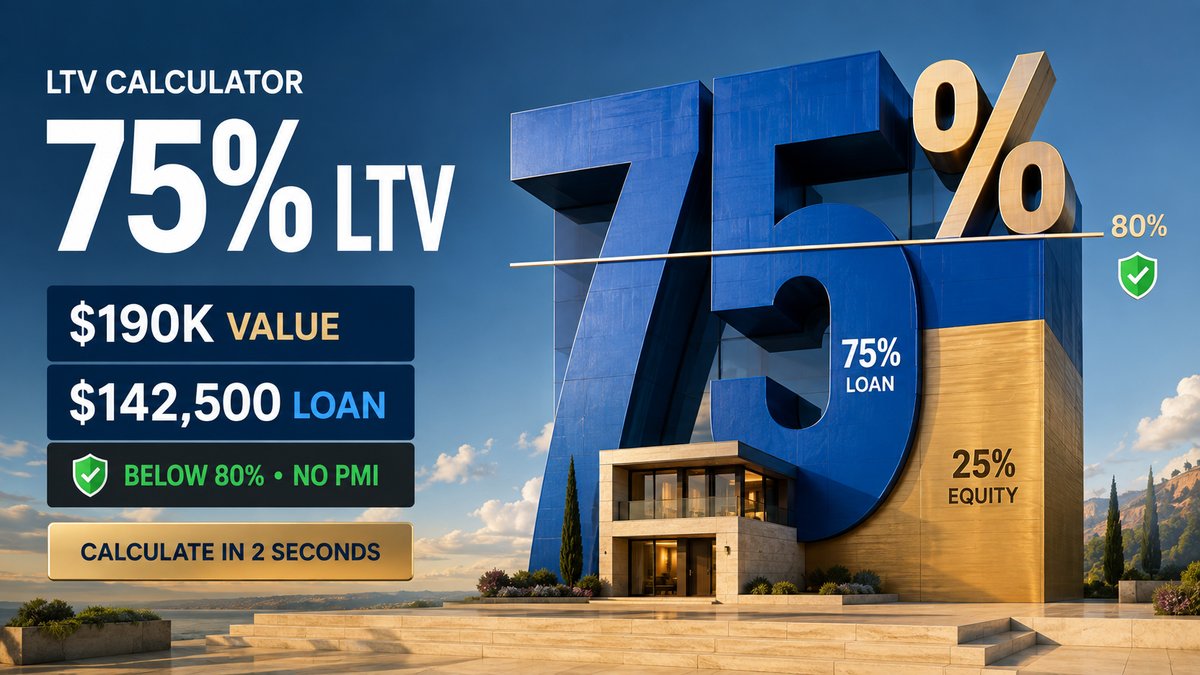
The LTV calculator tells you your loan-to-value ratio in 2 seconds — the number that determines your interest rate, whether you need PMI, and how much equity you can pull out on a cash-out refinance. On a $190K property with $142,500 loan, your LTV is 75% — the magic number for BRRRR cash-out refi. Below 80% = no PMI. Above 80% = higher rate + monthly PMI payment.
What Is LTV and Why Lenders Care
LTV = Loan Amount ÷ Property Value × 100
A $150,000 loan on a $200,000 property = 75% LTV. The remaining 25% is your equity — the lender’s safety margin. If you stop paying, the lender forecloses and needs to recover $150K from a $200K property. At 75% LTV, they have a 25% cushion. At 95% LTV, the cushion is only 5% — one bad appraisal and they lose money.
That is why LTV determines everything:
- Interest rate — lower LTV = lower rate. 75% LTV gets 0.25–0.50% better rate than 90% LTV
- PMI requirement — above 80% LTV on conventional loans = monthly PMI ($50–$200/month)
- Loan approval — most investment property loans cap at 75–80% LTV
- Cash-out refinance — BRRRR investors need 75% LTV to maximize capital recovery
- Hard money — lenders cap at 65–75% of ARV (after-repair value)
The LTV calculator computes your ratio instantly and shows where you fall on the lender’s risk scale.
How to Use the LTV Calculator
Mode 1: Standard — Calculate Your LTV
Enter property value and loan amount. The calculator shows your LTV percentage, equity amount, and equity percentage. Compare to lender thresholds (80% conventional, 75% BRRRR refi, 65% hard money).
Mode 2: Reverse — Find Maximum Loan
Enter property value and target LTV (e.g., 75%). The calculator shows the maximum loan amount. For a $190K ARV at 75% LTV = $142,500 max loan. This is what BRRRR investors use to calculate their cash-out refinance proceeds.
Mode 3: Reverse — Find Required Value
Enter your loan amount and target LTV. The calculator shows the minimum property value needed. If your loan is $142,500 and target is 75% LTV, the property must appraise at $190,000+. Below that = you leave money in the deal.
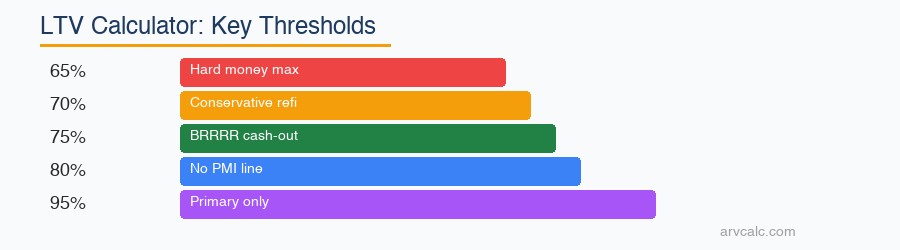
LTV Thresholds That Matter
| LTV | What Happens | Typical Use Case |
|---|---|---|
| 65% | Hard money maximum (conservative lenders) | Fix-and-flip acquisition |
| 70% | Conservative BRRRR refi, best rates | Leave more equity, better cash flow |
| 75% | Standard BRRRR cash-out refi | Maximize capital recovery |
| 80% | PMI threshold (conventional). Max for most investment loans | Standard buy-and-hold purchase |
| 85–90% | Higher rate + PMI. Some DSCR lenders allow | Low down payment (risky) |
| 95–97% | Primary residence only (FHA/conventional). NOT for investors | Homebuyers only |
For investment property, you almost always deal with 75–80% LTV. The LTV calculator shows exactly where your deal falls.
Worked Example 1: BRRRR Cash-Out Refinance
Scenario: You bought a Greensboro SFR for $110K cash, rehabbed for $30K, and it appraises at $190K after renovation. You want to refinance and pull cash out.
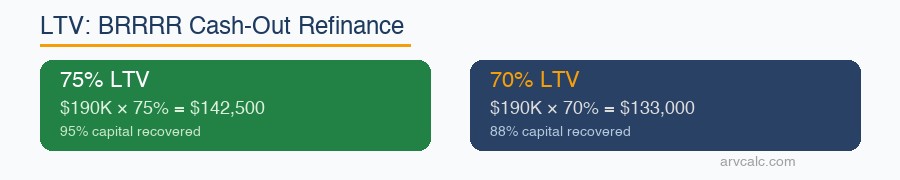
ARV (appraised value): $190,000

At 75% LTV: $190,000 × 0.75 = $142,500 loan
Cash back: $142,500 − $2,850 (refi closing) = $139,650
Capital invested: $147,536
Capital recovered: 95%

At 70% LTV: $190,000 × 0.70 = $133,000 loan
Cash back: $133,000 − $2,660 = $130,340
Capital recovered: 88%
5% LTV difference = $9,310 less cash back. That $9,310 stays in the deal as extra equity — safer, but ties up capital you could deploy elsewhere. Most BRRRR investors target 75% LTV to maximize recycling. Model both in the LTV calculator.
For the full BRRRR cycle analysis, use the BRRRR calculator. For state-specific BRRRR, see NC, GA, or OH BRRRR guides.
Worked Example 2: Investment Property Purchase
Scenario: Buying a $300K Indianapolis rental. Comparing 20% vs 25% down payment.
| Down Payment | Loan | LTV | PMI? | Monthly P&I | Cash Flow Impact |
|---|---|---|---|---|---|
| 20% ($60K) | $240,000 | 80% | No (at 80% line) | $1,597 | Lower CF but less cash tied up |
| 25% ($75K) | $225,000 | 75% | No | $1,497 | $100/mo better CF, $15K more cash in |
5% more down = $100/month better cash flow but $15,000 more capital deployed. The LTV calculator shows the trade-off. Compare the cash flow impact in the cash flow calculator and the return impact in the cash-on-cash calculator.
LTV for Hard Money Loans
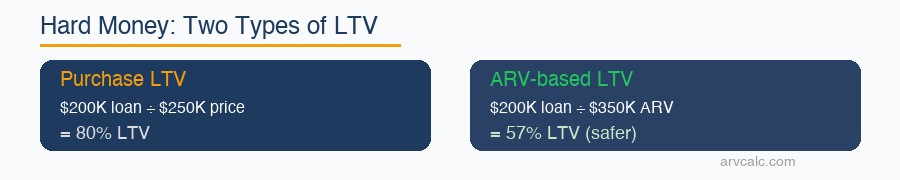
Hard money lenders use two LTV measurements:
- LTV (purchase) — loan ÷ purchase price. Typically 70–80%.
- LTV (ARV) — loan ÷ after-repair value. Typically 65–75%.
A $200K loan on a $250K purchase = 80% LTV (purchase). But if the ARV is $350K, that same $200K loan = 57% LTV (ARV) — much safer for the lender. Some hard money lenders will fund up to 90% of purchase if ARV-based LTV stays under 70%. Calculate in the hard money calculator.
5 LTV Mistakes
1. Using Purchase Price Instead of Current Value for Refi
Why: You bought at $110K and rehabbed to $190K value. LTV for refinance uses the NEW appraised value ($190K), not the purchase price. Using $110K gives you a meaningless 129% LTV.
Fix: Always use current appraised value for refi LTV. Get a BPO or appraisal before applying.
2. Forgetting Closing Costs Reduce Cash Back
Why: 75% of $190K = $142,500 gross. But refi closing costs ($2,500–$3,500) come out of that. Net cash = $139,000–$140,000.
Fix: Subtract 2% from refi proceeds for closing costs. Use the closing costs calculator.
3. Targeting Too High LTV on Investment Property
Why: 90% LTV on a rental = higher rate + PMI + thin equity cushion. One 5% market dip puts you underwater.
Fix: Target 75–80% max for investment. Higher LTV is for primary residence only.
4. Not Checking Lender’s LTV Limit Before Appraisal
Why: You pay $500 for an appraisal expecting 75% LTV refi. Lender’s max is 70%. You get $9,500 less cash back than planned.
Fix: Confirm max LTV with lender BEFORE ordering appraisal. DSCR lenders typically allow 75–80%. Per Fannie Mae, conventional investment max is 75% for cash-out refi.
5. Confusing LTV with CLTV
Why: If you have a first mortgage AND a HELOC, LTV uses only the first mortgage. CLTV (Combined LTV) includes both. Lenders may approve your first mortgage LTV but decline based on CLTV.
Fix: Disclose all liens. The LTV calculator computes single-loan LTV. For multiple loans, add them manually. Per FRED, rising rates make high-CLTV refinancing increasingly difficult.
Frequently Asked Questions
What is a good LTV for investment property?
75–80% for purchase, 75% for cash-out refinance. Below 80% avoids PMI. At 75%, you get the best rates and maximum BRRRR cash-out proceeds. Going below 70% is conservative — better cash flow but more capital tied up.
How does LTV affect my interest rate?
What LTV do I need for BRRRR refinance?
Do I need PMI on investment property?
What is the difference between LTV and equity?
Related Calculators and Guides
- LTV Calculator — Loan-to-value ratio
- BRRRR Calculator — Cash-out refinance modeling
- Hard Money Calculator — Bridge financing costs
- Mortgage Calculator — Payment scenarios
- Cash-on-Cash Calculator — Return on cash
- Cash Flow Calculator — Monthly projections
- Closing Costs Calculator — Refi + purchase costs
- ARV Calculator — After-repair value
- DSCR Calculator — Loan qualification
- All 30+ Calculators
Blog guides:
Leave a Reply